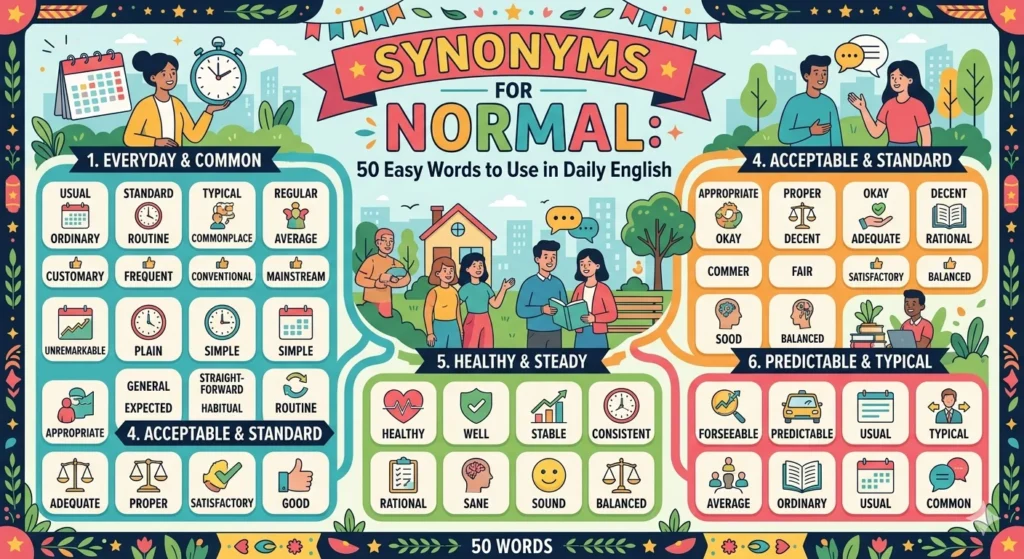
Have you ever used the word “normal” again and again in your writing? It can feel boring, right? Imagine you are writing an essay or a blog, and every sentence sounds the same. That’s where learning synonyms for normal helps a lot.
“Normal” means something usual, common, or not special. For example, a normal day means nothing new or exciting happens.
Knowing different synonyms for normal is very useful. Students can write better essays. Bloggers can create fresh content. Writers can avoid repetition. And in daily English, you sound more natural and confident.
In this guide, you will learn simple and easy synonyms for normal that you can use every day.
Regular
Meaning: Something that happens again and again.
Examples:
- I go for a regular walk every morning.
- This is my regular coffee order.
Usual
Meaning: Something that happens most of the time.
Examples:
- She came at her usual time.
- This is my usual seat.
Common
Meaning: Something many people have or do.
Examples:
- This mistake is very common.
- It’s common to feel tired after work.
Typical
Meaning: Something that shows a usual pattern.
Examples:
- That is a typical day for me.
- He gave a typical answer.
Ordinary
Meaning: Something not special or different.
Examples:
- It was just an ordinary day.
- She wore an ordinary dress.
Standard
Meaning: Something at a normal level or quality.
Examples:
- This is a standard size.
- The hotel offers standard rooms.
Average
Meaning: Something in the middle, not high or low.
Examples:
- His score is average.
- It was an average movie.
Routine
Meaning: Something done daily in the same way.
Examples:
- I follow a morning routine.
- Her routine is very simple.
Natural
Meaning: Something that feels right or expected.
Examples:
- It is natural to feel nervous.
- His reaction was natural.
Familiar
Meaning: Something you know well.
Examples:
- This place feels familiar.
- I know that voice; it sounds familiar.
Everyday
Meaning: Something used or seen daily.
Examples:
- These are everyday clothes.
- This is an everyday problem.
Plain
Meaning: Something simple and not fancy.
Examples:
- He wore a plain shirt.
- The room looks plain.
Basic
Meaning: Something simple and important.
Examples:
- This is a basic idea.
- Learn the basic rules first.
Simple
Meaning: Something easy and not complex.
Examples:
- The answer is simple.
- She gave a simple explanation.
Expected
Meaning: Something you think will happen.
Examples:
- His result was expected.
- That reaction was expected.
Customary
Meaning: Something done by habit.
Examples:
- It is customary to greet guests.
- He gave his customary smile.
Conventional
Meaning: Something done in a usual way.
Examples:
- They chose a conventional plan.
- This is a conventional method.
Predictable
Meaning: Something easy to guess.
Examples:
- The ending was predictable.
- His moves are predictable.
Unremarkable
Meaning: Something not special or exciting.
Examples:
- It was an unremarkable day.
- The place looked unremarkable.
Run-of-the-mill
Meaning: Something very ordinary.
Examples:
- It’s just a run-of-the-mill job.
- The show was run-of-the-mill.
Garden-variety
Meaning: Something very common.
Examples:
- It was a garden-variety issue.
- This is a garden-variety phone.
Typical-case
Meaning: Something that shows a usual example.
Examples:
- This is a typical-case scenario.
- It’s a typical-case problem.
Moderate
Meaning: Something not too much or too little.
Examples:
- The weather is moderate today.
- He has moderate skills.
Fair
Meaning: Something average in quality.
Examples:
- His work is fair.
- The price is fair.
Middle
Meaning: Something between high and low.
Examples:
- She is in the middle group.
- Choose the middle option.
Balanced
Meaning: Something equal or steady.
Examples:
- He lives a balanced life.
- The meal is balanced.
Neutral
Meaning: Something not strong or extreme.
Examples:
- She stayed neutral.
- The color is neutral.
Plain-vanilla
Meaning: Something very basic.
Examples:
- It’s a plain-vanilla design.
- The plan is plain-vanilla.
Default
Meaning: Something set as usual.
Examples:
- This is the default setting.
- Use the default option.
Set
Meaning: Something fixed or decided.
Examples:
- The time is set.
- We follow a set plan.
Fixed
Meaning: Something not changing.
Examples:
- He has a fixed schedule.
- The price is fixed.
Stable
Meaning: Something steady and not changing.
Examples:
- The market is stable.
- His mood is stable.
Steady
Meaning: Something regular and calm.
Examples:
- She made steady progress.
- Keep a steady pace.
Typicality
Meaning: The state of being normal.
Examples:
- This shows typicality.
- The pattern shows typicality.
Norm
Meaning: A usual way people act.
Examples:
- This is the norm here.
- Hard work is the norm.
Par
Meaning: A normal level or standard.
Examples:
- His work is up to par.
- That score is par.
Status quo
Meaning: The current normal state.
Examples:
- They kept the status quo.
- The status quo remains.
Everyday-type
Meaning: Something very common.
Examples:
- It’s an everyday-type task.
- This is an everyday-type issue.
By-the-book
Meaning: Done in a usual way.
Examples:
- He works by the book.
- Follow it by the book.
Typical-pattern
Meaning: A common way something happens.
Examples:
- This is a typical-pattern case.
- The data shows a typical-pattern.
Commonplace
Meaning: Something very ordinary.
Examples:
- The idea is commonplace.
- Such events are commonplace.
Average-level
Meaning: Something in the middle level.
Examples:
- He has average-level skills.
- This is average-level work.
Not unusual
Meaning: Something that often happens.
Examples:
- This is not unusual here.
- It’s not unusual to fail.
Usual-case
Meaning: Something that happens often.
Examples:
- This is the usual-case.
- It’s a usual-case result.
Typical-day
Meaning: A normal daily routine.
Examples:
- It was a typical-day for me.
- That’s my typical-day life.
Regular-type
Meaning: Something common or normal.
Examples:
- It’s a regular-type job.
- This is a regular-type issue.
Standard-case
Meaning: A normal example.
Examples:
- This is a standard-case.
- It’s a standard-case result.
Basic-level
Meaning: A simple or normal level.
Examples:
- He has basic-level knowledge.
- This is basic-level work.
Normal-state
Meaning: The usual condition.
Examples:
- The system is in normal-state.
- He returned to normal-state.
Everyday-normal
Meaning: Something very usual.
Examples:
- It’s everyday-normal life.
- This feels everyday-normal.
CONCLUSION
Learning synonyms for normal helps you become a better writer and speaker. Your sentences sound fresh and more interesting. It also improves your blogging and communication skills.
Start using these words in your emails, essays, and daily talks. Practice a few every day. Soon, your English will feel more natural, clear, and powerful.

Noah Reed delivers authoritative, high-quality synonym insights, helping readers master language with precision, clarity, and creative finesse.