
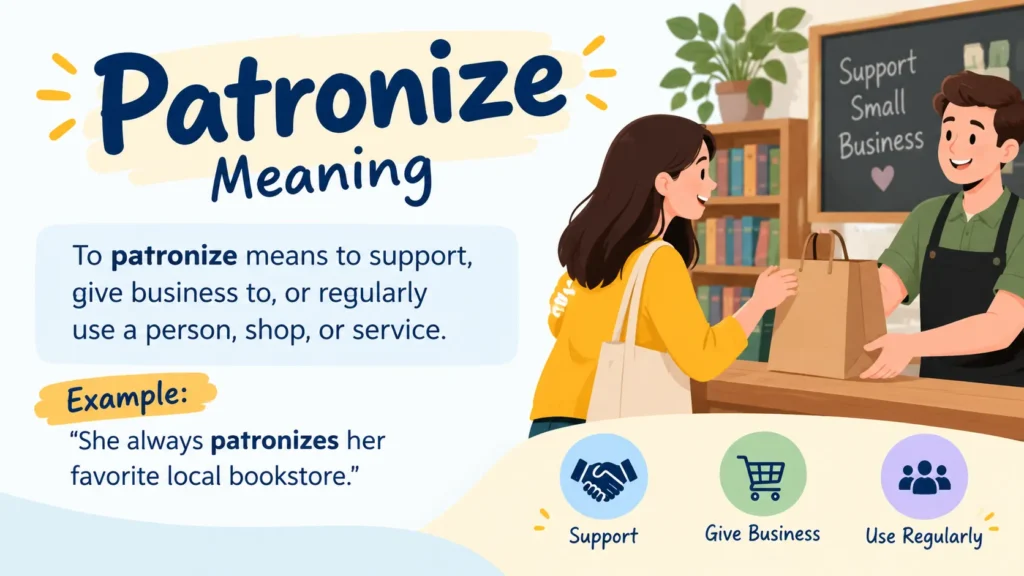

Patronize has two common meanings. It can mean to support a person, shop, business, or artist by buying from them or using their service.
It can also mean to speak to someone as if they are less smart, able, or important than you. The right meaning depends on the sentence. For example, “We patronize local shops” means “We support local shops.”
But “Don’t patronize me” means “Don’t talk down to me.” This makes patronize an easy word to mix up.
One meaning is often positive, while the other is usually negative. In this guide, you’ll learn both meanings, see simple examples, and learn how to use the word in everyday English.
Patronize Meaning in Simple English
In simple English, patronize can mean support or talk down to someone.
These meanings are very different.
The first meaning is about giving support. The second is about showing a superior attitude.
Here is the easiest way to remember them:
Patronize a business = support it.
Patronize a person = talk down to them.
The words around patronize will usually tell you which meaning is meant.
What Does Patronize Mean When You Support a Business?
When you patronize a business, you support that business by buying its products or using its services.
For example:
- “We patronize small shops in our town.”
- “She often patronizes local restaurants.”
- “Many people patronize this family-owned store.”
In these sentences, patronize has a neutral or positive meaning.
It does not mean that the person is being rude.
It simply means they choose to spend money at a business or use its services.
You may also see this use when people talk about local businesses, artists, stores, restaurants, theaters, or other services.
What Does Patronize Mean When Talking to a Person?
When patronize is used about a person, it usually has a negative meaning.
It means to treat someone as if they are not as smart, skilled, or important as you are.
This can happen through words, tone, or behavior.
For example:
“He always patronizes his younger coworkers.”
This means he talks to them in a way that makes him seem superior.
Another example is:
“I don’t like the way she patronizes me.”
The speaker feels that she is being treated as less capable.
The person may not use an openly rude word. Their tone may be enough to make the other person feel small.
What Does “Don’t Patronize Me” Mean?
“Don’t patronize me” means:
“Don’t talk to me as if I’m inconsiderate , helpless, or less important than you.”
People often say this when they feel someone is speaking to them in a superior way.
For example:
“I understand the problem. Don’t patronize me.”
The speaker is not asking for more support. They are asking the other person to stop talking down to them.
This phrase can sound strong. It is often used during a tense talk or argument.
What Does a Patronizing Person Sound Like?
A patronizing person may speak in a way that makes another person feel small.
The problem may not be the words alone. It can be the tone behind them.
For example, imagine someone says:
“Aww, you finally got it!”
The words may sound friendly. But if the person says them in a mocking way, they can sound patronizing.
Another example:
“Let me explain this very easy idea to you.”
If the speaker assumes the other person cannot understand a simple idea, the comment may feel patronizing.
A patronizing tone can include:
- Speaking like the other person is a child
- Acting as if you know everything
- Giving unwanted basic explanations
- Using fake praise
- Making someone feel less capable
So, patronizing is often more about attitude than the exact words.
Patronize vs. Patronizing
Patronize and patronizing come from the same word, but they work differently in a sentence.
Patronize is a verb.
“Please don’t patronize me.”
Here, it means to talk down to someone.
Patronizing often describes a tone, comment, or way of speaking.
“His tone was very patronizing.”
This means his tone made him seem superior.
You can also use patronizing for behavior:
“Her patronizing behavior upset him.”
Both words can describe the negative meaning of patronize.
Is Patronize a Positive or Negative Word?
It can be either.
This is one reason the word can be confusing.
When patronize means support a business, it is usually neutral or positive.
“We should patronize local businesses.”
When it means talk down to someone, it is usually negative.
“He patronized me during the meeting.”
So, don’t judge the word by itself.
Look at the context.
Ask:
Is someone supporting a business, or are they acting superior toward a person?
That simple question can help you understand the meaning.
Patronize vs. Support
Patronize can mean support, but the two words are not always used in the same way.
For example:
“We support local businesses.”
This is a very common and natural sentence.
You can also say:
“We patronize local businesses.”
This means the same basic thing, but patronize can sound more formal.
When you patronize a business, you usually support it by buying from it or using its service.
So:
Support = a broad word for helping or backing someone or something.
Patronize = often means supporting a business, artist, or service through your custom.
Patronize vs. Condescend
Patronize and condescend can have a similar meaning when they describe how someone treats another person.
Both can suggest a feeling of superiority.
For example:
“He was patronizing toward his assistant.”
You could also say:
“He was condescending toward his assistant.”
Both sentences suggest that he acted as if he were above the assistant.
But there is one big difference:
Patronising has another meaning: to support a business or person.
Condescending does not have that meaning.
Examples of Patronize in Everyday English
Here are some simple examples to make the two meanings clear.
Supporting a business:
“We patronize the bakery near our home.”
This means the speakers often buy from the bakery.
Supporting local shops:
“Our family tries to patronize local stores.”
This means they try to support local stores with their purchases.
Talking down to someone:
“Don’t patronize your teammates.”
This means don’t treat them as if they are less smart or able.
Feeling talked down to:
“She felt that her manager was patronizing her.”
This means she felt that her manager treated her as less capable.
Describing a tone:
“His patronizing tone made the conversation worse.”
Here, patronizing means his tone sounded superior.
Common Phrases With Patronize
Some phrases make the meaning easier to understand.
Patronize a business
This usually means to support the business by buying from it.
“Many people patronize this small bookstore.”
Patronize local businesses
This means to support businesses in your local area.
“We try to patronize local businesses.”
Don’t patronize me
This means don’t talk down to me.
“I know how this works, so don’t patronize me.”
Patronizing tone
This describes a way of speaking that sounds superior.
“Her patronizing tone annoyed him.”
These phrases show why context matters so much.
Why Can Someone Sound Patronizing Without Being Rude?
A person does not always need to use an insult to sound patronizing.
Sometimes, the problem is the way they speak.
For example, a person may explain something you already know. They may use a slow voice or act surprised that you understand the topic.
The words may be polite, but the message can still feel insulting.
For example:
“Oh, don’t worry. I’ll explain it to you.”
If the speaker says this because they think you cannot understand, it may sound patronizing.
This is why tone, context, and attitude matter when judging the word.
Common Mistakes With Patronize
One common mistake is thinking patronize always means to insult someone.
It does not.
“We patronize local shops.”
Here, the word means support.
Another mistake is thinking patronize always means support.
That is also not true.
“Don’t patronize me.”
Here, it means don’t talk down to me.
A third mistake is ignoring the word that follows it.
If patronize is linked to a shop, restaurant, or business, it may mean support.
If it is linked to how someone treats another person, it often has the negative meaning.
What Is the Noun Form of Patronize?
The noun patron is related to the supportive meaning of patronize.
A patron is someone who supports a business, artist, organization, or place.
For example:
“She is a regular patron of the café.”
This means she often visits or buys from the café.
The word patron can also have other uses, depending on the setting.
The key idea is that a patron gives support.
Is Patronize the Same as Insult?
Not exactly.
To insult someone means to say or do something that shows disrespect.
To patronize someone means to treat them as if they are below you in some way.
A patronizing comment may be insulting, but the two words do not have the same meaning.
For example:
“You’re too inconsiderate to understand this.”
This is a direct insult.
But:
“Don’t worry. This is probably too hard for you.”
This may be patronizing because the speaker acts as if the other person cannot understand.
The difference is often in the attitude of superiority.
How to Remember the Meaning of Patronize
If you often forget which meaning is being used, use this simple trick:
Business → support
Person → talk down
This is not a rule for every possible sentence, but it works well for many everyday examples.
For instance:
“They patronize the local theater.”
Think support.
But:
“He patronizes his coworkers.”
Think talks down to them.
Always check the full sentence for the exact meaning.
Final Takeaway
Patronize has two main meanings. It can mean to support a business, artist, or service, or it can mean to treat someone as if they are less smart or important.
The easiest way to remember the difference is:
Patronize a business = support it.
Patronize a person = talk down to them.
If someone says “Don’t patronize me,” they usually mean, “Don’t treat me like I’m less capable than you.”
Once you understand the context, this word becomes much easier to use.
FAQs About Patronize Meaning
What does patronize mean in simple words?
Patronize can mean to support a business by buying from it. It can also mean to talk to someone as if they are less smart or important.
What does “don’t patronize me” mean?
It means “Don’t talk down to me.” The speaker feels that the other person is treating them as less intelligent or capable.
Is patronize a bad word?
No. It depends on the meaning. It can be neutral or positive when it means supporting a business. It is usually negative when it means talking down to someone.
What does patronizing mean?
Patronizing means acting or speaking in a way that makes you seem superior to another person.
What is the difference between patronize and condescend?
Both can mean acting superior toward someone. But patronize can also mean supporting a business, while condescend does not have that meaning.
What is another word for patronize?
For the supportive meaning, you can use support, sponsor, visit, or buy from. For the negative meaning, you can use condescend, belittle, or talk down to.
Conclusion
Patronize has two very different meanings, so the context matters. It can mean to support a business, artist, or service, or it can mean to talk to someone as if they are less smart or important.
If someone says, “Don’t patronize me,” they usually mean, “Don’t talk down to me.” Remembering these two uses will help you understand and use the word correctly in everyday English.