
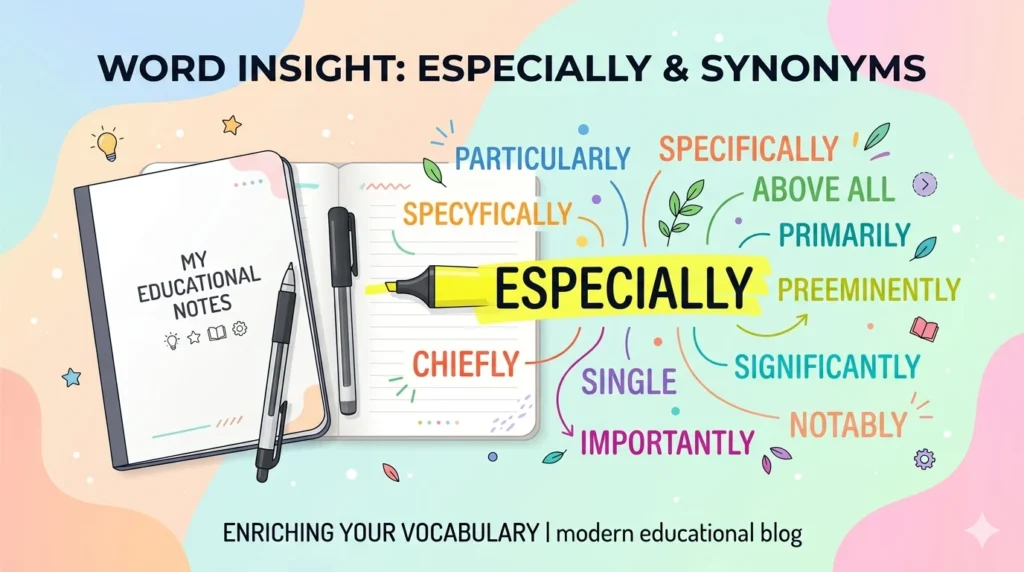
Are you tired of using the word “especially” again and again, and want your writing to sound more natural, polished, and professional? Repeating the same word can make your content feel weak — but the right synonym can instantly upgrade your English.
“Especially” can be replaced with particularly, mainly, chiefly, above all, and in particular.
In this guide, you’ll learn the exact meaning of each synonym, when to use them, and how to apply them correctly in real sentences.
By the end, you’ll confidently replace “especially” in any type of writing without hesitation.
What Does “Especially” Mean? (And Why Synonyms Matter)
The word “especially” is an adverb. It has three distinct jobs in a sentence — and understanding these jobs is critical, because not every synonym covers all three. Using the wrong replacement makes your sentence sound unnatural, even if the word technically means something similar.
The three core meanings of “especially”:
Meaning 1 — Singling out one from a group: “I love all vegetables, especially spinach.” → Best replacements: particularly, in particular, notably, above all
Meaning 2 — Greater degree than usual: “Be careful when driving, especially at night.” → Best replacements: particularly, significantly, most of all, above all
Meaning 3 — Made for a specific purpose: “I prepared this meal especially for you.” → Best replacements: specially, specifically, exclusively, expressly
Keep these three meanings in mind as you read through the list. The most common mistake writers make is replacing “especially” with any random synonym without checking which meaning applies. This guide will prevent that mistake entirely.
Before and After: See the Difference Synonyms Make
The fastest way to understand the value of synonyms is to see them in action. Compare these two paragraphs:
Before (overusing “especially”): “I enjoy reading, especially non-fiction books. I especially love books about history, especially those that cover ancient civilizations. This is especially true when the writing is clear and engaging.”
After (using varied synonyms): “I enjoy reading, particularly non-fiction books. I am especially drawn to history — above all, accounts of ancient civilizations. This holds true most of all when the writing is clear and deeply engaging.”
The second version uses the same ideas but sounds significantly more intelligent, varied, and professional. That is the power of synonyms.
Particularly
Meaning: More than others; to a degree that stands out from the rest of a group.
Formality: Neutral — works perfectly in formal essays and casual conversation alike.
Examples:
- The professor was particularly impressed by her original research methodology.
- I enjoy all music genres, but I am particularly fond of classical compositions.
- This safety rule applies to everyone, particularly those working in high-risk environments.
- The report was particularly useful for understanding regional market trends.
When to use it: “Particularly” is the single closest replacement for “especially” in almost every context. When in doubt, this is your safest and most natural swap.
In Particular
Meaning: One specific thing more than all others; used to draw sharp attention to a single item.
Formality: Neutral to slightly formal — excellent for essays and professional writing.
Examples:
- The second chapter, in particular, completely changed my perspective on leadership.
- He values three qualities in a colleague — honesty, reliability, and in particular, kindness.
- Nothing in particular was troubling her, yet she felt something was wrong.
- The data from Q3, in particular, demands closer examination.
When to use it: Place “in particular” in the middle or end of a sentence for maximum elegance. It sounds more sophisticated than “especially” without feeling forced.
Above All
Meaning: More than anything else; the single most important item among many.
Formality: Neutral — powerful in essays, speeches, persuasive writing, and daily use.
Examples:
- Above all, treat every person with the dignity they deserve.
- She wanted financial success, but above all, she wanted peace of mind.
- The company values creativity, above all when solving complex client problems.
- Good teachers inspire curiosity — above all, they teach students to think for themselves.
When to use it: “Above all” is your go-to phrase when you are listing several things and want to crown one as the most important. It is especially powerful at the start of a sentence.
Primarily
Meaning: First and most importantly; for the main reason or dominant purpose.
Formality: Formal — ideal for academic papers, professional reports, and business communication.
Examples:
- The research was designed primarily for use by healthcare professionals.
- He relocated to the capital primarily to pursue career growth in finance.
- This platform is used primarily for data visualization, though it has secondary functions.
- The delay was caused primarily by unexpected regulatory changes.
When to use it: “Primarily” is your strongest academic synonym for especially. Use it when you want to name the main reason or purpose while implying that other reasons also exist.
Mainly
Meaning: For the most part; the dominant element among several.
Formality: Neutral — fits both casual speech and formal writing comfortably.
Examples:
- The disruption was caused mainly by poor internal communication.
- She reads mainly non-fiction, though she enjoys literary fiction on weekends.
- The diet in this region consists mainly of grains, legumes, and seasonal vegetables.
- His success was driven mainly by his willingness to keep learning.
When to use it: “Mainly” is one of the most versatile options. Slightly softer than “particularly,” it works in almost any sentence where you want to indicate the dominant factor without over-emphasizing.
Chiefly
Meaning: Most of all; above all other reasons; primarily in the most important sense.
Formality: Formal — best in essays, literary writing, journalism, and academic reports.
Examples:
- The system failed chiefly due to insufficient testing before the launch.
- The organization operates chiefly on government grants and private donations.
- She is remembered chiefly for her groundbreaking contributions to environmental law.
- The resistance came chiefly from stakeholders who feared financial loss.
When to use it: “Chiefly” has an authoritative, slightly literary tone. It elevates formal writing beautifully and signals careful, precise thinking.
Notably
Meaning: Worth special attention; to a remarkable or particularly significant degree.
Formality: Formal — excellent for journalism, essays, and analytical writing.
Examples:
- Several team members excelled, notably the two junior researchers who joined last year.
- The restaurant has received international recognition, notably for its seasonal tasting menu.
- The new reforms, notably those targeting education funding, have faced strong opposition.
- The quarter saw strong growth, notably in emerging markets across Southeast Asia.
When to use it: “Notably” is perfect for highlighting one standout example within a broader point. It signals that the example you are about to give is genuinely significant — not just any random instance.
Significantly
Meaning: To a meaningful and important degree; in a way that has real measurable impact.
Formality: Formal — essential in research writing, analytical reports, and data-driven content.
Examples:
- The updated medication significantly reduced patient recovery time by 40%.
- Team productivity improved significantly after the workflow was restructured.
- His early mentorship contributed significantly to her later professional success.
- Consumer confidence dropped significantly following the policy announcement.
When to use it: “Significantly” works best when size or degree of impact is your main point. It is the dominant synonym in scientific, research, and business writing.
Predominantly
Meaning: Mostly; as the largest or most influential element of a group or situation.
Formality: Formal to neutral — great for analytical and descriptive writing.
Examples:
- The workforce in this sector is predominantly female and under 35.
- The novel is predominantly set in rural England during the early 20th century.
- The local diet is predominantly plant-based, with meat eaten only on special occasions.
- Public reaction to the policy was predominantly negative across all age groups.
When to use it: Use “predominantly” when describing what makes up the majority or dominant characteristic of something — a group, a place, a time period, or a situation.
Largely
Meaning: To a great extent; mostly true, though with some exceptions remaining.
Formality: Neutral to formal — works across academic, professional, and blog writing.
Examples:
- The success of the initiative was largely due to the team’s early planning.
- Public opinion was largely supportive of the proposed changes to education policy.
- The issue has been largely ignored by mainstream news outlets until recently.
- Her recovery was largely complete within six weeks of beginning treatment.
When to use it: “Largely” is softer than “especially” — use it when something is mostly but not completely true, or when you want to acknowledge nuance while still making a strong point.
Remarkably
Meaning: In a way that is genuinely surprising, impressive, or worthy of admiration.
Formality: Neutral to formal.
Examples:
- She adapted to the new country’s culture remarkably quickly.
- The 200-year-old building has been remarkably well preserved.
- He recovered from the career setback remarkably fast, surprising everyone around him.
- The two independent studies reached remarkably similar conclusions.
When to use it: “Remarkably” adds a sense of genuine surprise or admiration. Use it when the degree of something is genuinely beyond expectation — not just “more than others” but “more than anyone expected.”
Exceptionally
Meaning: To an unusually high degree; well beyond what is considered normal or expected.
Formality: Neutral to formal.
Examples:
- She is an exceptionally gifted communicator who connects instantly with any audience.
- This winter has been exceptionally warm across the entire northern region.
- The candidate demonstrated exceptionally strong analytical skills throughout the process.
- It was an exceptionally rare opportunity that would not arise again for years.
When to use it: “Exceptionally” implies that the quality is not just better than others — it is genuinely rare. Use it when you want to express that something stands far above the norm.
Extraordinarily
Meaning: To a degree that is truly remarkable and far beyond what is ordinary.
Formality: Formal — adds powerful emphasis in essays and professional writing.
Examples:
- The young composer showed extraordinarily mature technique for someone her age.
- The situation escalated extraordinarily fast, catching authorities off guard.
- He remained extraordinarily calm throughout the most difficult hours of the crisis.
- The discovery was extraordinarily significant for our understanding of human evolution.
When to use it: “Extraordinarily” is a high-impact word. Use it sparingly — once or twice in a piece — for maximum effect. Overusing it reduces its power.
Principally
Meaning: Mainly; most importantly; as the primary or leading factor.
Formality: Formal — excellent for academic, legal, and business writing.
Examples:
- The bill was rejected principally because of concerns about long-term budget impact.
- She is principally responsible for managing relationships with international partners.
- The foundation operates principally in regions with limited access to clean water.
- His argument was principally based on three independent studies published in 2023.
When to use it: “Principally” is close to “primarily” but carries a slightly more authoritative tone. It works especially well in formal arguments and structured writing.
Specifically
Meaning: In an exact and precise way; referring clearly to one particular thing.
Formality: Neutral to formal.
Examples:
- I am referring specifically to the events of the third quarter of last year.
- The training manual was written specifically for non-technical users with no prior experience.
- He called specifically to discuss the details of the revised contract.
- This warning applies specifically to users running older versions of the software.
When to use it: “Specifically” adds precision. Use it when you want to narrow focus to one exact thing — not just “more than others” but “this one in particular and no other.”
Synonyms for Run: 69+Words for Move and Operate
Exclusively
Meaning: Only; entirely limited to one thing, person, or group.
Formality: Neutral to formal.
Examples:
- This membership tier is available exclusively to premium annual subscribers.
- She works exclusively with natural, hand-sourced materials in her sculpture practice.
- The event is exclusively by invitation — no walk-in registrations will be accepted.
- The platform is designed exclusively for verified healthcare providers.
When to use it: “Exclusively” is stronger than “especially” — it implies complete restriction to one thing. Use it only when something truly applies to one group or purpose and nothing else.
Most of All
Meaning: More than everything and everyone else; the single top priority or feeling.
Formality: Neutral — warm and expressive, ideal for personal and narrative writing.
Examples:
- She missed many things about home, but most of all, she missed her grandmother’s cooking.
- He worked hard for recognition, but most of all, he wanted his parents to feel proud.
- The book is informative, entertaining, and most of all, genuinely honest.
- Thank you for everything — most of all, for believing in me when I doubted myself.
When to use it: “Most of all” is emotionally resonant and human. It works beautifully in personal essays, narratives, and any writing where warmth and authenticity matter.
Above Everything Else
Meaning: More important or significant than all other things combined.
Formality: Neutral to slightly formal.
Examples:
- Above everything else, he valued his personal integrity in every professional decision.
- She prioritized her mental health above everything else during the recovery period.
- The organization, above everything else, is committed to transparency.
When to use it: Slightly more emphatic than “above all” — use this when you want the emphasis to feel absolute and final.
More Than Anything
Meaning: To a greater degree than all other things; the highest possible priority.
Formality: Neutral — emotional and expressive, strong in personal writing.
Examples:
- More than anything, I want you to be genuinely happy in the life you choose.
- She missed home more than anything during those difficult months abroad.
- More than anything, the experience taught her the importance of patience.
When to use it: “More than anything” carries strong emotional weight. Use it in personal, heartfelt, or persuasive writing to convey deep conviction.
Strikingly
Meaning: In a very obvious, strong, and visually or intellectually impressive way.
Formality: Neutral to formal.
Examples:
- The two proposals were strikingly similar despite being created independently.
- She looked strikingly calm for someone entering their first public debate.
- The results were strikingly consistent across all seven research sites.
When to use it: “Strikingly” emphasizes that something is clearly and dramatically noticeable — not just more, but visibly, undeniably so.
Synonyms for Lead – 59 Simple Words to Improve Your English
By Far
Meaning: By a large and clear margin; much more than all others.
Formality: Neutral — works in all types of writing.
Examples:
- This is by far the most comprehensive solution we have evaluated.
- She was by far the strongest candidate in a highly competitive field.
- The first option is by far the most cost-effective for a team of our size.
When to use it: “By far” adds conviction and decisiveness. It is great for comparisons and recommendations.
Deeply
Meaning: To a strong emotional or fundamental degree; profoundly.
Formality: Neutral — powerful in personal, narrative, and reflective writing.
Examples:
- He was deeply moved by the documentary about climate refugees.
- The community was deeply affected by the sudden loss of their longtime leader.
- She is deeply committed to making education accessible for every child.
When to use it: “Deeply” works specifically for feelings, values, and emotional states. Do not use it for factual comparisons — use it for heartfelt emphasis.
Greatly
Meaning: To a very large degree; very much; substantially.
Formality: Neutral to formal.
Examples:
- We greatly appreciate your continued patience and support.
- The new workflow has greatly improved our team’s overall productivity.
- His guidance greatly influenced the direction of her academic career.
When to use it: “Greatly” is clean, professional, and versatile. It works in thank-you notes, professional emails, academic writing, and blog posts equally well.
Strongly
Meaning: With great force, intensity, or conviction.
Formality: Neutral.
Examples:
- I strongly recommend reading this book before attending the workshop.
- She strongly believes that consistent effort matters more than natural talent.
- The data strongly suggests a direct link between the two variables.
When to use it: Use “strongly” for recommendations, beliefs, and evidence-based statements where you want to convey confidence and conviction.
First and Foremost
Meaning: Before and above all else; the single most important priority or quality.
Formality: Neutral to formal — excellent for speeches, introductions, and structured essays.
Examples:
- First and foremost, I want to acknowledge the incredible work of the entire team.
- First and foremost, patient safety must always drive every clinical decision.
- He is, first and foremost, a teacher — everything else comes after that.
When to use it: “First and foremost” is powerful at the opening of a point or a speech. It signals that what follows is genuinely the top priority, not just one of many.
Uncommonly
Meaning: To an unusual degree; much more than is typical or expected.
Formality: Formal — has a literary, refined quality.
Examples:
- She showed uncommonly sound judgment for someone with so little experience.
- The lake was uncommonly still on that cold, grey winter morning.
- He was an uncommonly generous mentor to everyone who worked under him.
When to use it: “Uncommonly” has an elegant, old-world tone. It works well in literary essays, biographical writing, and any content where a refined vocabulary is valued.
Markedly
Meaning: In a clearly noticeable, measurable, and significant way.
Formality: Formal — strong in research, clinical, and analytical writing.
Examples:
- Sales figures improved markedly in the third and fourth quarters.
- The patient’s condition changed markedly within 48 hours of beginning the new treatment.
- Response times dropped markedly after the system update was deployed.
When to use it: “Markedly” implies a change or difference that is visible and measurable. It is particularly strong when discussing improvements, declines, or shifts in data.
Impressively
Meaning: In a way that earns genuine admiration and respect.
Formality: Neutral.
Examples:
- She handled the unexpected criticism impressively well in front of the entire board.
- The startup grew impressively fast, reaching 100,000 users within three months.
- He managed the transition impressively, maintaining team morale throughout.
When to use it: “Impressively” works when performance, handling, or achievement exceeds expectations in a way that commands respect.
For the Most Part
Meaning: In the majority of cases; mostly, though not without exception.
Formality: Neutral — works in conversational and professional writing.
Examples:
- For the most part, the transition to remote work went more smoothly than expected.
- The reviews were overwhelmingly positive for the most part, with a few minor criticisms.
- For the most part, the students adapted well to the new curriculum structure.
When to use it: Use this phrase when you want to make a general positive or negative point while honestly acknowledging that exceptions exist.
To a Great Extent
Meaning: Very much; in a large and significant measure.
Formality: Formal — works well in academic and analytical writing.
Examples:
- Long-term success depends to a great extent on the habits built in the early stages.
- The outcome of the project was influenced to a great extent by the team’s initial planning.
- Public trust has been damaged to a great extent by repeated inconsistencies in messaging.
When to use it: “To a great extent” adds nuance — it says “very much” without saying “completely.” It is honest, precise, and academically appropriate.
Synonyms for “Especially Because” and “Especially Since”
These are two of the highest-searched variations of the keyword. Here are the best replacements for each:
Synonyms for “Especially Because”
| Original | Better Alternatives |
|---|---|
| especially because | particularly because, primarily because, most notably because, above all because, chiefly because |
| especially since | particularly since, primarily since, most of all since, given that, notably since |
| especially considering | particularly considering, primarily in light of, above all considering, notably given, especially in view of |
| especially when | particularly when, most critically when, above all when, notably when, primarily when |
Example sentences:
- Particularly because the deadline is tomorrow, we need to finalize this today.
- Primarily since the data is incomplete, we cannot draw firm conclusions yet.
- Above all considering the budget constraints, Option A is the most viable choice.
- Notably when working with vulnerable populations, these guidelines must be followed strictly.
Synonyms for “Especially Important” and “Especially True”
Especially Important Synonyms
If you keep writing “especially important,” here are more precise and professional alternatives:
- Critically important — This is critically important for patient safety.
- Particularly significant — This finding is particularly significant for future research.
- Of paramount importance — Clear communication is of paramount importance here.
- Above all important — Above all, consistency is important in this process.
- Notably significant — The third data point is notably significant.
- Especially vital — Timing is especially vital in emergency response situations.
- Primarily essential — Strong leadership is primarily essential during a crisis.
Especially True Synonyms
- Particularly true — This is particularly true for first-generation college students.
- Notably accurate — The prediction proved notably accurate over time.
- Most certainly true — This is most certainly true in high-stakes environments.
- Especially accurate — The forecast proved especially accurate this quarter.
- Particularly applicable — This principle is particularly applicable in creative fields.
Quick Reference Table: Synonyms for Especially by Context
| Synonym | Formality | Best Context | Avoid When |
|---|---|---|---|
| Particularly | Neutral | Any writing, essays, s ]peech | Never — highly versatile |
| In particular | Neutral-Formal | Essays, reports | Very casual texts |
| Primarily | Formal | Academic, business | Emotional/personal writing |
| Chiefly | Formal | Literary, academic | Casual conversation |
| Notably | Formal | Journalism, analysis | Simple lists |
| Mainly | Neutral | All contexts | Extreme emphasis needed |
| Above all | Neutral | Speeches, persuasion | Data-heavy reports |
| Most of all | Neutral | Personal, narrative | Formal academic papers |
| By far | Neutral | Comparisons, rankings | Nuanced/partial claims |
| First and foremost | Neutral-Formal | Speeches, introductions | Mid-sentence use |
| Exclusively | Neutral-Formal | Legal, policy, formal | Partial inclusion |
| Predominantly | Formal | Research, demographics | Absolute statements |
| Markedly | Formal | Data, research, change | Emotional contexts |
| Exceptionally | Neutral-Formal | Profiles, recommendations | Mild emphasis |
| Significantly | Formal | Research, data, reports | Informal conversation |
| More than anything | Neutral | Personal, emotional | Formal academic work |
| Strikingly | Neutral-Formal | Comparisons, observations | Routine descriptions |
| Deeply | Neutral | Emotions, values | Factual comparisons |
| Strongly | Neutral | Recommendations, evidence | Mild suggestions |
| Uncommonly | Formal | Literary, refined writing | Casual conversation |
Common Mistakes When Using Synonyms for Especially
Understanding what NOT to do is just as important as knowing what to do.
Mistake 1: Confusing “specially” with “especially” These are different words with different meanings. “Specially” means “for a specific purpose.” (“I baked this cake specially for you.”) “Especially” means “more than others.” Mixing them up is one of the most common grammar errors in English writing.
Mistake 2: Replacing one overused word with another If you swap “especially” for “particularly” in every single sentence, you have the same problem with a different word. Vary your choices. Aim to use at least 3–4 different synonyms across a piece of writing.
Mistake 3: Using formal synonyms in casual contexts Writing “He is chiefly responsible for dinner tonight” in a text message to your friend sounds bizarre. Always match the formality level of your synonym to the formality level of your context.
Mistake 4: Forcing a replacement where none fits Sometimes “especially” is genuinely the most natural word. If your replacement sounds awkward when read aloud, revert to the original. Synonyms are tools, not rules.
Mistake 5: Ignoring meaning when choosing a synonym “Especially” has three meanings (see the opening section). “Exclusively” only covers Meaning 3. “Notably” only covers Meaning 1. Picking randomly without checking meaning leads to subtle but real errors that sophisticated readers will notice.
20 More Synonyms for Especially — Extended Reference List
| Synonym | Example Sentence |
|---|---|
| Unusually | She remained unusually calm during the most chaotic moments of the project. |
| Outstandingly | He performed outstandingly in every category of the evaluation. |
| More so | I valued his advice then — I value it even more so now. |
| More importantly | It is affordable — more importantly, it is reliably effective. |
| In truth | In truth, this is the part of the argument that matters most. |
| At heart | He is, at heart, a deeply compassionate and generous leader. |
| In essence | In essence, this chapter contains the core argument of the entire book. |
| To a large degree | This is, to a large degree, an issue of communication rather than resources. |
| In the main | The program worked, in the main, as the designers had intended. |
| To a higher degree | His performance improved to a higher degree than any previous candidate. |
| Singularly | This is a singularly important moment for the organization’s future direction. |
| Overwhelmingly | The evidence is overwhelmingly in favor of the proposed intervention. |
| More than ever | Now, more than ever, strong and transparent leadership is essential. |
| Beyond all else | Beyond all else, integrity defines the character of a genuine leader. |
| Most notably | She has achieved many things — most notably, leading the team to three consecutive wins. |
| Of all things | This is, of all things, the aspect that deserves the most careful attention. |
| Strongly | I strongly recommend reviewing the data before making any final decisions. |
| Decisively | The result was decisively in favor of the reform — 78% voted in support. |
| Pre-eminently | She is pre-eminently qualified for this position among all applicants. |
| Expressly | This clause was written expressly to protect the rights of minority shareholders. |
FAQ: Synonyms for Especially
Q: What is the best synonym for “especially” in formal writing? A: The strongest formal synonyms are particularly, primarily, principally, notably, chiefly, and significantly. These are widely accepted in academic papers, business reports, and professional essays without sounding out of place.
Q: What is another word for “especially” in an essay? A: For essay writing, the best options are particularly, in particular, notably, primarily, above all, and significantly. These add academic weight without feeling forced or unnatural.
Q: What is the difference between “especially” and “particularly”? A: They are nearly identical in meaning, but “particularly” is slightly more formal and flows more naturally in complex sentences. “Especially” is slightly more conversational. In 90% of cases, they are interchangeable — choose based on which sounds better when you read the sentence aloud.
Q: What is a good synonym for “especially since”? A: Replace “especially since” with particularly since, primarily since, most notably since, given that, above all because, or particularly in light of the fact that.
Q: What is another word for “especially considering”? A: Strong alternatives include particularly considering, notably given, primarily in light of, above all considering, especially in view of, and given particularly that.
Q: What is a synonym for “especially important”? A: Use particularly important, critically important, of paramount importance, notably significant, above all essential, or especially vital.
Q: What is a synonym for “especially true”? A: Good options include particularly true, notably accurate, especially accurate, most certainly the case, and particularly applicable.
Q: How do you say “especially” in a professional or formal way? A: In professional contexts, use particularly, primarily, notably, principally, in particular, or significantly. These all carry the same meaning with a more refined, authoritative tone.
Q: What are the antonyms of “especially”? A: Words with the opposite meaning include generally, broadly, universally, commonly, ordinarily, usually, and across the board. These all suggest something applies equally everywhere rather than more to one thing.
Q: What is the synonym of “especially” in academic writing? A: The top academic synonyms are primarily, principally, notably, particularly, significantly, predominantly, and chiefly. These are all commonly used in published research papers and are accepted in university-level writing.
Q: What are some other ways to say “especially”? A: Beyond individual words, you can use phrases like above all, most of all, first and foremost, more than anything, to a great extent, by far, and in particular. These add variety and natural flow to any writing style.
How to Build the Habit: Practical Tips for Using These Synonyms Daily
Knowing synonyms is step one. Actually using them automatically is step two. Here is how to bridge that gap:
Tip 1: Learn in groups of five. Do not try to memorize all 50 synonyms at once. Choose five that feel most natural to you this week. Practice those five until they flow automatically, then add five more.
Tip 2: Do the “read aloud” test. Every time you write a sentence with “especially,” read it aloud once with the original word, then again with your chosen synonym. Your ear will immediately tell you which sounds better.
Tip 3: Keep a personal synonym bank. Create a short document — or a sticky note — with your favorite 10 replacements. Refer to it while writing until the choices become automatic.
Tip 4: Review one section of this guide each day. Focus on one synonym per day, read its examples, and then write three original sentences using it. Active practice builds retention faster than passive reading.
Tip 5: Use the comparison table. Every time you want to replace “especially,” check the table above for the best match based on formality and context. Over time, this will become instinctive.
Conclusion
The difference between good writing and great writing is often not the ideas — it is the language. A writer who reaches for “especially” in every other sentence and a writer who naturally flows between particularly, above all, notably, primarily, and most of all are saying the same things. But one sounds like a student finding their voice, and the other sounds like a confident, skilled communicator.
You now have more than 50 synonyms for especially — organized by meaning, formality, and context — along with tables, examples, mistake warnings, and a full FAQ section. Everything you need to make your writing genuinely richer starts here.
Your action plan:
- Save or bookmark this page for instant reference while writing.
- Pick your top 5 synonyms from this list and use them today.
- Read your writing aloud — catch any repeated word and replace it.
- Match formality to context using the comparison table.
- Keep practicing — vocabulary grows through use, not memorization alone.
Your writing already has great ideas. Now give those ideas the language they deserve.

Leo Grant is a language strategist at SynonymLabi, providing meticulously crafted synonym content that sharpens vocabulary and elevates expression.