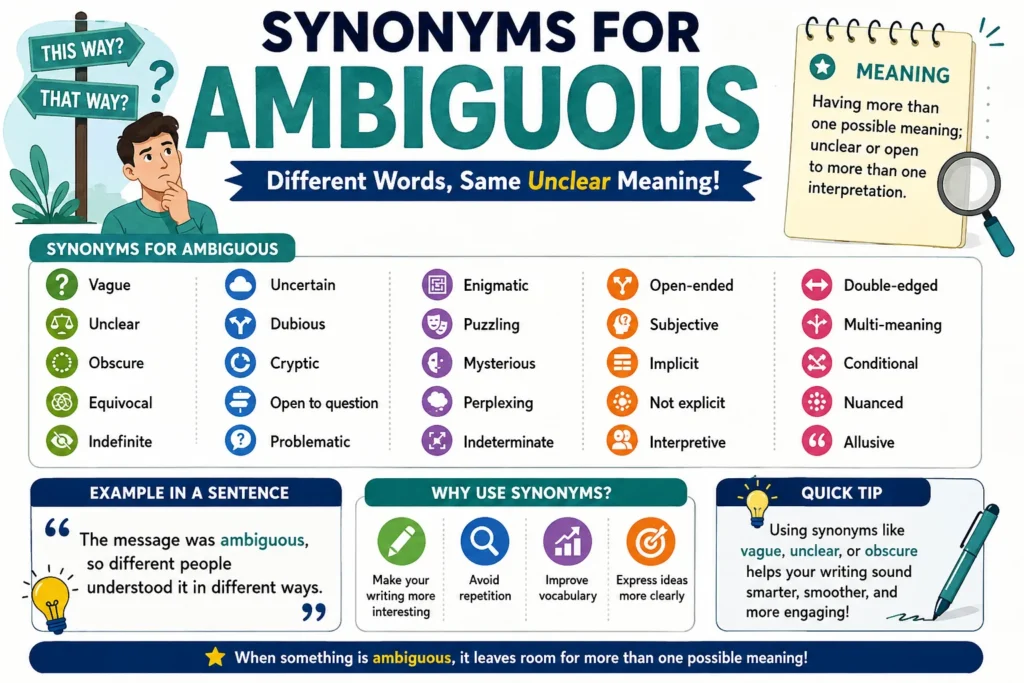
Looking for another word for “ambiguous” but want one that captures the exact kind of lack of clarity or multiple interpretation? The best alternative depends on whether something is unclear, open to more than one interpretation, lacking specific detail, or deliberately noncommittal.
Unclear is a broad everyday choice when something is difficult to understand, while equivocal can describe a statement or response that avoids a definite meaning or commitment. Vague suggests a lack of specific details, whereas uncertain emphasizes doubt about what is true, known, or decided. Cryptic describes something puzzling or difficult to interpret, while indeterminate suggests that an outcome or meaning cannot be clearly established.
These words overlap with “ambiguous,” but they emphasize different kinds of uncertainty, imprecision, or multiple interpretation and are not interchangeable in every context. This guide explores synonyms of ambiguous by meaning, context, and tone, with clear definitions, examples, nuanced comparisons, and practical tips for choosing the most precise word.
Unclear
Meaning: Something unclear is difficult to understand or does not have a clear meaning.
Examples:
- The teacher’s question was unclear.
- His message was unclear to me.
Vague
Meaning: Something vague does not give enough detail or a clear idea.
Examples:
- She gave a vague answer.
- His directions were too vague.
Equivocal
Meaning: Something equivocal can have more than one meaning or does not give a definite answer.
Examples:
- His reply was equivocal.
- The lawyer gave an equivocal statement.
Indefinite
Meaning: Something indefinite is not clearly fixed, limited, or stated.
Examples:
- We made an indefinite plan.
- The project has an indefinite end date.
Uncertain
Meaning: Something uncertain is not known or decided for sure.
Examples:
- The meaning of the note is uncertain.
- Her answer left me uncertain.
Imprecise
Meaning: Something imprecise is not exact or clear enough.
Examples:
- His wording was imprecise.
- The report gave an imprecise estimate.
Obscure
Meaning: Something obscure is difficult to understand because its meaning is not clear.
Examples:
- The poem has an obscure meaning.
- He used an obscure phrase.
Cryptic
Meaning: Something cryptic is difficult to understand because its meaning is hidden or indirect.
Examples:
- She sent me a cryptic message.
- His note was short and cryptic.
Synonyms for Popular: Famous, Trendy & Well-Liked
Enigmatic
Meaning: Something enigmatic is mysterious and hard to understand.
Examples:
- His smile was enigmatic.
- The story has an enigmatic ending.
Puzzling
Meaning: Something puzzling is difficult to understand or explain.
Examples:
- Her decision was puzzling.
- I found his answer puzzling.
Confusing
Meaning: Something confusing is hard to understand because it lacks clarity.
Examples:
- The instructions were confusing.
- This question is confusing for beginners.
Perplexing
Meaning: Something perplexing is very difficult to understand or explain.
Examples:
- The strange result was perplexing.
- His sudden choice was perplexing.
Baffling
Meaning: Something baffling is extremely difficult to understand or explain.
Examples:
- The error was baffling.
- Her behavior seemed baffling.
Bewildering
Meaning: Something bewildering makes a person feel very confused.
Examples:
- The new rules were bewildering.
- His sudden change was bewildering.
Confounding
Meaning: Something confounding is confusing and difficult to make sense of.
Examples:
- The problem was confounding.
- Her explanation was confounding.
Indistinct
Meaning: Something indistinct is not clear enough to identify or understand easily.
Examples:
- I heard an indistinct voice.
- The writing was indistinct.
Synonyms for Allow: Permit, Let & Enable
Indeterminate
Meaning: Something indeterminate has no clear or fixed meaning, result, or limit.
Examples:
- The cause remains indeterminate.
- The final result is indeterminate.
Inconclusive
Meaning: Something inconclusive does not give a clear or final answer.
Examples:
- The evidence was inconclusive.
- The test gave an inconclusive result.
Undecided
Meaning: Something undecided has not been settled or determined.
Examples:
- The issue is still undecided.
- The final choice remains undecided.
Unsettled
Meaning: Something unsettled has not been clearly resolved or decided.
Examples:
- The question remains unsettled.
- The dispute is still unsettled.
Undetermined
Meaning: Something undetermined has not yet been clearly decided or known.
Examples:
- The cause is still undetermined.
- His exact role remains undetermined.
Undefined
Meaning: Something undefined has not been clearly explained, described, or limited.
Examples:
- The term is still undefined.
- Their relationship seems undefined.
Ill-Defined
Meaning: Something ill-defined does not have clear limits, details, or meaning.
Examples:
- The goal was ill-defined.
- The concept remains ill-defined.
Unspecified
Meaning: Something unspecified has not been clearly named or described.
Examples:
- The reason was unspecified.
- The form asks for an unspecified detail.
Inexplicit
Meaning: Something inexplicit does not state its meaning or details clearly.
Examples:
- The instructions were inexplicit.
- His answer was inexplicit.
Nebulous
Meaning: Something nebulous is vague and difficult to understand or define.
Examples:
- She had a nebulous idea.
- The plan remained nebulous.
Hazy
Meaning: Something hazy is not clear in meaning or detail.
Examples:
- His explanation was hazy.
- I have a hazy memory of the event.
Murky
Meaning: Something murky is unclear, confusing, or difficult to understand.
Examples:
- The rules are still murky.
- His role in the deal is murky.
Fuzzy
Meaning: Something fuzzy is not clear or exact.
Examples:
- The difference between them is fuzzy.
- His explanation was a little fuzzy.
Foggy
Meaning: Something foggy is unclear or difficult to understand.
Examples:
- The details are still foggy.
- My understanding of the plan is foggy.
Muddy
Meaning: Something muddy is unclear because different ideas or details are mixed together.
Examples:
- The article makes the issue muddy.
- His explanation only made things muddy.
Cloudy
Meaning: Something cloudy is not clear in meaning, purpose, or detail.
Examples:
- The contract language is cloudy.
- Her explanation left the issue cloudy.
Shadowy
Meaning: Something shadowy is unclear, uncertain, or difficult to understand fully.
Examples:
- The report gives a shadowy picture of events.
- His past remains shadowy.
Opaque
Meaning: Something opaque is difficult to understand or explain clearly.
Examples:
- The policy is opaque.
- The company’s decision-making process seems opaque.
Abstruse
Meaning: Something abstruse is difficult to understand because it is complex or unclear.
Examples:
- The book discusses an abstruse topic.
- The professor explained an abstruse idea.
Recondite
Meaning: Something recondite is difficult to understand because it is very specialized or obscure.
Examples:
- The article contains recondite ideas.
- He enjoys reading recondite books.
Inscrutable
Meaning: Something inscrutable is very difficult to understand or explain.
Examples:
- His expression was inscrutable.
- The reason for her choice was inscrutable.
Delphic
Meaning: Something Delphic is mysterious and open to different interpretations.
Examples:
- His answer was strangely Delphic.
- The message sounded Delphic to everyone.
Amphibolous
Meaning: Something amphibolous is ambiguous because its grammar allows more than one meaning.
Examples:
- The sentence is amphibolous.
- The editor noticed an amphibolous phrase.
Amphibological
Meaning: Something amphibological has a grammatical structure that allows more than one interpretation.
Examples:
- The statement is amphibological.
- The writer removed the amphibological wording.
Multivalent
Meaning: Something multivalent has several possible meanings, uses, or interpretations.
Examples:
- The symbol is multivalent.
- Her words were multivalent.
Polysemous
Meaning: A polysemous word has several related meanings.
Examples:
- “Head” is a polysemous English word.
- The dictionary lists several meanings for this polysemous term.
Double-Meaning
Meaning: Something with a double meaning can be understood in two different ways.
Examples:
- The joke has a double meaning.
- His comment carried a double meaning.
Double-Entendre
Meaning: A double-entendre is a phrase with two meanings, often with one meaning being humorous or suggestive.
Examples:
- The comedian used a clever double-entendre.
- Her line sounded like a double-entendre.
Open-Ended
Meaning: Something open-ended allows more than one possible answer or interpretation.
Examples:
- The teacher asked an open-ended question.
- The discussion was open-ended.
Interpretive
Meaning: Something interpretive allows people to understand or explain it in different ways.
Examples:
- The poem has an interpretive quality.
- The artwork invites an interpretive reading.
Indirect
Meaning: Something indirect does not express its meaning in a direct way.
Examples:
- He gave an indirect answer.
- Her message was indirect.
Evasive
Meaning: Something evasive avoids giving a direct or clear answer.
Examples:
- He gave an evasive reply.
- The politician remained evasive during the interview.
Noncommittal
Meaning: Something noncommittal avoids making a clear choice, promise, or statement.
Examples:
- She gave a noncommittal response.
- His answer was polite but noncommittal.
Roundabout
Meaning: Something roundabout expresses an idea in an indirect rather than direct way.
Examples:
- He gave a roundabout answer.
- Her roundabout explanation took too long.
Slippery
Meaning: Something slippery is difficult to define, understand, or pin down exactly.
Examples:
- The word has a slippery meaning.
- Truth can be a slippery concept.
Uncertain in Meaning
Meaning: Something uncertain in meaning can be understood in more than one possible way.
Examples:
- The phrase is uncertain in meaning.
- His final sentence was uncertain in meaning.
Open to Interpretation
Meaning: Something open to interpretation can reasonably be understood in different ways.
Examples:
- The ending is open to interpretation.
- Her comment is open to interpretation.
Conclusion
Learning the synonyms of ambiguous gives you more choices when you write and speak. Words such as unclear, vague, equivocal, and indefinite can help you describe different kinds of unclear meaning. Students can use them in essays, while bloggers and content writers can use them to make their language more precise. Daily English users can also practice these words in emails and conversations. Try replacing common words with better alternatives when the context allows. With regular practice, your writing, blogging, speaking, and communication will become clearer and stronger.

Evan Blake creates powerful, research-backed synonym resources, guiding readers to communicate smarter, clearer, and more effectively every day.