
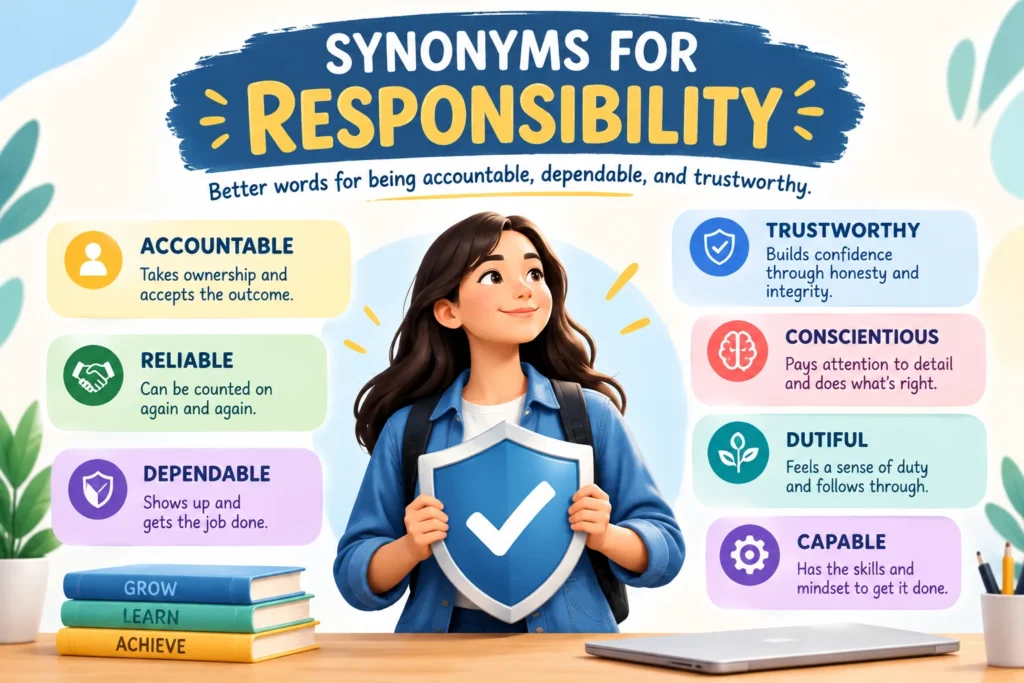
Finding the right synonym for “responsibility” can be tricky because the word has several related meanings. It can refer to a duty you are expected to fulfill, an obligation you must meet, accountability for an action or outcome, or the care and management of something entrusted to you. Words and phrases such as duty, obligation, accountability, commitment, charge, ownership, liability, and stewardship may fit particular contexts, but they are not interchangeable in every sentence.
For example, a job may involve a specific duty, a legal situation may involve liability, a manager may have accountability for a team’s results, and a person who takes ownership of a project accepts responsibility for seeing it through. Choosing the wrong alternative can change your sentence’s meaning, tone, or level of formality.
If you’re searching for synonyms for responsibility, you likely want the right word for work, leadership, relationships, parenting, school, business, law, academic writing, or everyday conversation. This guide covers synonyms, related words, and context-specific alternatives with clear meanings, natural examples, and practical usage tips.
Duty
Meaning:
Duty means something you are expected or required to do.
Examples:
- It is my duty to help my family.
- She takes her work duties seriously.
Obligation
Meaning:
Obligation means something you must do because of a rule, promise, or situation.
Examples:
- I have an obligation to pay the bill.
- He fulfilled his obligation to the client.
Accountability
Meaning:
Accountability means being responsible for your actions and their results.
Examples:
- Good leaders accept accountability for mistakes.
- The manager takes accountability for the decision.
Liability
Meaning:
Liability means legal or financial responsibility for something.
Examples:
- The company accepted liability for the damage.
- The contract explains who has liability.
Onus
Meaning:
Onus means the duty or responsibility to do something or prove something.
Examples:
- The onus is on you to provide the details.
- The onus falls on the seller to fix the problem.
Burden
Meaning:
Burden means a difficult duty or responsibility that someone has to carry.
Examples:
- Paying all the bills became a heavy burden.
- She felt the burden of caring for her family.
Charge
Meaning:
Charge means responsibility for taking care of a person, place, or task.
Examples:
- She is in charge of the office today.
- He was given charge of the project.
Commitment
Meaning:
Commitment means a strong promise or decision to do something.
Examples:
- Her commitment to the project is clear.
- I made a commitment to attend the meeting.
Ownership
Meaning:
Ownership means accepting full responsibility for a task, decision, or mistake.
Examples:
- He took ownership of the problem.
- She showed ownership after the error.
Answerability
Meaning:
Answerability means being expected to explain your actions or decisions.
Examples:
- Leaders need answerability for major decisions.
- The new system improves answerability at work.
Stewardship
Meaning:
Stewardship means careful responsibility for managing something that belongs to others or must be protected.
Examples:
- Good stewardship protects public resources.
- Her stewardship helped the charity grow.
Trusteeship
Meaning:
Trusteeship means managing something for the benefit of other people.
Examples:
- The land was placed under trusteeship.
- His trusteeship involved careful financial decisions.
Guardianship
Meaning:
Guardianship means the legal or personal duty to protect and care for someone.
Examples:
- The child remained under her guardianship.
- Guardianship requires patience and care.
Custodianship
Meaning:
Custodianship means responsibility for protecting or taking care of something.
Examples:
- He accepted custodianship of the old records.
- The museum has custodianship of the collection.
Care
Meaning:
Care means giving attention to someone or something and keeping it safe.
Examples:
- She takes good care of her younger brother.
- Please take care of these important files.
Trust
Meaning:
Trust can mean a duty given to someone because they are believed to be reliable.
Examples:
- She was given the trust of managing the funds.
- He valued the trust placed in him.
Oversight
Meaning:
Oversight means the responsibility of watching and checking work.
Examples:
- The manager provides oversight for the project.
- Regular oversight helps prevent mistakes.
Supervision
Meaning:
Supervision means the responsibility of watching and guiding work.
Examples:
- The children need adult supervision.
- The work was completed under close supervision.
Management
Meaning:
Management means organizing and controlling people, tasks, or resources.
Examples:
- The project needs careful management.
- Her management of the team was effective.
Leadership
Meaning:
Leadership means guiding people while taking responsibility for a group or goal.
Examples:
- His leadership helped the team succeed.
- Good leadership requires clear decisions.
Synonyms for Suddenly: From Abruptly to Without Warning
Authority
Meaning:
Authority means the power to make decisions or direct others, often with related responsibility.
Examples:
- The manager has authority over the team.
- She has the authority to approve the request.
Role
Meaning:
Role means a position or set of duties that someone has in a situation.
Examples:
- My role is to support the new employees.
- She plays an important role in the project.
Function
Meaning:
Function means a particular duty or purpose that a person or group performs.
Examples:
- One function of the manager is to guide the team.
- His main function is to check the records.
Task
Meaning:
Task means a specific piece of work that someone is responsible for completing.
Examples:
- My main task is checking the reports.
- She finished the task before lunch.
Assignment
Meaning:
Assignment means a piece of work given to someone to complete.
Examples:
- I finished my writing assignment last night.
- The teacher gave us a new assignment.
Job
Meaning:
Job means a piece of work or duty that someone is expected to handle.
Examples:
- It is my job to answer customer emails.
- Her job includes checking the daily reports.
Commission
Meaning:
Commission means a task or piece of work officially given to someone.
Examples:
- The artist received a commission for a portrait.
- He accepted the commission from the company.
Mission
Meaning:
Mission means an important task or purpose that someone is expected to carry out.
Examples:
- Our mission is to help local students.
- She completed her mission before sunset.
Mandate
Meaning:
Mandate means an official order or duty that gives someone the responsibility to act.
Examples:
- The agency has a mandate to protect consumers.
- The new law gives the board a clear mandate.
Remit
Meaning:
Remit means the area of work or responsibility given to a person or organization.
Examples:
- Education is within the committee’s remit.
- The issue falls outside my remit.
Province
Meaning:
Province can mean an area or subject that is someone’s responsibility or concern.
Examples:
- Budget planning is within her province.
- Customer support is not my province.
Jurisdiction
Meaning:
Jurisdiction means the official area or matters over which someone has authority and responsibility.
Examples:
- The case falls under the court’s jurisdiction.
- This matter is outside our jurisdiction.
Office
Meaning:
Office can mean a position that carries duties and responsibilities.
Examples:
- He accepted the office of chairperson.
- The office carries many important duties.
Incumbency
Meaning:
Incumbency means holding a position that comes with specific duties or responsibilities.
Examples:
- The role requires experience in public service and incumbency.
- His incumbency brought several new duties.
Synonyms for Ghost:56+ From Spirits & Phantoms to Cutting Contact
Culpability
Meaning:
Culpability means responsibility for doing something wrong or causing a problem.
Examples:
- The investigation examined his culpability.
- The report found no clear evidence of culpability.
Blame
Meaning:
Blame means responsibility for something bad or wrong.
Examples:
- She accepted the blame for the mistake.
- The team shared the blame for the loss.
Fault
Meaning:
Fault means responsibility for a mistake, failure, or problem.
Examples:
- The accident was not his fault.
- She admitted fault for the error.
Account
Meaning:
Account can mean an explanation or record that makes someone answerable for an action.
Examples:
- He gave an account of what happened.
- The manager asked for a full account of the incident.
Undertaking
Meaning:
Undertaking means a task, promise, or responsibility that someone agrees to handle.
Examples:
- The project was a major undertaking.
- She accepted the undertaking with confidence.
Pledge
Meaning:
Pledge means a serious promise to do something or support something.
Examples:
- He made a pledge to support the school.
- The company renewed its pledge to protect customer data.
Promise
Meaning:
Promise means a commitment to do something or keep an agreement.
Examples:
- I made a promise to call her tonight.
- He kept his promise to the team.
Dedication
Meaning:
Dedication means strong effort and commitment toward a person, task, or goal.
Examples:
- Her dedication helped the project succeed.
- His dedication to his work is easy to see.
Devotion
Meaning:
Devotion means strong loyalty, care, or commitment to someone or something.
Examples:
- Her devotion to her family is clear.
- His devotion to the cause inspired others.
Diligence
Meaning:
Diligence means careful and steady effort when handling a duty.
Examples:
- She completed the work with diligence.
- His diligence helped him avoid mistakes.
Dependability
Meaning:
Dependability means being reliable and able to be trusted with duties.
Examples:
- Her dependability makes her a valuable employee.
- Everyone appreciates his dependability at work.
Reliability
Meaning:
Reliability means being consistently trustworthy when something needs to be done.
Examples:
- His reliability makes him a strong team member.
- We value her reliability at work.
Trustworthiness
Meaning:
Trustworthiness means being honest and reliable enough for others to trust you.
Examples:
- His trustworthiness earned the team’s respect.
- Trustworthiness is important in every workplace.
Responsibility
Meaning:
Responsibility itself means having a duty to deal with something or accepting the results of your actions.
Examples:
- She accepted responsibility for the mistake.
- Taking responsibility builds trust.
Accountability for Actions
Meaning:
Accountability for actions means accepting responsibility and being ready to explain what you did.
Examples:
- Good employees show accountability for their actions.
- He accepted accountability for his actions.
Sense of Duty
Meaning:
A sense of duty means a strong feeling that you should do what is expected of you.
Examples:
- Her sense of duty keeps her focused.
- He acted from a strong sense of duty.
Sense of Responsibility
Meaning:
A sense of responsibility means a strong feeling that you should handle your duties properly.
Examples:
- She has a strong sense of responsibility.
- His sense of responsibility makes him dependable.
Moral Duty
Meaning:
Moral duty means a responsibility to do something because you believe it is right.
Examples:
- He felt a moral duty to tell the truth.
- Helping someone in need can be a moral duty.
Professional Duty
Meaning:
Professional duty means a responsibility connected to someone’s job or profession.
Examples:
- Protecting client information is a professional duty.
- Safety is an important professional duty.
Legal Responsibility
Meaning:
Legal responsibility means a duty or liability created by law.
Examples:
- Drivers have legal responsibility for safe driving.
- The company has legal responsibility for the product.
Financial Responsibility
Meaning:
Financial responsibility means managing money carefully and meeting money-related duties.
Examples:
- Paying bills on time shows financial responsibility.
- Saving money is part of financial responsibility.
Parental Responsibility
Meaning:
Parental responsibility means the duty to care for and guide a child.
Examples:
- Parental responsibility includes keeping children safe.
- Parents share parental responsibility for their children.
Civic Responsibility
Meaning:
Civic responsibility means duties that help a community or society.
Examples:
- Helping your community is a civic responsibility.
- Voting is often seen as a civic responsibility.
Shared Responsibility
Meaning:
Shared responsibility means two or more people have responsibility for something together.
Examples:
- Cleaning the office is a shared responsibility.
- We have shared responsibility for the project.
How to Choose the Right Synonym for Responsibility
Not every word above can replace responsibility in every sentence. The best choice depends on the meaning you want.
Use duty when you mean something you are expected to do.
Use obligation when a rule, promise, or situation makes something necessary.
Use accountability when you mean accepting responsibility for results or decisions.
Use liability when the responsibility is mainly legal or financial.
Use commitment when you want to stress a promise or strong dedication.
Use ownership when someone accepts full control of a task, problem, or mistake.
Use onus when you want to show that the duty falls on a particular person.
Use charge when someone has control or care of a person, place, or task.
Use stewardship when someone must carefully protect or manage something for others.
Use blame or fault when responsibility is connected to a mistake or bad result.
This small difference matters. Choosing the right synonym makes your English more precise and natural.
FAQ
What is the best synonym for responsibility?
The best synonym depends on the sentence. Duty, obligation, accountability, commitment, ownership, and charge are useful choices in different contexts.
What is a simple word for responsibility?
Duty is one of the simplest alternatives. It means something you are expected or required to do.
What is a professional synonym for responsibility?
Accountability, ownership, commitment, stewardship, and charge can work well in professional writing, depending on the context.
What is a strong word for taking responsibility?
Ownership is a strong choice when someone accepts full responsibility for a task, decision, or mistake. Accountability is also useful when the person must explain the result.
What is the difference between responsibility and accountability?
Responsibility means having a duty or task. Accountability means being answerable for your actions and their results. A person can have responsibility for a task and still be held accountable for its outcome.
What is the difference between responsibility, duty, and obligation?
Responsibility is a general duty or task. Duty often means something you are expected to do. Obligation usually suggests something you must do because of a rule, promise, or situation.
What is the opposite of responsibility?
Common opposites include irresponsibility, neglect, carelessness, and unreliability. The best opposite depends on the sentence.
Conclusion
Learning synonyms for responsibility can make your writing clearer, stronger, and more natural. The right word helps you show duty, accountability, commitment, ownership, or legal responsibility with greater accuracy. Students can use these words in essays, while bloggers and content writers can avoid repetition. Practice them in emails, school work, and daily conversations. The more you use these words, the easier it becomes to choose the right one with confidence