Looking for a better word for “discuss” but unsure which synonym fits your sentence? You’re not alone—“discuss” can involve talking about a topic, examining an issue, exchanging viewpoints, or considering different possibilities, so the best alternative depends on the context and tone. You might address an important issue, explore a complex idea, analyze evidence, debate opposing viewpoints, or negotiate the terms of a contract.
Other alternatives, such as consider, review, examine, deliberate, and cover, can work in specific situations, but each emphasizes something different. Some focus on careful analysis, others on disagreement or decision-making, while mention simply refers to a subject without necessarily exploring it in detail. Because these alternatives are not interchangeable in every sentence, choosing the right one helps you communicate your intended meaning more precisely.
This guide explores the best synonyms for “discuss” by meaning, context, tone, and usage, with clear definitions and natural examples to help you choose the right alternative.
What Is Another Word for Discuss?
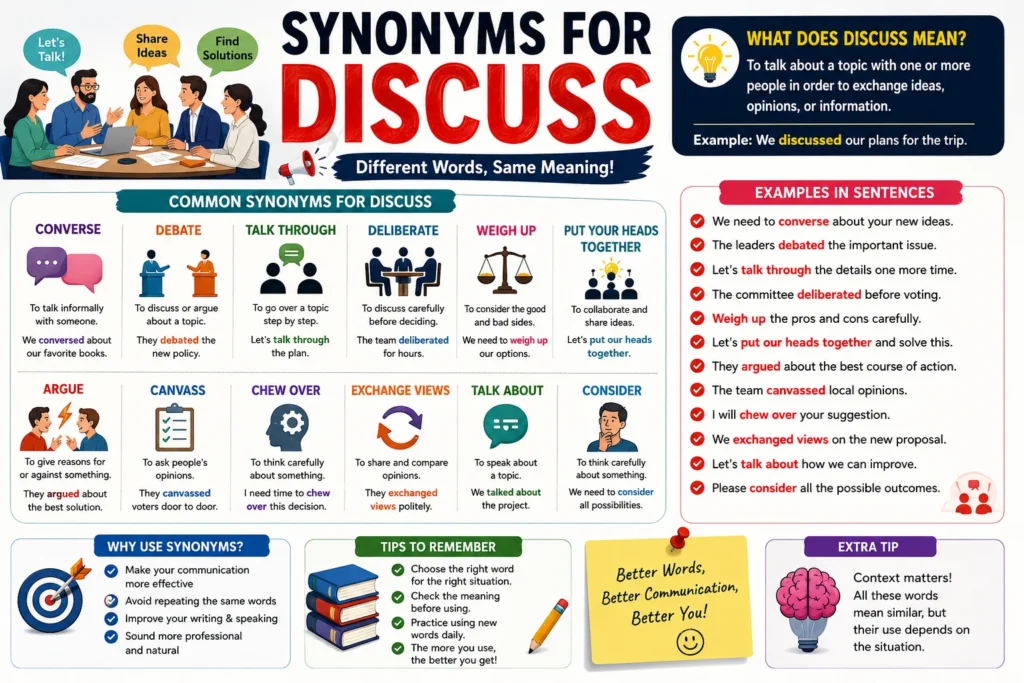
Some useful alternatives to discuss include talk about, converse, debate, deliberate, confer, consult, explore, examine, review, address, consider, negotiate, brainstorm, talk over, and talk through.
Some are close synonyms, while others are useful alternatives in specific situations. For example, debate suggests different opinions, while consult usually means talking to someone for advice.
Talk About
Meaning: To talk about something means to speak about a topic, person, idea, or event.
Best for: Everyday English and casual conversation.
Examples:
- We need to talk about our weekend plans.
- Sarah talked about her new job over dinner.
Converse
Meaning: To converse means to talk with someone, often in a friendly or formal way.
Best for: Formal writing and polished English.
Examples:
- The guests conversed quietly after dinner.
- I enjoy conversing with people from different cultures.
Debate
Meaning: To debate means to discuss an issue while giving different opinions or arguments.
Best for: Academic, political, and formal discussions.
Examples:
- The students debated the new school rule.
- The leaders debated the best way to reduce costs.
Deliberate
Meaning: To deliberate means to discuss something carefully before making a decision.
Best for: Formal and professional situations.
Examples:
- The judges deliberated before choosing the winner.
- The board deliberated on the proposal for several hours.
Confer
Meaning: To confer means to talk with someone in order to share ideas or make a decision.
Best for: Formal, academic, and professional English.
Examples:
- The doctors conferred about the best treatment plan.
- I need to confer with my manager before replying.
Consult
Meaning: To consult means to talk to someone to get advice or useful information.
Best for: Professional and formal situations.
Examples:
- She consulted her teacher about the assignment.
- We consulted an expert before buying the equipment.
Converse About
Meaning: To converse about something means to talk with someone about a particular subject.
Best for: Formal or literary English.
Examples:
- The two writers conversed about modern literature.
- They conversed about their travel experiences.
Explore
Meaning: To explore a topic means to discuss and examine its different ideas or possibilities.
Best for: Essays, blogs, reports, and academic writing.
Examples:
- This article explores the causes of stress.
- The class explored different ways to protect the environment.
Examine
Meaning: To examine a topic means to look at it closely and discuss its details.
Best for: Academic and analytical writing.
Examples:
- The essay examines the effects of social media.
- We examined the problem from several angles.
Review
Meaning: To review something means to look at it again and discuss its main points.
Best for: Meetings, lessons, reports, and work.
Examples:
- Let’s review the project before the meeting.
- The teacher reviewed the main points with the class.
Address
Meaning: To address an issue means to talk about it or deal with it directly.
Best for: Formal, professional, and academic writing.
Examples:
- The manager addressed the team’s concerns.
- This report addresses the main causes of the problem.
Consider
Meaning: To consider something means to think about it carefully before making a choice.
Best for: Formal and academic writing.
Examples:
- We should consider all the available options.
- The committee considered several possible solutions.
Analyze
Meaning: To analyze something means to study it closely to understand its parts and meaning.
Best for: Academic, scientific, and professional writing.
Examples:
- The students analyzed the poem in class.
- We analyzed the survey results before writing the report.
Assess
Meaning: To assess something means to examine it and decide how good, useful, or important it is.
Best for: Academic and professional contexts.
Examples:
- The team assessed the risks before starting the project.
- The teacher assessed each student’s progress.
Evaluate
Meaning: To evaluate something means to study it carefully and judge its value or quality.
Best for: Academic and professional writing.
Examples:
- We evaluated the results of the new program.
- The manager evaluated each proposal carefully.
Debate Over
Meaning: To debate over something means to discuss different views about it before reaching a decision.
Best for: Situations involving disagreement or competing choices.
Examples:
- The family debated over where to spend the holiday.
- The team debated over which design to choose.
Talk Over
Meaning: To talk over something means to discuss it carefully with another person.
Best for: Everyday and professional English.
Examples:
- Let’s talk over the plan after lunch.
- I want to talk over this idea with my partner.
Go Over
Meaning: To go over something means to review or discuss it carefully.
Best for: Casual and workplace English.
Examples:
- Can we go over the schedule together?
- The teacher went over the answers with us.
Talk Through
Meaning: To talk through something means to discuss it step by step.
Best for: Problems, plans, decisions, and instructions.
Examples:
- Let’s talk through the problem before we decide.
- She talked me through the new process.
Work Through
Meaning: To work through something means to discuss a problem and deal with it step by step.
Best for: Problems, disagreements, and difficult situations.
Examples:
- We worked through the issue together.
- They worked through their differences calmly.
Synonyms for Insane: 60+ Alternatives by Meaning
Think Through
Meaning: To think through something means to consider every part of it carefully.
Best for: Decisions and planning.
Examples:
- We need to think through this decision.
- He thought through the plan before speaking.
Bring Up
Meaning: To bring up a topic means to start talking about it.
Best for: Everyday conversations and meetings.
Examples:
- She brought up an interesting question.
- I want to bring up one small concern.
Raise an Issue
Meaning: To raise an issue means to introduce a problem or topic for discussion.
Best for: Meetings, workplaces, and formal conversations.
Examples:
- Mark raised an issue during the meeting.
- She raised an important concern about the project.
Touch On
Meaning: To touch on a topic means to talk about it briefly.
Best for: Essays, speeches, presentations, and general writing.
Examples:
- The speaker touched on the topic of online safety.
- The report touches on several social issues.
Go Into
Meaning: To go into a topic means to discuss it with more detail.
Best for: Conversation and informal writing.
Examples:
- I don’t want to go into every detail right now.
- The article goes into the reasons behind the change.
Deal With
Meaning: To deal with a topic means to discuss or handle it as part of a larger matter.
Best for: Problems, issues, reports, and practical situations.
Examples:
- The meeting will deal with customer complaints.
- This chapter deals with basic grammar rules.
Cover
Meaning: To cover a topic means to include and discuss it as part of a lesson, article, or meeting.
Best for: Education, blogging, reports, and presentations.
Examples:
- The course covers several important topics.
- Our meeting will cover the new safety rules.
Address a Concern
Meaning: To address a concern means to talk about a worry or problem and try to solve it.
Best for: Professional and formal communication.
Examples:
- The manager addressed my concern quickly.
- The email addresses several customer concerns.
Consider Together
Meaning: To consider something together means to think and talk about it with other people.
Best for: Decisions and group discussions.
Examples:
- Let’s consider the options together.
- The team considered the possible results together.
Exchange Ideas
Meaning: To exchange ideas means to share thoughts and opinions with another person or group.
Best for: Academic, professional, and creative settings.
Examples:
- We exchanged ideas during the workshop.
- The writers exchanged ideas about their next project.
Exchange Views
Meaning: To exchange views means to share different opinions about a topic.
Best for: Formal and professional English.
Examples:
- The two experts exchanged views on education.
- We exchanged views before reaching an agreement.
Share Thoughts
Meaning: To share thoughts means to tell other people what you think about something.
Best for: Friendly, professional, and online communication.
Examples:
- Please share your thoughts on the new design.
- We shared our thoughts after watching the film.
Share Opinions
Meaning: To share opinions means to tell others what you think about a subject.
Best for: Conversations, meetings, essays, and social discussions.
Examples:
- Everyone had a chance to share their opinions.
- She shared her opinion during the class discussion.
Brainstorm
Meaning: To brainstorm means to share many ideas in order to find a useful solution.
Best for: Business, school, writing, and creative work.
Examples:
- Let’s brainstorm ideas for the new website.
- The team brainstormed ways to improve the service.
Collaborate On
Meaning: To collaborate on something means to work and discuss ideas with others to achieve a shared goal.
Best for: Work, school, business, and creative projects.
Examples:
- We collaborated on the final presentation.
- The designers collaborated on a new campaign.
Negotiate
Meaning: To negotiate means to discuss something in order to reach an agreement.
Best for: Business, contracts, prices, and disagreements.
Examples:
- They negotiated a better price with the seller.
- We need to negotiate the terms of the contract.
Mediate
Meaning: To mediate means to help people discuss a disagreement and reach an agreement.
Best for: Conflicts, workplaces, and formal situations.
Examples:
- A manager mediated the dispute between the workers.
- She agreed to mediate the discussion.
60+Synonyms for Interest: Words for Every Meaning
Confer With
Meaning: To confer with someone means to talk with them before making a decision or taking action.
Best for: Formal and professional English.
Examples:
- I will confer with the team before making a choice.
- The lawyer conferred with her client before court.
Consult With
Meaning: To consult with someone means to discuss something with them to get advice or help.
Best for: Professional and formal communication.
Examples:
- We consulted with a designer about the new logo.
- He consulted with his coach before the match.
Dialogue About
Meaning: To dialogue about something means to take part in a conversation about it.
Best for: Formal, academic, and social contexts.
Examples:
- The groups began a dialogue about community safety.
- The article encourages dialogue about mental well-being.
Communicate About
Meaning: To communicate about something means to share information or ideas about it with others.
Best for: Professional and everyday communication.
Examples:
- We need to communicate about the changes clearly.
- The team communicated about the project throughout the week.
Delve Into
Meaning: To delve into a topic means to examine and discuss it in great detail.
Best for: Academic, journalistic, and advanced writing.
Examples:
- The book delves into the history of the city.
- The report delves into the causes of the financial problem.
Reflect On
Meaning: To reflect on something means to think carefully about it and its meaning or effects.
Best for: Essays, personal writing, and thoughtful discussions.
Examples:
- The students reflected on what they learned.
- She reflected on her experience before answering.
Question
Meaning: To question something means to ask about it or examine whether it is correct or true.
Best for: Critical discussions and situations involving doubt.
Examples:
- The reporter questioned the new policy.
- The students questioned the accuracy of the claim.
Challenge an Idea
Meaning: To challenge an idea means to question it or give reasons for thinking it may be wrong.
Best for: Academic, professional, and critical discussions.
Examples:
- The student challenged the writer’s main idea.
- She challenged the plan during the meeting.
Argue
Meaning: To argue means to give reasons for or against an idea, often when people have different views.
Best for: Debates, disagreements, and argumentative writing.
Examples:
- The writer argues that schools need more resources.
- They argued about the best way to solve the problem.
Present an Idea
Meaning: To present an idea means to explain or show an idea to other people.
Best for: Meetings, presentations, school, and work.
Examples:
- Maya presented her idea to the team.
- He presented a new solution during the meeting.
Put Forward
Meaning: To put forward an idea means to suggest it for other people to consider.
Best for: Formal and professional writing.
Examples:
- She put forward a practical solution.
- The committee put forward several new proposals.
Propose
Meaning: To propose means to suggest an idea or plan for people to consider.
Best for: Formal, business, and professional English.
Examples:
- He proposed a new way to organize the files.
- The team proposed moving the meeting to Friday.
Suggest
Meaning: To suggest means to give an idea that someone may consider or use.
Best for: Everyday, professional, and written English.
Examples:
- I suggest talking to your teacher first.
- She suggested a different approach to the problem.
Explain
Meaning: To explain means to make an idea or subject clear by giving information.
Best for: Teaching, instructions, and situations where clarity is needed.
Examples:
- Can you explain your idea to the group?
- The teacher explained the new rule clearly.
Elaborate On
Meaning: To elaborate on something means to give more details about it.
Best for: Formal, academic, and professional communication.
Examples:
- Could you elaborate on your main point?
- The speaker elaborated on the reasons for the change.
Clarify
Meaning: To clarify something means to make an idea or statement easier to understand.
Best for: Emails, meetings, lessons, and professional communication.
Examples:
- Could you clarify your question?
- The manager clarified the new instructions.
Describe
Meaning: To describe something means to give details about it using words.
Best for: Situations where you need to explain what something is like.
Examples:
- She described the problem to her teacher.
- He described what happened during the meeting.
Outline
Meaning: To outline something means to give its main points without explaining every detail.
Best for: Reports, essays, presentations, and plans.
Examples:
- The report outlines the main causes of the issue.
- She outlined her plan at the beginning of the meeting.
Report On
Meaning: To report on something means to give information and details about it.
Best for: Journalism, business reports, school work, and formal writing.
Examples:
- The newspaper reported on the local election.
- Students were asked to report on the experiment.
Communicate Ideas
Meaning: To communicate ideas means to share thoughts or information so others can understand them.
Best for: Writing, speaking, presentations, and professional communication.
Examples:
- Good writers communicate ideas clearly.
- The presentation helped us communicate our ideas.
When Should You Use These Synonyms for Discuss?
The best alternative depends on the situation.
For casual conversations, use phrases such as talk about, talk over, go over, bring up, and share thoughts.
For academic writing, stronger choices include examine, analyze, explore, evaluate, assess, address, and delve into.
For business and professional communication, useful options include confer, consult, negotiate, address, review, deliberate, and exchange views.
For disagreements or different opinions, use debate, argue, question, challenge an idea, or exchange views when the context fits.
For ideas and creative work, try brainstorm, exchange ideas, propose, suggest, put forward, and present an idea.
Remember that these alternatives are not always interchangeable. For example, debate suggests different opinions, consult suggests seeking advice, and negotiate suggests trying to reach an agreement. Choosing the right word is more important than simply replacing discuss.
Formal Synonyms for Discuss
If you are writing an essay, report, research paper, or professional document, these alternatives can sound more precise:
- Examine
- Analyze
- Evaluate
- Assess
- Address
- Deliberate
- Confer
- Consider
- Explore
- Elaborate on
- Delve into
- Exchange views
For example, instead of:
This essay discusses the effects of technology.
You could write:
This essay examines the effects of technology.
Or:
This essay explores the effects of technology.
The best choice depends on what the sentence actually means.
Synonyms for Discuss in an Essay
Students often need alternatives to discuss because academic writing can become repetitive. Good choices include examine, explore, analyze, evaluate, assess, address, consider, and delve into.
For example:
This essay discusses the causes of pollution.
can become:
This essay examines the causes of pollution.
Or:
This essay explores the causes of pollution.
Use analyze when you are studying parts or evidence closely. Use evaluate when you are judging value or quality. Use address when you are dealing with an issue or question.
Synonyms for Discuss in a Meeting
Meetings often need practical and natural expressions. Useful choices include talk about, go over, review, bring up, raise an issue, address, talk through, confer, and deliberate.
For example:
We need to discuss the new schedule.
You could say:
We need to go over the new schedule.
Or:
We need to review the new schedule.
Use bring up when someone introduces a new topic. Use address when the topic is an issue or concern.
Synonyms for Discuss in an Email
For professional emails, choose words based on your purpose.
Use discuss or talk about for a general conversation.
Use review when checking something.
Use address when dealing with a problem.
Use clarify when making something clear.
Use consult or confer with when getting advice or another person’s opinion.
For example:
I would like to discuss the project with you.
A professional alternative is:
I would like to review the project with you.
Another option is:
I would like to talk through the project with you.
Synonyms for Discuss in Everyday English
Everyday English usually sounds better with simple words and phrases.
Try:
- Talk about
- Talk over
- Go over
- Bring up
- Talk through
- Share thoughts
- Share opinions
- Suggest
For example:
Can we discuss the trip tonight?
sounds very natural as:
Can we talk about the trip tonight?
Simple alternatives are often better than formal words in friendly conversations.
Important Difference Between Discuss and Its Alternatives
The word discuss is broad. It simply means to talk about something with another person or group.
Other words add a special meaning.
Debate usually involves different opinions or arguments.
Consult usually means asking someone for advice.
Negotiate usually involves trying to reach an agreement.
Deliberate suggests careful discussion before a decision.
Examine suggests looking closely at a subject.
Explore suggests looking at different ideas or possibilities.
Review suggests looking at something again.
Bring up means introducing a topic.
Clarify means making something easier to understand.
Suggest means offering an idea.
This is why a good synonym should be chosen based on meaning and context, not just because it appears in a synonym list.
Common Mistake to Avoid
Do not replace discuss with another word just because it looks similar in a dictionary.
For example:
We discussed our holiday plans.
The most natural replacement is:
We talked about our holiday plans.
But:
We debated our holiday plans.
changes the meaning because it suggests different opinions or disagreement.
Likewise:
We discussed the contract.
and:
We negotiated the contract.
are not exactly the same. Negotiated suggests that the people were trying to reach an agreement.
Good vocabulary is not about using the most difficult word. It is about using the most accurate word.
Conclusion
Learning synonyms for discuss gives you more control over your English. You can use simple phrases such as talk about in daily conversations and stronger words such as examine, analyze, address, or deliberate in formal writing. These alternatives can improve essays, blogs, emails, presentations, and everyday speech. Practice a few words at a time. Try them in your own sentences, emails, and conversations. The more you use them, the easier it becomes to choose the right word naturally and communicate your ideas with confidence.

Noah Reed delivers authoritative, high-quality synonym insights, helping readers master language with precision, clarity, and creative finesse.