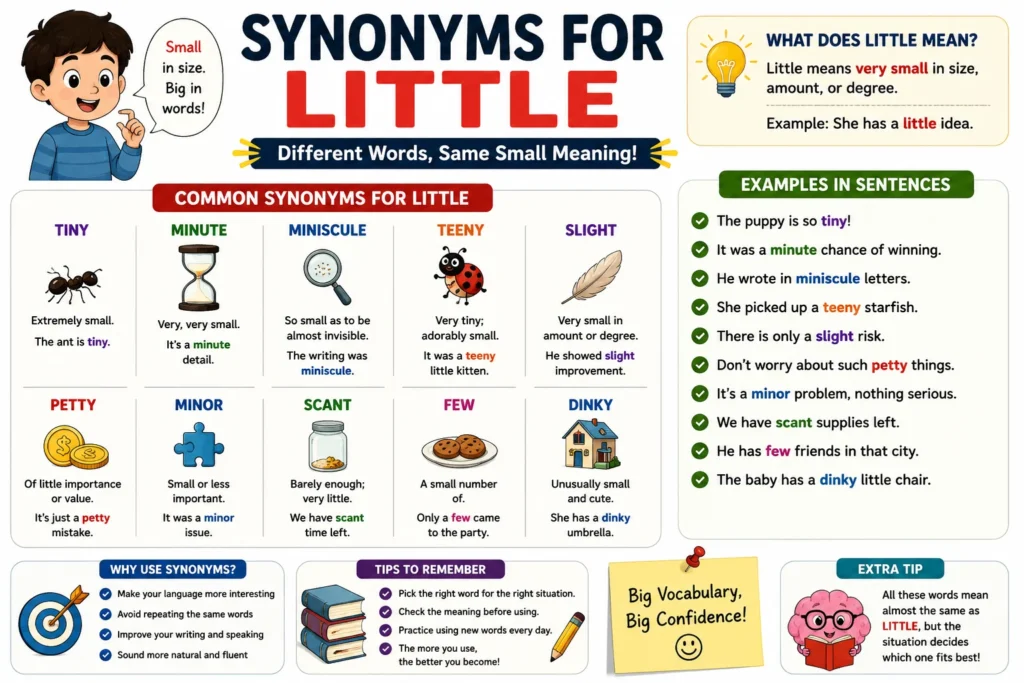
Looking for a better word for “little” but unsure which synonym fits your sentence? You’re not alone—“little” can refer to small size, a small amount, young age, limited duration, or lesser importance, so the best alternative depends on the context. You might describe a tiny house, scant resources, a young child, a brief moment, or a minor detail.
However, “little” can also change meaning depending on how it is used: “little time” suggests not much time, while “a little time” means some time. Other alternatives, such as small, tiny, slight, minimal, modest, petite, diminutive, and insignificant, work in specific contexts but are not interchangeable. For example, tiny emphasizes very small size, scant suggests an insufficient amount, and minor refers to lesser importance.
This guide explores the best synonyms and alternatives for “little” by meaning, context, tone, and usage, with clear explanations and natural examples.
Small
Meaning:
- Small means not large in size.
Examples:
- We live in a small house.
- She bought a small backpack.
Use: Common and neutral. This is the best general alternative to little when talking about size.
Tiny
Meaning:
- Tiny means very small in size.
Examples:
- I found a tiny shell on the beach.
- The kitten has tiny paws.
Use: Common and often friendly. Use it when something is smaller than what you would normally call small.
Miniature
Meaning:
- Miniature means made in a much smaller size than the real thing.
Examples:
- He keeps miniature cars on his desk.
- She made a miniature garden for the dollhouse.
Use: Common when talking about models, art, toys, and small copies.
Minute
Meaning:
- Minute means extremely small and is often used for details or changes.
Examples:
- The glass has a minute crack.
- We noticed a minute change in the design.
Use: Formal or literary. It is pronounced “my-NOOT” when it means extremely small.
Diminutive
Meaning:
- Diminutive means unusually small in size.
Examples:
- A diminutive plant grew beside the wall.
- The artist painted a diminutive bird.
Use: Formal. It works well in descriptive writing but is less common in daily speech.
Wee
Meaning:
- Wee means very small.
Examples:
- A wee bird sat on the fence.
- Can I have a wee piece of cake?
Use: Informal and friendly. It is especially common in British and Irish English.
Petite
Meaning:
- Petite means small and delicately built, especially when describing a woman.
Examples:
- She is petite and loves simple clothes.
- The petite woman chose a small handbag.
Use: Usually positive and often used for people, clothing, and body size.
Compact
Meaning:
- Compact means small but arranged so that it takes up little space.
Examples:
- This compact camera fits in my pocket.
- We bought a compact desk for the room.
Use: Useful for products, rooms, furniture, cars, and technology.
Undersized
Meaning:
- Undersized means smaller than the normal or expected size.
Examples:
- The player was undersized for his position.
- The store sent an undersized box.
Use: Neutral or slightly negative. It often suggests that something is smaller than it should be.
Dainty
Meaning:
- Dainty means small, pretty, and delicate.
Examples:
- She wore a dainty silver necklace.
- The table was covered with dainty flowers.
Use: Usually positive and decorative.
Puny
Meaning:
- Puny means small and weak-looking.
Examples:
- The puny puppy soon became strong.
- He felt puny next to the tall player.
Use: Informal and often negative. It is not a good replacement when you simply mean “small.”
Dinky
Meaning:
- Dinky means small and sometimes cute or attractive.
Examples:
- They rented a dinky little car.
- She lives in a dinky apartment near the park.
Use: Informal. It can sound playful or slightly dismissive depending on context.
Teensy
Meaning:
- Teensy means extremely small.
Examples:
- There was a teensy hole in my sock.
- The child drew a teensy star.
Use: Very informal and playful.
Itsy-bitsy
Meaning:
- Itsy-bitsy means extremely small.
Examples:
- A tiny spider crawled across the itsy-bitsy web.
- She made an itsy-bitsy paper boat.
Use: Very informal and playful, especially in speech.
Lilliputian
Meaning:
- Lilliputian means extremely small, often in a humorous or literary way.
Examples:
- The artist created a Lilliputian village.
- The tiny figures looked Lilliputian beside the statue.
Use: Literary or humorous. It comes from the tiny people in Gulliver’s Travels.
Microscopic
Meaning:
- Microscopic means so small that it is difficult or impossible to see without a microscope.
Examples:
- The scientist studied microscopic cells.
- A microscopic crack caused the leak.
Use: Best for extremely small things, especially in science.
Infinitesimal
Meaning:
- Infinitesimal means extremely, almost unbelievably small.
Examples:
- The difference was infinitesimal.
- Only an infinitesimal amount of dust remained.
Use: Formal. It is useful for very small amounts, differences, or measurements.
Imperceptible
Meaning:
- Imperceptible means so small that it cannot easily be noticed.
Examples:
- There was an imperceptible change in the sound.
- The machine made an imperceptible movement.
Use: Formal. It focuses on being hard to notice rather than simply being physically small.
Slight
Meaning:
- Slight means small in size, amount, degree, or effect.
Examples:
- There was a slight change in the weather.
- I felt a slight pain in my shoulder.
Use: Common and useful for changes, feelings, differences, and problems.
Modest
Meaning:
- Modest can mean small or not very large.
Examples:
- They live in a modest home.
- She made a modest request.
Use: Neutral and often positive. It can suggest something simple rather than poor or inadequate.
Limited
Meaning:
- Limited means small in amount, number, time, or range.
Examples:
- We have limited time today.
- The shop has limited parking.
Use: Common and useful for resources, choices, time, and availability.
Synonyms for Insane: 60+ Alternatives by Meaning
Minimal
Meaning:
- Minimal means very small in amount or degree.
Examples:
- The repair caused minimal damage.
- We made minimal changes to the plan.
Use: Common in formal, academic, business, and technical writing.
Scant
Meaning:
- Scant means very small in amount and often less than needed.
Examples:
- We had scant information about the event.
- The report gave scant details.
Use: Formal. It often suggests that the amount is not enough.
Scanty
Meaning:
- Scanty means small in amount and not enough.
Examples:
- The travelers had scanty food supplies.
- The report contained scanty information.
Use: Less common than scant. It often has a negative tone.
Meager
Meaning:
- Meager means small in amount and not enough for a need.
Examples:
- His meager pay barely covered the bills.
- We had a meager meal after the long trip.
Use: Usually negative. It suggests that something is less than what is needed or expected.
Paltry
Meaning:
- Paltry means very small and disappointing.
Examples:
- They offered him a paltry reward.
- The company gave us a paltry discount.
Use: Negative and often used to show disappointment.
Measly
Meaning:
- Measly means very small in amount and often unfairly small.
Examples:
- He received a measly payment for the work.
- They offered us a measly ten percent discount.
Use: Informal and negative.
Negligible
Meaning:
- Negligible means so small that it has almost no effect or importance.
Examples:
- The extra cost was negligible.
- The difference was negligible.
Use: Formal and common in business, science, and academic writing.
Minor
Meaning:
- Minor means small or not very serious.
Examples:
- We had a minor problem with the printer.
- She made a minor mistake in the report.
Use: Common. It is especially useful for problems, injuries, changes, and issues.
Trivial
Meaning:
- Trivial means very small or not important.
Examples:
- They argued about a trivial issue.
- The mistake was trivial and easy to fix.
Use: Often negative because it suggests that something does not deserve much attention.
Insignificant
Meaning:
- Insignificant means too small or unimportant to matter much.
Examples:
- The price difference was insignificant.
- The change had an insignificant effect.
Use: Formal and useful when discussing importance or effect.
Inconsequential
Meaning:
- Inconsequential means not important enough to affect the result.
Examples:
- The error was inconsequential.
- The delay was inconsequential to the final plan.
Use: Formal. It focuses on a lack of importance or effect.
Unimportant
Meaning:
- Unimportant means not important or not worth much attention.
Examples:
- That detail is unimportant now.
- We can ignore the unimportant parts.
Use: Simple and direct. It is a good choice when little means “not important.”
Few
Meaning:
- Few means a small number of people or things.
Examples:
- Only a few students stayed after class.
- I have a few questions for you.
Use: Use few with countable nouns. It is not used with uncountable nouns such as water or time.
Sparse
Meaning:
- Sparse means small in amount or spread out with large spaces between things.
Examples:
- The desert has sparse vegetation.
- The room had sparse furniture.
Use: Useful for populations, information, plants, furniture, and other things that are spread out.
Young
Meaning:
- Young means being at an early age.
Examples:
- The young boy loves football.
- She started reading when she was young.
Use: This can replace little when little refers to age, but not when it only refers to size.
Youthful
Meaning:
- Youthful means young or showing the energy of a young person.
Examples:
- He has a youthful face.
- Her youthful energy filled the room.
Use: Usually positive and often used for appearance, energy, or style.
Juvenile
Meaning:
- Juvenile means young or related to a young person or animal.
Examples:
- The zoo rescued a juvenile monkey.
- The juvenile bird was learning to fly.
Use: Formal and common in science, law, and animal studies.
Immature
Meaning:
- Immature means not fully grown or developed.
Examples:
- The young plant is still immature.
- The immature bird stayed near its nest.
Use: Use it for age or development. When describing people, it can also mean that their behavior is not mature.
Junior
Meaning:
- Junior can describe someone who is younger or lower in rank or level.
Examples:
- My junior brother joined the school team.
- The junior players trained in the morning.
Use: Context matters. It can refer to age, school level, or position.
Infant
Meaning:
- Infant means a very young baby.
Examples:
- The infant slept peacefully in the crib.
- The nurse checked the infant carefully.
Use: Formal and specific. It refers to a very young child, not simply anything small.
Childlike
Meaning:
- Childlike means having qualities that are typical of a child.
Examples:
- Her childlike smile made everyone happy.
- He showed childlike excitement at the fair.
Use: Often positive when it means innocent or joyful. It is not the same as childish, which can be negative.
Tender
Meaning:
- Tender can describe someone or something that is young, new, or not yet strong.
Examples:
- The gardener protected the tender plants.
- The tender shoots needed more sunlight.
Use: More natural for young plants or developing things than for people.
Brief
Meaning:
- Brief means short in time or duration.
Examples:
- We had a brief meeting before lunch.
- She took a brief break from work.
Use: A contextual alternative when little means a short amount of time, not small physical size.
Short
Meaning:
- Short means having little length, height, or duration.
Examples:
- We took a short walk after dinner.
- He wrote a short note for his teacher.
Use: Useful when little refers to length, height, or time. It is not a general replacement for little.
Low
Meaning:
- Low means small in level, amount, or degree.
Examples:
- The battery is low.
- Sales were low this month.
Use: A contextual alternative when little means a small level or amount.
Reduced
Meaning:
- Reduced means made smaller in size, amount, or degree.
Examples:
- The store has reduced prices this week.
- We used a reduced amount of sugar.
Use: Best when something has become smaller than it was before.
Diminished
Meaning:
- Diminished means becoming smaller, weaker, or less.
Examples:
- His interest in the game diminished over time.
- The noise diminished after midnight.
Use: Formal. It works well for strength, interest, sound, effects, and amounts.
Thin
Meaning:
- Thin can mean small in thickness or small in amount.
Examples:
- The book has thin pages.
- There was only a thin layer of snow.
Use: Use it when the small size relates to thickness or depth.
Narrow
Meaning:
- Narrow means having little width from one side to the other.
Examples:
- We walked through a narrow street.
- The box has a narrow opening.
Use: This is a context-specific alternative when little refers to width.
Slender
Meaning:
- Slender means thin and usually attractively shaped.
Examples:
- The tree has a slender trunk.
- She wore a dress with slender straps.
Use: Often positive or descriptive. It refers to shape or thinness, not general smallness.
Synonyms for Discuss: 56+ Ways to Say It
How to Choose the Right Synonym for Little
The best synonym depends on what “little” means in your sentence. You should not replace it with any small-related word.
When “little” means small in size
Choose words such as:
- small
- tiny
- miniature
- diminutive
- wee
- petite
- compact
Example:
She lives in a little house.
You can write:
She lives in a small house.
But tiny house gives a stronger meaning. It suggests that the house is very small.
When “little” means a small amount
Choose:
- minimal
- scant
- meager
- limited
- scanty
- paltry
Example:
We have little information.
A natural alternative is:
We have limited information.
But paltry information sounds unusual because paltry often carries a negative or disappointing tone.
When “little” means a small number
Use:
- few
- limited
Example:
Only a little number of people came. ❌
A better sentence is:
Only a few people came. ✅
This is an important grammar difference.
When “little” means a small degree
Use:
- slight
- minimal
- minor
- negligible
Example:
There was a little change in the plan.
You could say:
There was a slight change in the plan.
Here, slight is more natural because the sentence describes a small degree of change.
When “little” refers to age
Use:
- young
- youthful
- juvenile
- infant
- immature
Example:
She was a little girl.
You can say:
She was a young girl.
But these sentences are not exactly the same. Little girl can sound warmer or more affectionate, while young girl mainly describes age.
Little vs. Small
Little and small are close in meaning, but they are not always interchangeable.
Small is usually neutral:
They bought a small house.
Little can describe size but can also add a friendly, personal, or affectionate feeling:
They bought a little house.
Compare:
She has a small dog.
This simply describes the dog’s size.
She has a little dog.
This can sound warmer or more personal.
So, small is often the safer general choice for physical size, while little can carry extra feeling.
Little vs. Tiny
Both words describe size, but tiny usually means much smaller.
We live in a small apartment.
This means the apartment is not large.
We live in a tiny apartment.
This gives a stronger idea that the apartment has very little space.
Use tiny when you want to emphasize extreme smallness.
Little vs. Few
This is one of the most important grammar differences.
Use little with uncountable nouns:
I have little time.
There is little water left.
Use few with countable nouns:
I have few books.
There are few students in the room.
Remember:
little → uncountable
few → countable
Also compare:
I have little money.
This means I do not have much money.
I have a little money.
This means I have some money.
Likewise:
I have few friends.
This suggests that I have almost no friends.
I have a few friends.
This means I have some friends.
The small word “a” can change the meaning.
Little vs. A Little
These expressions are related but not identical.
Little often means almost none:
I have little time.
This suggests that I do not have enough time.
A little means some:
I have a little time.
This suggests that I have some time available.
This difference is very useful in everyday English.
Little vs. Slight
Use little for general smallness.
She has a little bag.
Use slight for a small degree, change, feeling, or difference.
There was a slight change in the plan.
You would not normally say:
There was a little change.
It is possible, but slight change is often more natural in formal writing.
Little vs. Minor
Minor means small in importance, seriousness, or effect.
We had a minor problem.
This means the problem was not serious.
Little can also mean small, but it does not always show importance.
We have a little problem.
This may sound casual or even like an understatement.
Therefore, choose minor when you want to clearly show that something is not serious.
Little vs. Minimal
Minimal means very small in amount or degree.
The damage was minimal.
This means there was very little damage.
It is especially useful in formal, academic, business, and technical writing.
Little vs. Negligible
Negligible is stronger and more formal than little.
The extra cost was negligible.
This means the cost was so small that it hardly matters.
Use negligible when the small amount has almost no effect or importance.
Synonyms for Little by Meaning
Small in Size
Small, tiny, miniature, diminutive, wee, petite, compact, undersized, dainty
Small in Amount
Minimal, limited, scant, scanty, meager, paltry, measly
Small in Importance
Minor, trivial, insignificant, inconsequential, unimportant, negligible
Small in Number
Few, limited
Small in Degree
Slight, minimal, minor, negligible
Young in Age
Young, youthful, juvenile, immature, junior, infant
Small in Length or Duration
Brief, short
Small in Level or Thickness
Low, thin, reduced, diminished, narrow
Positive, Neutral, and Negative Synonyms for Little
Synonyms can change the feeling of a sentence.
Usually Positive or Friendly
- tiny
- petite
- dainty
- wee
- youthful
- childlike
For example:
She has a tiny puppy.
This sounds warm and friendly.
Usually Neutral
- small
- compact
- limited
- slight
- minimal
- young
- short
These words usually describe something without adding a strong emotional judgment.
Often Negative
- puny
- meager
- paltry
- measly
- trivial
- insignificant
- unimportant
For example:
They gave him a measly reward.
This shows that the speaker is unhappy with the small reward.
Formal and Informal Alternatives
Choosing the right level of formality can make your English sound more natural.
Common and Simple
Use these in everyday English:
- small
- little
- tiny
- young
- few
- slight
- short
Informal
These are more casual:
- wee
- dinky
- teensy
- itsy-bitsy
- measly
Formal
These work better in academic or professional writing:
- diminutive
- negligible
- infinitesimal
- inconsequential
- insignificant
- minimal
Do not use a very formal word when a simple word is clearer.
Common Mistakes With Synonyms for Little
Using “few” with an uncountable noun
Incorrect:
I have few time.
Correct:
I have little time.
Using “tiny” for every meaning of little
Incorrect:
I have tiny time.
Correct:
I have little time.
Or:
I have very little time.
Tiny normally describes physical size, not an amount of time.
Using “young” for physical size
Incorrect:
I bought a young table.
Correct:
I bought a small table.
Young describes age, not physical size.
Using “minor” for physical size
Incorrect:
She lives in a minor house.
Correct:
She lives in a small house.
Minor usually refers to importance, seriousness, or degree.
Using negative words without checking the tone
Compare:
She has a small dog.
and:
She has a puny dog.
The second sentence can sound insulting because puny suggests weakness.
Always check the feeling of a synonym before using it.
How Synonyms for Little Improve Your Writing
Using different words can make your writing more precise.
Instead of writing:
The little room had a little table and a little window.
You could write:
The small room had a compact table and a narrow window.
The second sentence gives the reader more information.
This is why synonyms are not only about avoiding repetition. They help you choose the exact word that matches your meaning.
Synonyms for Little in Academic Writing
Students often need alternatives to simple words in essays and assignments.
Instead of:
There was a little change in the results.
You can write:
There was a slight change in the results.
Instead of:
The difference was little.
You can write:
The difference was minimal.
Instead of:
The effect was very little.
You can write:
The effect was negligible.
These choices can make academic writing more precise without making it difficult to understand.
Synonyms for Little in Blogging
Bloggers often repeat simple words because they want their writing to sound natural.
That is good, but too much repetition can make an article feel flat.
For example:
This little guide gives you a little help with a little problem.
A better version could be:
This short guide gives you practical help with a minor problem.
The meaning is clearer, and the sentence sounds more polished.
Synonyms for Little in Daily English
You do not need advanced words in every conversation.
Simple choices are usually best.
Instead of:
I have a little amount of time.
Say:
I have little time.
Or:
I have a little time.
Instead of:
There are a little number of people here.
Say:
There are a few people here.
Natural English is often about choosing the right simple word, not the most difficult word.
Quick Guide to the Best Synonyms for Little
If you need a simple replacement, start with small.
If something is extremely small, use tiny.
If you are talking about a model or small copy, use miniature.
If something is small and pretty, use dainty.
If a person is small and delicately built, use petite.
If something takes up little space, use compact.
If an amount is very small, use minimal.
If there is not enough of something, use scant or meager.
If something is small but disappointing, use paltry or measly.
If a problem is small, use minor.
If something has almost no importance or effect, use negligible.
If something is young, use young or juvenile, depending on the context.
If you mean a small number, use few.
If you mean a short amount of time, use brief or short.
If you mean a small level, use low.
If you mean small thickness, use thin.
This simple guide can help you choose the right word instead of replacing little blindly.
Conclusion
Learning synonyms for little can make your writing more clear, natural, and interesting. The right word can show size, amount, age, degree, or importance more precisely. Students can use these words in essays, bloggers can avoid repetition, and content writers can create smoother articles. They are also useful in everyday speaking and communication. Start with simple words such as small, tiny, slight, few, and young, then learn more advanced choices as your vocabulary grows. Practice them in emails, essays, blog posts, and daily conversations. With regular practice, choosing the right synonym will become easier and more natural

Leo Grant is a language strategist at SynonymLabi, providing meticulously crafted synonym content that sharpens vocabulary and elevates expression.