At first glance, during seems like one of those words you never need to replace. But the moment you start writing an essay, email, or report, you may find yourself using it again and again. The challenge is that not every alternative fits every sentence, so choosing the wrong replacement can make your writing sound awkward or even change its meaning.
In simple terms, “during” means at some point within or throughout a specific period of time. For example, instead of saying “during the meeting,” you might write “throughout the meeting,” “in the course of the meeting,” or “amid the meeting,” depending on what you want to emphasize. Since each expression has a slightly different meaning and usage, understanding those differences is the key to writing naturally and accurately.
The best synonyms for “during” include throughout, amid, amidst, in the course of, over the course of, and through (in certain contexts). In this guide, you’ll discover when each alternative works best, explore practical examples, and learn how to replace during with confidence—so every sentence flows smoothly, sounds more polished, and conveys exactly the meaning you intend.
What Does “During” Mean?
“During” is a preposition of time.
It is used when:
- something happens within a period
- something happens while another event is ongoing
Examples:
- I slept during the meeting.
- She laughed during the movie.
🟢 Group 1: Common Everyday Alternatives
While
Meaning: Two actions happen at the same time.
Examples:
- I studied while listening to music.
- She cooked while talking on the phone.
As
Meaning: Two things happen together.
Examples:
- He smiled as he entered the room.
- I left as she arrived.
Over
Meaning: Something happens across time.
Examples:
- We improved over time.
- Prices changed over the year.
Through
Meaning: From beginning to end of a period.
Examples:
- She stayed strong through hardship.
- We worked through the night.
🟡 Group 2: Academic & Formal Alternatives
Throughout
Meaning: Something continues for the whole period.
Examples:
- It rained throughout the day.
- He was focused throughout the lecture.
In the Course of
Meaning: During a process or activity.
Examples:
- We met many experts in the course of research.
- Errors were found in the course of review.
During the Course of
Meaning: While something is developing.
Examples:
- Changes happened during the course of training.
- New ideas appeared during the course of work.
In the Process of
Meaning: While doing something.
Examples:
- I met her in the process of moving.
- He learned skills in the process of work.
🔵 Group 3: Simultaneous / Same-Time Expressions
Simultaneously With
Meaning: Happening at the exact same time.
Examples:
- Both events happened simultaneously.
- She worked simultaneously with studies.
Concurrently With
Meaning: Two actions happening together.
Examples:
- The projects ran concurrently.
- He studied concurrently with job training.
Alongside
Meaning: Happening together with something else.
Examples:
- She studied alongside work.
- He grew alongside his team.
🟣 Group 4: Mid-Event / Contextual Alternatives
In the Middle of
Meaning: At a midpoint of an event.
Examples:
- He called in the middle of dinner.
- The lights went out in the middle of class.
In the Midst of
Meaning: Surrounded by an ongoing situation.
Examples:
- She arrived in the midst of discussion.
- He laughed in the midst of stress.
Midway Through
Meaning: At the middle stage of something.
Examples:
- She left midway through the movie.
- He joined midway through class.
50+Synonyms for Sex: Alternative Words and Meanings Explained
🔴 Group 5: Extended Time / Span Alternatives
Throughout the Course of
Meaning: Continuous action over a process.
Examples:
- He improved throughout the course of study.
- Changes appeared throughout the course of work.
Over the Course of
Meaning: During a period as it progresses.
Examples:
- We improved over the course of the year.
- She learned a lot over the course of training.
Through the Span of
Meaning: Across a long period of time.
Examples:
- Growth happened through the span of years.
- Changes occurred through the span of time.
In the Span of
Meaning: Within a limited period.
Examples:
- He improved in the span of weeks.
- Many changes happened in the span of months.
Along the Way
Meaning: During a journey or process.
Examples:
- I learned a lot along the way.
- He made mistakes along the way.
Through the Entirety of
Meaning: For the full duration.
Examples:
- She stayed focused through the entirety of training.
- He worked through the entirety of the project.
During the Period of
Meaning: Within a defined timeframe.
Examples:
- Sales increased during the period of summer.
- Changes happened during the period of war.
Amid
Meaning: In the middle of a situation.
Examples:
- She stayed calm amid chaos.
- He worked amid noise.
Amidst
Meaning: Surrounded by something.
Examples:
- He smiled amidst confusion.
- She worked amidst crowds.
Common Mistakes With “During”
❌ Mistake 1: Using “during” with verbs directly
- ❌ I slept during sleeping
- ✔ I slept while sleeping
❌ Mistake 2: Confusing during vs while
- “During” = time period
- “While” = two actions happening together
❌ Mistake 3: Overusing “during”
- Makes writing repetitive and weak
- Replace with synonyms for natural flow
59+Synonyms for Foster: From Nurture to Encourage Growth and Support
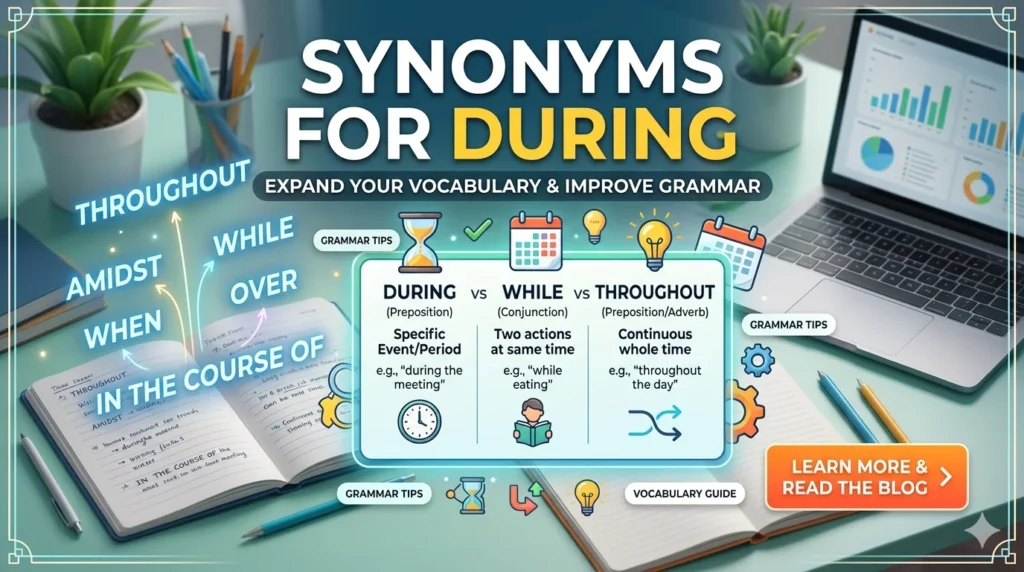
During vs While vs Throughout
| Word | Use Case | Example |
|---|---|---|
| During | Time period | I slept during class |
| While | Two actions | I studied while listening |
| Throughout | Entire duration | It rained throughout the day |
FAQs
What is another word for during?
Words like while, throughout, amid, and over can be used depending on sentence meaning.
Can I always replace during with while?
No. “While” is used for simultaneous actions, not general time periods.
What is the most formal synonym for during?
“Throughout” and “in the course of” are the most formal alternatives.
Is during a preposition?
Yes, it is a preposition of time in English grammar.
Conclusion
Learning synonyms for during is a simple but powerful way to improve your English writing. It helps you avoid repetition, build fluency, and sound more natural in essays, blogs, and conversations.
Practice these alternatives in daily writing, emails, and speaking. The more you use them, the more professional and confident your English will become.

Noah Reed delivers authoritative, high-quality synonym insights, helping readers master language with precision, clarity, and creative finesse.