
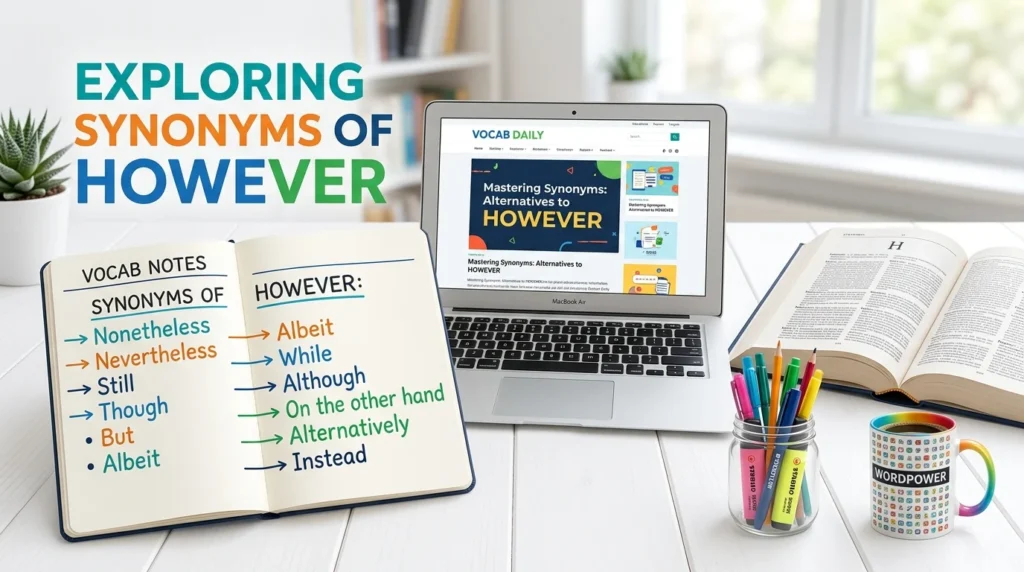
If you find yourself using “however” in almost every paragraph, you’re not alone. It’s one of the most overused transition words in English, but replacing it isn’t always as simple as choosing another word. The best synonyms for “however” include nevertheless, nonetheless, still, yet, even so, although, though, on the other hand, and in contrast, but each one works differently depending on your sentence, tone, and purpose.
While all of these words express contrast or introduce a different idea, they aren’t always interchangeable. Some are better suited to formal or academic writing, while others sound more natural in everyday conversations, emails, blogs, or creative content. Choosing the right transition word helps your ideas flow smoothly, strengthens your writing, and ensures your message is clear without sounding repetitive.
This guide brings together the most accurate and commonly used synonyms for “however,” organized by meaning, context, and writing style. You’ll also find simple definitions, real examples, and practical usage tips, so you can confidently choose the best alternative for every sentence—whether you’re writing an essay, business document, article, or professional email.
What Does “However” Mean?
However is a transition word that introduces a contrasting idea.
Example:
- I wanted to play football. However, it started raining.
In simple words, however tells readers that the next idea is different from the first one.
Common meanings include:
- But
- Yet
- Even so
- Despite that
- Nevertheless
Quick Synonyms of However Table
| Synonym | Style |
|---|---|
| Nevertheless | Formal |
| Nonetheless | Formal |
| Yet | Neutral |
| Still | Neutral |
| Though | Neutral |
| Although | Formal |
| Even So | Neutral |
| Regardless | Formal |
| Instead | Neutral |
| On the Other Hand | Neutral |
Nevertheless
Meaning:
It means despite what happened before.
Examples:
- The weather was bad. Nevertheless, we went hiking.
- She felt tired. Nevertheless, she finished her project.
Nonetheless
Meaning:
It means even so.
Examples:
- The test was difficult. Nonetheless, I passed.
- He was nervous. Nonetheless, he gave a great speech.
Yet
Meaning:
It shows a different idea after the first one.
Examples:
- The book was long, yet interesting.
- She is young, yet very talented.
Still
Meaning:
It means despite that.
Examples:
- It was expensive. Still, I bought it.
- He was late. Still, we waited for him.
Though
Meaning:
It means despite something being true.
Examples:
- I enjoyed the movie, though it was long.
- She smiled, though she was worried.
Although
Meaning:
It introduces a contrast.
Examples:
- Although it rained, we had fun.
- Although he was busy, he helped me.
Even So
Meaning:
It means despite that fact.
Examples:
- The road was crowded. Even so, we arrived on time.
- She had little practice. Even so, she performed well.
Regardless
Meaning:
It means without being affected by something.
Examples:
- The forecast predicted rain. Regardless, we traveled.
- He kept working regardless of the challenge.
Notwithstanding
Meaning:
It means despite something.
Examples:
- Notwithstanding the delay, the event was successful.
- Notwithstanding the rain, the match continued.
Conversely
Meaning:
It shows the opposite idea.
Examples:
- Some people enjoy winter. Conversely, others prefer summer.
- Cats are often independent. Conversely, dogs seek attention.
Synonyms for Made: Better Words to Fit Every Context
On the Other Hand
Meaning:
It introduces a different point of view.
Examples:
- The apartment is affordable. On the other hand, it is small.
- The car is fast. On the other hand, it uses more fuel.
In Contrast
Meaning:
It highlights a difference.
Examples:
- My office is quiet. In contrast, hers is busy.
- The first lesson was easy. In contrast, the second was harder.
By Contrast
Meaning:
It compares two different situations.
Examples:
- John enjoys sports. By contrast, Mike prefers books.
- Summer is warm. By contrast, winter is cold.
Instead
Meaning:
It means as another choice.
Examples:
- I stayed home instead.
- She ordered tea instead of coffee.
Alternatively
Meaning:
It introduces another option.
Examples:
- We can walk. Alternatively, we can take a taxi.
- Study tonight. Alternatively, finish it tomorrow.
Whereas
Meaning:
It compares two different things.
Examples:
- I prefer tea, whereas my brother likes coffee.
- She works mornings, whereas I work evenings.
While
Meaning:
It can show contrast between ideas.
Examples:
- While I enjoy reading, my friend prefers movies.
- While the task was difficult, it was rewarding.
Albeit
Meaning:
It means although.
Examples:
- The meal was delicious, albeit expensive.
- He succeeded, albeit slowly.
Even Though
Meaning:
It means despite the fact that.
Examples:
- Even though it rained, we went out.
- Even though she was tired, she studied.
But
Meaning:
It connects two opposite ideas.
Examples:
- I called him, but he did not answer.
- She wanted pizza, but the restaurant was closed.
All the Same
Meaning:
It means despite everything.
Examples:
- The weather was poor. All the same, we enjoyed the trip.
- He was warned. All the same, he continued.
Synonyms for World: Powerful Words for Earth, Life, and Reality
In Spite of That
Meaning:
It means despite that fact.
Examples:
- The exam was difficult. In spite of that, I passed.
- She was busy. In spite of that, she visited us.
Having Said That
Meaning:
It introduces a different opinion.
Examples:
- The hotel was nice. Having said that, it was expensive.
- The movie was entertaining. Having said that, it felt too long.
Even Then
Meaning:
It means despite the situation.
Examples:
- We arrived early. Even then, the seats were full.
- He practiced every day. Even then, he felt nervous.
In Any Case
Meaning:
It means whatever happens.
Examples:
- The weather may change. In any case, we will go.
- He may be late. In any case, dinner is ready.
At Any Rate
Meaning:
It means anyway.
Examples:
- We missed the bus. At any rate, we found another ride.
- The meeting ended early. At any rate, the work was finished.
Anyway
Meaning:
It means despite everything.
Examples:
- It looked difficult. Anyway, I tried.
- She was busy. Anyway, she helped me.
Despite That
Meaning:
It means even after that happened.
Examples:
- He was injured. Despite that, he played well.
- The room was noisy. Despite that, I slept.
For All That
Meaning:
It means despite everything.
Examples:
- The task was difficult. For all that, she succeeded.
- He made mistakes. For all that, he improved.
After All
Meaning:
It adds a contrasting thought or reason.
Examples:
- I decided to attend after all.
- She bought the dress after all.
On the Contrary
Meaning:
It means the opposite is true.
Examples:
- He is not lazy. On the contrary, he works very hard.
- The food was not bad. On the contrary, it was excellent.
Despite This
Meaning:
It means regardless of this fact.
Examples:
- The project was delayed. Despite this, it succeeded.
- The weather changed suddenly. Despite this, we traveled.
Mind You
Meaning:
It adds an important contrasting point.
Examples:
- The house is small. Mind you, it is very comfortable.
- He is young. Mind you, he has years of experience.
Be That as It May
Meaning:
It means despite what was said.
Examples:
- The plan is risky. Be that as it may, we will try it.
- The project is difficult. Be that as it may, it is worth doing.
Then Again
Meaning:
It introduces another possibility.
Examples:
- I may buy the laptop. Then again, I may wait.
- The idea sounds good. Then again, it could fail.
At the Same Time
Meaning:
It shows another side of a situation.
Examples:
- The job is demanding. At the same time, it is rewarding.
- The course is long. At the same time, it is useful.
Though
Meaning:
It can also be used at the end of a sentence to show contrast.
Examples:
- I liked the restaurant. It was expensive, though.
- The journey was tiring. It was fun, though.
Even So
Meaning:
It means despite what happened.
Examples:
- The team had little practice. Even so, they won.
- The road was long. Even so, we enjoyed the drive.
Admittedly
Meaning:
It means accepting that something is true before giving a different view.
Examples:
- Admittedly, the task is hard. Still, it can be done.
- Admittedly, the price is high. The quality is excellent, though.
Granted
Meaning:
It means accepting a fact before presenting another point.
Examples:
- Granted, the trip is expensive. It will be memorable.
- Granted, the work takes time. The results are worth it.
Nonetheless
Meaning:
It means despite that fact.
Examples:
- The challenge was difficult. Nonetheless, they continued.
- She had little experience. Nonetheless, she did well.
Though Even So
Meaning:
It combines contrast with a positive outcome.
Examples:
- The journey was long. Though even so, we enjoyed it.
- He felt nervous. Though even so, he spoke clearly.
In Contrast
Meaning:
It highlights a difference between ideas.
Examples:
- My room is quiet. In contrast, hers is busy.
- The first plan was simple. In contrast, the second was complex.
Contrastingly
Meaning:
It means in a different or opposite way.
Examples:
- The first team played aggressively. Contrastingly, the second team played carefully.
- The city is crowded. Contrastingly, the village is peaceful.
By Comparison
Meaning:
It shows a difference when comparing things.
Examples:
- This phone is affordable. By comparison, that one is expensive.
- The first route is short. By comparison, the second is longer.
Rather Than That
Meaning:
It introduces another idea or choice.
Examples:
- Rather than that, let’s try a different approach.
- Rather than that, we can wait until tomorrow.
In Opposition
Meaning:
It means against or opposite to something.
Examples:
- His view was in opposition to the group.
- The proposal stood in opposition to the earlier plan.
Differently
Meaning:
It means in another way.
Examples:
- She solved the puzzle differently.
- We viewed the situation differently.
Yet
Meaning:
It means despite that.
Examples:
- The task was hard, yet rewarding.
- He was tired, yet continued working.
Still
Meaning:
It means despite what happened before.
Examples:
- The weather was bad. Still, we traveled.
- She was nervous. Still, she performed well.
However vs But
Many people wonder whether they should use however or but.
Use “But” for Casual Writing
Example:
- I wanted to go outside, but it started raining.
“But” sounds natural in conversations and informal writing.
Use “However” for Formal Writing
Example:
- I wanted to go outside. However, it started raining.
“However” is common in essays, reports, articles, and professional communication.
However vs Nevertheless
Both words show contrast, but there is a small difference.
However
Used to introduce a different idea.
Example:
- The task was difficult. However, we completed it.
Nevertheless
Used to emphasize that something happened despite a problem.
Example:
- The task was difficult. Nevertheless, we completed it.
“Nevertheless” often sounds more formal and stronger than “however.”
Formal Alternatives to However
If you are writing essays, research papers, reports, or business documents, these alternatives work well:
- Nevertheless
- Nonetheless
- Notwithstanding
- Conversely
- In Contrast
- Whereas
- Albeit
- Having Said That
- Admittedly
- Granted
These words make formal writing sound more professional and varied.
Academic Synonyms of However
Students often need alternatives to “however” in academic writing.
Popular academic choices include:
- Nevertheless
- Nonetheless
- Conversely
- On the Other Hand
- In Contrast
- Whereas
- Notwithstanding
- Even So
- Granted
- Admittedly
Using these transition words helps create smoother connections between ideas.
Common Mistakes When Using However
Using It Too Often
Bad:
- However, this happened. However, that happened. However, another thing happened.
Better:
- However, this happened. Nevertheless, another issue appeared. Even so, progress continued.
Incorrect Punctuation
Wrong:
- I wanted to go however it rained.
Correct:
- I wanted to go. However, it rained.
Choosing an Overly Formal Alternative
Some words like “notwithstanding” are useful in formal writing but may sound strange in casual conversations.
Always choose a synonym that matches your audience.
Frequently Asked Questions
What is the best synonym for however?
“Nevertheless” and “nonetheless” are among the strongest and most common alternatives to however.
Is however formal or informal?
“However” is generally considered more formal than “but.”
Can I use nevertheless instead of however?
Yes. In many situations, nevertheless can replace however while adding slightly stronger emphasis.
What are academic alternatives to however?
Common academic alternatives include nevertheless, nonetheless, conversely, in contrast, and notwithstanding.
What word can replace however in an essay?
You can use nevertheless, nonetheless, conversely, on the other hand, or in contrast depending on the sentence.
Conclusion
Learning the best synonyms of however can make your writing more engaging, professional, and natural. Instead of repeating the same transition word, you can choose alternatives that fit your tone, audience, and purpose. Whether you are writing essays, blog posts, emails, reports, or everyday messages, using a variety of contrast words helps your ideas flow smoothly. Start practicing these alternatives in daily conversations and written work. The more you use them, the more confident and effective your communication will become. Expanding your vocabulary is one of the easiest ways to become a stronger writer, speaker, and communicator.

Noah Reed delivers authoritative, high-quality synonym insights, helping readers master language with precision, clarity, and creative finesse.