The tiny word “and” might be quietly weakening your writing more than you realize. Use it once, and nobody notices. Use it repeatedly, and your sentences can start sounding repetitive, predictable, and less powerful.
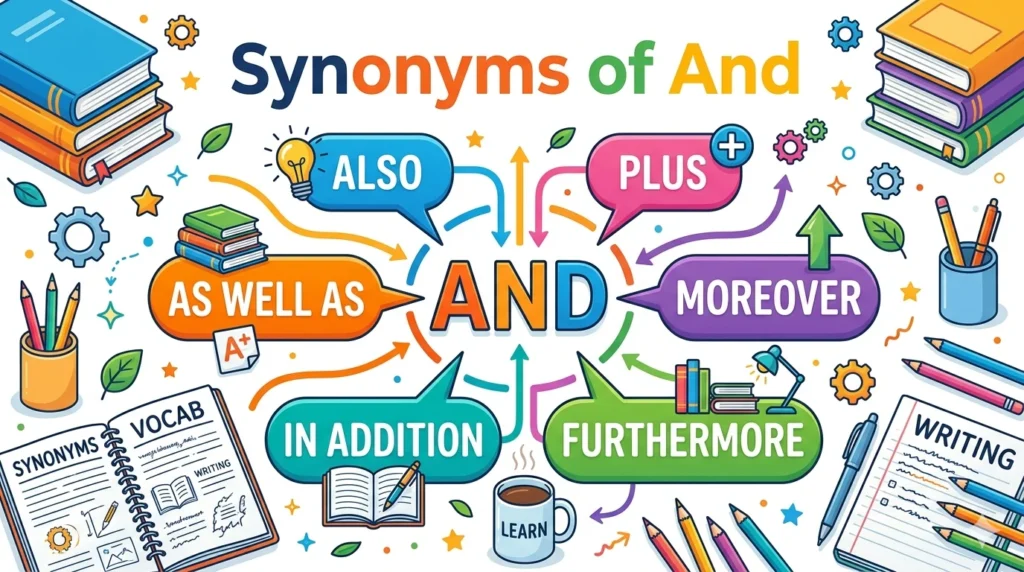
Common synonyms and alternatives for “and” include plus, also, as well as, along with, in addition to, moreover, furthermore, and additionally. The right choice depends on your sentence, writing style, and level of formality.
Here’s what many writers don’t know: there is no single perfect replacement for and. Some alternatives can make your writing sound more professional, more persuasive, or simply more natural. Choosing the right one can instantly improve sentence flow and readability.
In this guide, you’ll discover the best synonyms for and, when to use them, and examples that help you write with more variety and confidence.
What Does “And” Mean?
The word and is a conjunction. It joins two or more words, ideas, or sentences together.
Examples:
- I like tea and coffee.
- Sara and Ali are friends.
- He studied hard and passed the test.
Because “and” is used so often, learning alternatives can help make your writing smoother and more engaging.
When Should You Replace “And”?
You do not need to replace “and” every time. However, using alternatives can help when:
- You repeat “and” too many times.
- You want your writing to sound more professional.
- You are writing an essay.
- You are creating blog content.
- You are writing business emails.
- You want better sentence flow.
Formal vs Informal Alternatives to And
| Alternative | Style |
|---|---|
| Plus | Informal |
| Too | Informal |
| Also | Neutral |
| As Well As | Neutral |
| Along With | Neutral |
| In Addition | Formal |
| Moreover | Formal |
| Furthermore | Formal |
| Additionally | Formal |
| Together With | Formal |
Plus
Meaning:
Used to add another thing or idea.
Examples:
- I bought a notebook plus some pens.
- She is friendly plus hardworking.
Also
Meaning:
Used to add extra information.
Examples:
- I enjoy reading. I also like writing.
- He speaks Urdu and also English.
Too
Meaning:
Means also or in addition.
Examples:
- I want to join too.
- She loves movies too.
As Well
Meaning:
Used to add something else.
Examples:
- I would like some juice as well.
- Ahmed came to the party as well.
As Well As
Meaning:
Used to connect similar ideas.
Examples:
- She likes tea as well as coffee.
- We visited Lahore as well as Islamabad.
Along With
Meaning:
Together with something else.
Examples:
- She brought snacks along with drinks.
- I submitted photos along with the form.
Together With
Meaning:
Combined with another thing.
Examples:
- The package arrived together with a note.
- He came together with his brother.
In Addition
Meaning:
Used to add more information.
Examples:
- In addition, the service was excellent.
- In addition, we received free samples.
Additionally
Meaning:
Used when adding another point.
Examples:
- Additionally, the room was clean.
- Additionally, breakfast was included.
Moreover
Meaning:
Used to add an important point.
Examples:
- The course is affordable. Moreover, it is useful.
- She is talented. Moreover, she works hard.
Furthermore
Meaning:
Used to introduce another related idea.
Examples:
- Furthermore, the plan saves time.
- Furthermore, it is easy to follow.
Besides
Meaning:
In addition to something.
Examples:
- Besides English, I study science.
- We packed snacks besides lunch.
Including
Meaning:
Containing something as part of a group.
Examples:
- Everyone attended, including Sara.
- Many fruits were available, including mangoes.
Coupled With
Meaning:
Combined with another thing.
Examples:
- Hard work coupled with patience brings success.
- Good planning coupled with effort helps teams.
Synonyms For Research: 70+Better Words For Study And Analysis
Accompanied By
Meaning:
Happening together with something.
Examples:
- The meal was accompanied by tea.
- The singer was accompanied by musicians.
With
Meaning:
Used to show something together.
Examples:
- I ate rice with chicken.
- She arrived with her cousin.
Not Only But Also
Meaning:
Adds emphasis to two ideas.
Examples:
- She is not only smart but also kind.
- He not only studies but also teaches.
What’s More
Meaning:
Used to add another important point.
Examples:
- The hotel was clean. What’s more, it was affordable.
- The laptop is fast. What’s more, it is lightweight.
More Than That
Meaning:
Adds stronger information.
Examples:
- He is honest. More than that, he is dependable.
- The event was fun. More than that, it was inspiring.
On Top Of That
Meaning:
Used to add another benefit.
Examples:
- The food was delicious. On top of that, it was cheap.
- We finished early. On top of that, we got praise.
Added To That
Meaning:
Used when adding extra information.
Examples:
- Added to that, the weather was perfect.
- Added to that, parking was free.
In Addition To That
Meaning:
Means also or furthermore.
Examples:
- In addition to that, the process was simple.
- In addition to that, delivery was fast.
Beyond That
Meaning:
Used to add another point.
Examples:
- Beyond that, I have no questions.
- Beyond that, everything was excellent.
Another Thing Is
Meaning:
Introduces one more idea.
Examples:
- Another thing is the price is low.
- Another thing is the location is convenient.
Likewise
Meaning:
Used when something is similar or also true.
Examples:
- Sara enjoys music. Likewise, her sister does.
- The team worked hard. Likewise, the coach did.
Equally
Meaning:
Used when two things are important in the same way.
Examples:
- Both players performed equally well.
- The book is equally useful and interesting.
Similarly
Meaning:
Used to show another similar idea.
Examples:
- I enjoy swimming. Similarly, my brother does.
- The first team succeeded. Similarly, the second team did well.
Combined With
Meaning:
Joined together with something else.
Examples:
- Talent combined with effort brings success.
- Good habits combined with practice improve skills.
Synonyms for Opposite: 50 Powerful Alternatives to Improve Your English
Alongside
Meaning:
Together with another person or thing.
Examples:
- She worked alongside her team.
- The article appeared alongside the photo.
Hand In Hand With
Meaning:
Closely connected with something else.
Examples:
- Success goes hand in hand with effort.
- Learning goes hand in hand with practice.
In Conjunction With
Meaning:
Working together with something.
Examples:
- The event was organized in conjunction with local schools.
- The project was completed in conjunction with volunteers.
Side By Side With
Meaning:
Together with someone or something.
Examples:
- He worked side by side with his friend.
- The shop stands side by side with a bakery.
Not To Mention
Meaning:
Used to add extra information.
Examples:
- The hotel was comfortable, not to mention affordable.
- She is talented, not to mention hardworking.
To Boot
Meaning:
Also; in addition.
Examples:
- The phone is fast, to boot.
- He is friendly and helpful to boot.
Over And Above
Meaning:
More than expected.
Examples:
- She helped over and above her duties.
- The team delivered over and above expectations.
Over And Beyond
Meaning:
Far more than required.
Examples:
- He went over and beyond to help customers.
- The staff worked over and beyond expectations.
Added To This
Meaning:
Used to introduce another point.
Examples:
- Added to this, the service was excellent.
- Added to this, the room was spacious.
Plus The Fact That
Meaning:
Adds another reason or detail.
Examples:
- The house is large, plus the fact that it is affordable.
- The course is useful, plus the fact that it is online.
As An Added Bonus
Meaning:
Something extra is included.
Examples:
- As an added bonus, parking was free.
- As an added bonus, we received gifts.
Together
Meaning:
Joined or combined.
Examples:
- We solved the problem together.
- They walked home together.
Together With Others
Meaning:
Along with additional people.
Examples:
- He attended together with others from school.
- The project was completed together with others.
Correspondingly
Meaning:
In a matching or related way.
Examples:
- Sales increased and profits correspondingly grew.
- Demand rose and production correspondingly expanded.
By The Same Token
Meaning:
For the same reason.
Examples:
- She was tired. By the same token, she rested early.
- He studied hard. By the same token, he passed.
In The Same Way
Meaning:
In a similar manner.
Examples:
- Birds migrate. In the same way, some animals travel.
- She teaches. In the same way, her mother does.
Further
Meaning:
Used to add more information.
Examples:
- Further discussion is needed.
- Further details will follow.
Further Still
Meaning:
Used to add another strong point.
Examples:
- The product is affordable. Further still, it is durable.
- She is skilled. Further still, she learns quickly.
Another Plus
Meaning:
An additional benefit.
Examples:
- Another plus is the low cost.
- Another plus is the fast delivery.
Added Benefit
Meaning:
An extra advantage.
Examples:
- An added benefit is free support.
- The added benefit is easy setup.
Extra Advantage
Meaning:
Something good in addition.
Examples:
- The extra advantage is flexibility.
- Another extra advantage is reliability.
Bonus Point
Meaning:
An additional positive feature.
Examples:
- A bonus point is the free trial.
- Another bonus point is the simple design.
FAQ
What is another word for and?
Some common alternatives include also, plus, as well as, along with, together with, additionally, moreover, and furthermore.
What can I use instead of and in writing?
You can use in addition, also, plus, as well as, along with, or furthermore, depending on the sentence and tone.
What are formal alternatives to and?
Formal alternatives include:
- In addition
- Additionally
- Moreover
- Furthermore
- Together with
- In conjunction with
Is plus a synonym of and?
Yes, plus can replace and in many informal situations. However, it is less common in formal writing.
Can I replace and in essays?
Yes. Using alternatives such as moreover, furthermore, additionally, and in addition can make essays sound more professional.
Why should I learn synonyms of and?
Learning alternatives helps you:
- Avoid repetition
- Improve writing flow
- Sound more professional
- Create better blog content
- Strengthen communication skills
Conclusion
The word and is one of the most useful words in English, but using it too often can make writing repetitive. Learning these synonyms of and, alternatives to and, connecting words, and linking phrases can make your writing more engaging and professional.
Whether you are writing emails, blog posts, essays, assignments, or social media content, these words can help you connect ideas more smoothly. Start using a few alternatives every day, and you will quickly notice improvements in your writing, speaking, and overall communication skills.

Eli Frost is a passionate writer at SynonymLabi, specializing in words, meanings, and language insights, helping readers express ideas with clarity and creativity.