
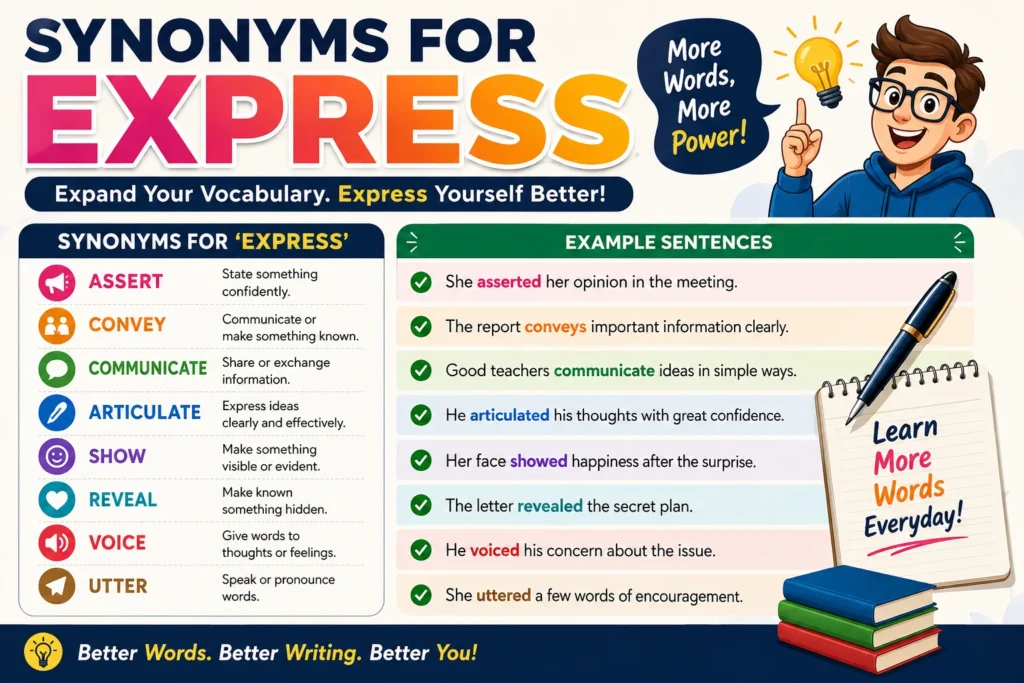
Looking for a better word for “express” but unsure which synonym fits your sentence? You’re not alone—“express” has several meanings, so the best alternative depends on what you want to communicate. It can mean communicate an idea or opinion, show a feeling, communicate something through art, or describe a fast service or form of transportation.
For example, you might convey an idea, voice an opinion, show a feeling, portray an emotion through art, or refer to express delivery as a faster service. Because these alternatives emphasize different meanings, they are not interchangeable in every situation.
Choosing the right word helps you communicate your intended meaning while keeping your sentence natural and precise. This guide explores the best synonyms for “express” by meaning, context, tone, and usage, with clear definitions and natural examples to help you choose the most appropriate alternative.
Best Synonyms for Express
Some of the most useful synonyms for express are communicate, convey, state, say, articulate, voice, describe, explain, reveal, show, declare, announce, indicate, demonstrate, disclose, affirm, assert, proclaim, mention, and share.
The best choice depends on what you mean. For example, state works well for facts and opinions, convey works well for ideas and feelings, reveal works well for hidden information or feelings, and articulate works well for clear and careful speech.
Communicate
Meaning: To communicate means to share information, ideas, or feelings with another person.
Usage: Common and useful in everyday, academic, and professional English.
Examples:
- Good writers communicate ideas clearly.
- We communicate with our customers by email.
Convey
Meaning: To convey means to communicate an idea, message, or feeling to someone.
Usage: Neutral to formal; very useful for feelings, ideas, and messages.
Examples:
- Her smile conveyed her happiness.
- The letter conveyed a clear message.
State
Meaning: To state means to say something clearly and directly.
Usage: Neutral and formal; especially useful for facts, opinions, and answers.
Examples:
- Please state your reason for applying.
- She stated her opinion during the meeting.
Say
Meaning: To say means to speak words or give information.
Usage: Very common and natural in everyday English.
Examples:
- I want to say how I feel.
- He said that the plan was ready.
Tell
Meaning: To tell means to give information to someone through words.
Usage: Very common in everyday English.
Examples:
- Please tell me what happened.
- She told her brother the good news.
Voice
Meaning: To voice means to openly express a thought, concern, or opinion.
Usage: Neutral to formal; often used with opinions and concerns.
Examples:
- Several workers voiced their concerns.
- She voiced her support for the idea.
Articulate
Meaning: To articulate means to express an idea clearly and carefully in words.
Usage: Formal or academic; useful for ideas, opinions, and arguments.
Examples:
- He articulated his ideas very well.
- She articulated the problem clearly.
Verbalize
Meaning: To verbalize means to put a thought or feeling into spoken words.
Usage: Formal; often used for thoughts and feelings.
Examples:
- He struggled to verbalize his feelings.
- She verbalized her concerns at the meeting.
Describe
Meaning: To describe means to explain what someone or something is like.
Usage: Common in everyday, academic, and professional English.
Examples:
- Can you describe the problem?
- She described her first day at school.
Explain
Meaning: To explain means to make an idea or fact easy to understand.
Usage: Very common and useful in school, work, and daily speech.
Examples:
- Can you explain your answer?
- He explained the new rule to us.
Synonyms for Lastly: 55+ Ways to Say It Naturally
Clarify
Meaning: To clarify means to make something easier to understand.
Usage: Neutral to formal; common in work and academic writing.
Examples:
- Could you clarify your question?
- The teacher clarified the main point.
Define
Meaning: To define means to give the exact meaning of a word, idea, or term.
Usage: Common in academic and educational English.
Examples:
- Can you define this word?
- The lesson defines several key terms.
Specify
Meaning: To specify means to give exact details about something.
Usage: Formal; common in instructions, forms, and professional writing.
Examples:
- Please specify your preferred date.
- The form asks you to specify your needs.
Mention
Meaning: To mention means to talk about something briefly.
Usage: Very common and natural in everyday English.
Examples:
- She mentioned your name yesterday.
- Did he mention the new schedule?
Explain
Meaning: To explain means to give details that help someone understand something.
Usage: Common and useful when expressing an idea in more detail.
Examples:
- Please explain your main idea.
- She explained why she changed her plan.
Share
Meaning: To share means to give your thoughts, feelings, or information to others.
Usage: Friendly and common in everyday English.
Examples:
- I want to share my opinion.
- He shared his feelings with his friend.
Reveal
Meaning: To reveal means to show or tell something that was hidden or unknown.
Usage: Common in writing; especially useful for information and feelings.
Examples:
- She revealed her true feelings.
- The report revealed a serious problem.
Synonyms for Evaluate: Smart Alternatives to Use
Disclose
Meaning: To disclose means to give information that was private or not known.
Usage: Formal; common in business, legal, and official writing.
Examples:
- The company disclosed the new figures.
- He refused to disclose his plans.
Uncover
Meaning: To uncover means to discover or bring hidden information to light.
Usage: Common in news, research, and investigative writing.
Examples:
- The report uncovered a major error.
- The study uncovered new facts.
Expose
Meaning: To expose means to make something hidden or wrong known.
Usage: Strong; often used for problems, mistakes, or hidden facts.
Examples:
- The article exposed the false claim.
- The investigation exposed a serious issue.
Show
Meaning: To show means to make a feeling, fact, or idea clear or visible.
Usage: Very common and simple.
Examples:
- Her face showed her surprise.
- His actions showed great courage.
Demonstrate
Meaning: To demonstrate means to show something clearly through actions, facts, or examples.
Usage: Neutral to formal; common in academic and professional English.
Examples:
- The test demonstrated the value of practice.
- She demonstrated strong leadership skills.
Display
Meaning: To display means to show a feeling, quality, or object openly.
Usage: Neutral to formal.
Examples:
- He displayed great confidence.
- The student displayed excellent manners.
Indicate
Meaning: To indicate means to show or point to something.
Usage: Formal and common in academic and professional writing.
Examples:
- The results indicate a clear change.
- His tone indicated that he was upset.
Signal
Meaning: To signal means to give a sign or message that shows something.
Usage: Common in everyday and formal English.
Examples:
- Her smile signaled that she agreed.
- The warning light signals a problem.
Reflect
Meaning: To reflect means to show a feeling, quality, or idea.
Usage: Common in descriptive and academic writing.
Examples:
- Her words reflect her kindness.
- The design reflects the company’s values.
Represent
Meaning: To represent means to show or stand for an idea, feeling, or quality.
Usage: Neutral to formal.
Examples:
- The color represents peace.
- This symbol represents hope.
Embody
Meaning: To embody means to clearly show a particular idea or quality.
Usage: Formal; often used for qualities and ideas.
Examples:
- She embodies true confidence.
- The building embodies modern design.
Manifest
Meaning: To manifest means to become clear or visible through actions or signs.
Usage: Formal; more common in academic or literary writing.
Examples:
- His happiness manifested in a wide smile.
- Her talent manifested at an early age.
Exhibit
Meaning: To exhibit means to show a particular quality, feeling, or behavior.
Usage: Formal; common in academic and professional writing.
Examples:
- The child exhibited great patience.
- The team exhibited strong discipline.
Evince
Meaning: To evince means to clearly show a feeling, quality, or attitude.
Usage: Very formal and uncommon in everyday English.
Examples:
- His actions evinced strong concern.
- The student evinced a keen interest in art.
Declare
Meaning: To declare means to say something clearly and openly.
Usage: Formal or strong; often used for public statements.
Examples:
- The leader declared his support for the plan.
- She declared that she was ready.
Announce
Meaning: To announce means to tell people about something officially or publicly.
Usage: Common in news, business, school, and daily English.
Examples:
- The school announced the exam date.
- They announced their new product today.
Proclaim
Meaning: To proclaim means to announce something publicly and strongly.
Usage: Formal, strong, or literary.
Examples:
- The speaker proclaimed his support for change.
- She proudly proclaimed her love for the city.
Assert
Meaning: To assert means to say something firmly and confidently.
Usage: Formal; common in arguments and academic writing.
Examples:
- He asserted that the claim was false.
- She asserted her right to speak.
Affirm
Meaning: To affirm means to state that something is true or to show strong support for it.
Usage: Formal; common in professional and academic contexts.
Examples:
- She affirmed her commitment to the project.
- He affirmed that the report was accurate.
Insist
Meaning: To insist means to say something firmly and keep saying that it is true or necessary.
Usage: Common in everyday and formal English.
Examples:
- She insisted that she was telling the truth.
- He insisted on helping with the work.
Confirm
Meaning: To confirm means to state that something is true, correct, or certain.
Usage: Common in emails, business, and everyday communication.
Examples:
- Please confirm your booking by Friday.
- She confirmed that the meeting was still on.
Admit
Meaning: To admit means to say that something is true, often when it is difficult to accept.
Usage: Common in everyday and formal English.
Examples:
- He admitted that he made a mistake.
- She admitted that she was nervous.
Acknowledge
Meaning: To acknowledge means to accept or openly recognize something.
Usage: Neutral to formal.
Examples:
- She acknowledged the team’s hard work.
- He acknowledged that the problem was serious.
Emphasize
Meaning: To emphasize means to give special importance to an idea or point.
Usage: Common in academic, professional, and everyday English.
Examples:
- The teacher emphasized the need for practice.
- She emphasized that time was important.
Stress
Meaning: To stress means to give special importance to something when speaking or writing.
Usage: Common and natural, especially in speech and writing.
Examples:
- He stressed the need for better planning.
- The guide stressed the importance of safety.
Assertively State
Meaning: To assertively state means to express an idea firmly and with confidence.
Usage: Useful when discussing strong opinions or positions.
Examples:
- She assertively stated her position.
- He assertively stated what he needed.
Articulate an Opinion
Meaning: To articulate an opinion means to express what you think in clear words.
Usage: Formal or academic.
Examples:
- Students should articulate their opinions clearly.
- She articulated her opinion during the debate.
Put Into Words
Meaning: To put something into words means to use language to express a thought or feeling.
Usage: Natural and conversational.
Examples:
- I cannot put my feelings into words.
- She finally put her worries into words.
Give Voice To
Meaning: To give voice to something means to openly express a thought, feeling, or concern.
Usage: Neutral to formal; often used for opinions and concerns.
Examples:
- The article gives voice to young writers.
- He gave voice to his concerns at the meeting.
Make Known
Meaning: To make something known means to tell people about it or reveal it.
Usage: Neutral and useful in formal writing.
Examples:
- The company made its plans known.
- She made her wishes known to everyone.
Communicate
Meaning: To communicate means to send or share a message, idea, or feeling.
Usage: Common in almost every type of English.
Examples:
- We need to communicate our goals clearly.
- Good teachers communicate with their students.
Formulate
Meaning: To formulate means to create and express an idea or plan carefully.
Usage: Formal and academic.
Examples:
- She formulated a clear response.
- The team formulated a new strategy.
Phrase
Meaning: To phrase means to express an idea using particular words.
Usage: Common when discussing writing and speaking.
Examples:
- How should I phrase this email?
- She phrased her answer very politely.
Word
Meaning: To word something means to choose and arrange the words used to express it.
Usage: Common in writing and professional communication.
Examples:
- Please word your message carefully.
- He worded the request in a friendly way.
Express Quickly or Directly: Fast
Meaning: Fast means moving or happening at high speed.
Usage: This is an alternative only when express means quick or speedy.
Examples:
- We took a fast train to the city.
- The fast service saved us time.
Rapid
Meaning: Rapid means happening or moving very quickly.
Usage: Formal; useful when express means fast.
Examples:
- The rapid train arrived on time.
- We saw rapid growth in online sales.
Direct
Meaning: Direct means going straight to a place without unnecessary stops or changes.
Usage: Useful when express means a direct service or route.
Examples:
- We booked a direct train to Lahore.
- Is there a direct flight to Karachi?
Speedy
Meaning: Speedy means very quick.
Usage: Informal to neutral; useful for services and actions.
Examples:
- The restaurant offers speedy service.
- We received a speedy reply.
Rapid-Service
Meaning: Rapid-service describes a service designed to be completed or delivered quickly.
Usage: Best used as a descriptive alternative rather than a direct replacement for every use of express.
Examples:
- The company offers rapid service.
- I chose the rapid-service option for my order.
How to Choose the Right Synonym for Express
The best synonym depends on the meaning of express in your sentence.
If you mean say something clearly, use state, say, tell, voice, or declare.
If you mean share an idea or message, use communicate, convey, articulate, or explain.
If you mean show a feeling, use show, reveal, display, demonstrate, or reflect.
If you mean make hidden information known, use reveal, disclose, uncover, or expose.
If you mean give a strong opinion, use assert, affirm, insist, or proclaim.
If you mean make something clear, use clarify, explain, describe, or indicate.
If express means fast or direct, use words such as fast, rapid, speedy, or direct.
Express in Different Contexts
Express an opinion:
Use state, voice, assert, share, or articulate.
Express a feeling:
Use show, convey, reveal, display, or communicate.
Express an idea:
Use communicate, explain, articulate, convey, or formulate.
Express information:
Use state, disclose, announce, reveal, or communicate.
Express yourself:
Use communicate, articulate, verbalize, share, or put into words.
Express service:
Use fast, rapid, speedy, or direct, depending on the exact meaning.
Formal Synonyms for Express
For formal writing, some strong choices include:
- articulate
- convey
- state
- assert
- affirm
- declare
- disclose
- indicate
- specify
- formulate
- acknowledge
- demonstrate
These words are especially useful in essays, reports, academic writing, business emails, and professional documents.
Easy Everyday Alternatives for Express
For simple daily English, choose:
- say
- tell
- show
- share
- mention
- explain
- communicate
- describe
- voice
- reveal
These words sound natural in conversations, messages, emails, and casual writing.
Conclusion
Learning synonyms for express gives you more choices when you write and speak. Instead of using express again and again, you can choose a word that gives the exact meaning you need. Use state for clear statements, convey for ideas and feelings, reveal for hidden information, and articulate for clear formal speech. Practice these words in emails, essays, blog posts, and daily conversations. The more you use them, the easier it becomes to choose the right word and communicate with confidence.

Eli Frost is a passionate writer at SynonymLabi, specializing in words, meanings, and language insights, helping readers express ideas with clarity and creativity.