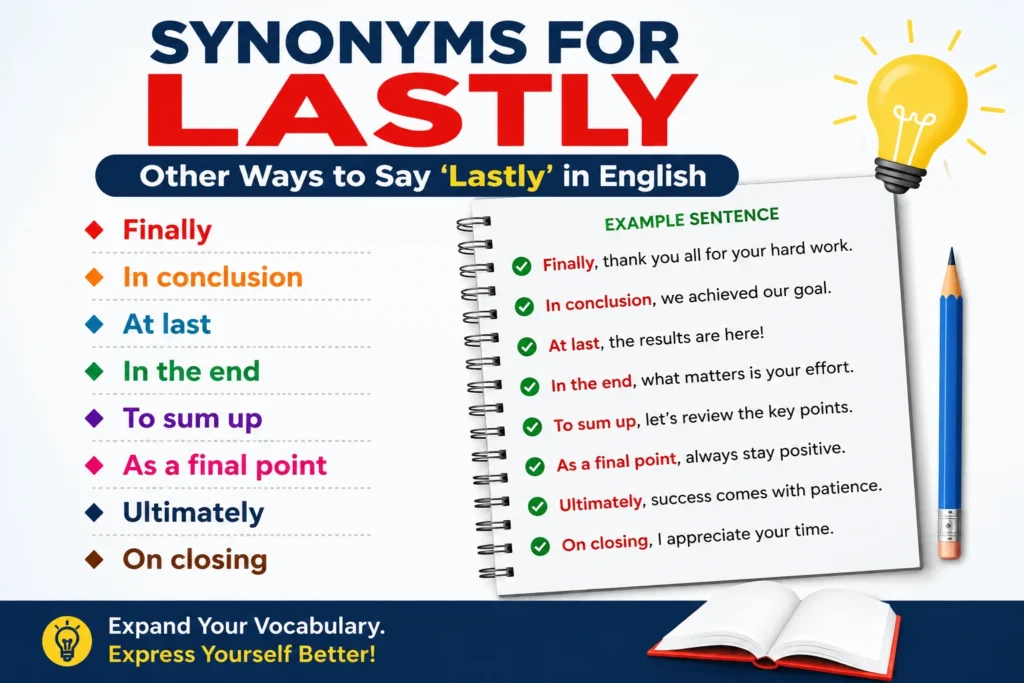
Looking for a better alternative to “lastly” but not sure which expression fits your sentence? Whether you’re writing an essay, presenting an argument, giving a speech, or introducing your final point, choosing the right transition can make your writing clearer and more natural.
“Finally” is usually the closest and most versatile alternative to “lastly,” while “as a final point” clearly signals the last idea in a discussion. More formal options include “in closing” and “to conclude,” whereas “to wrap up” is more conversational and often signals that a discussion is coming to an end.
However, expressions such as “ultimately,” “in the end,” and “at last” can convey different ideas and should not automatically replace “lastly.” This guide explores the best alternatives to lastly by meaning, context, tone, and formality, with clear explanations and natural examples to help you choose the most appropriate expression.
What Is Another Word for Lastly?
The most common synonym for lastly is finally. Other useful alternatives include last of all, in conclusion, to conclude, as a final point, and to sum up. The best choice depends on what you want to say. Some alternatives introduce a final item, while others summarize a whole discussion or show a final result.
Finally
Meaning:
Finally means you are giving the last point, action, or event in a series.
Examples:
- Finally, check your work before you leave.
- Finally, we reached the hotel.
Usage: This is the best general replacement for “lastly” in most situations.
Last
Meaning:
Last means something comes after all the other things in a list or order.
Examples:
- Last, add your name to the form.
- Last, check that all the doors are locked.
Usage: This can introduce a final point, especially in lists or instructions.
Last of All
Meaning:
Last of all means something is the final thing in a series.
Examples:
- Last of all, wash the cups.
- Last of all, tell me what you learned.
Usage: This is clear and natural in everyday English.
In Conclusion
Meaning:
In conclusion means you are giving the final thoughts about a topic.
Examples:
- In conclusion, exercise can improve your health.
- In conclusion, the plan is worth trying.
Usage: This is common in essays, reports, and formal writing.
To Conclude
Meaning:
To conclude means to introduce your final idea or statement.
Examples:
- To conclude, we need a better plan.
- To conclude, this book offers useful advice.
Usage: This is a formal choice for essays, speeches, and reports.
In Closing
Meaning:
In closing means you are giving your final words or thoughts.
Examples:
- In closing, I want to thank everyone.
- In closing, we hope you enjoyed the event.
Usage: This works well in speeches, letters, and formal messages.
To Finish
Meaning:
To finish means to introduce the final part of something.
Examples:
- To finish, let’s review today’s lesson.
- To finish, please write your name below.
Usage: This is simple and natural in speech and informal writing.
To End
Meaning:
To end means to introduce something that comes at the end.
Examples:
- To end, I want to share one final idea.
- To end the meeting, she thanked the team.
Usage: This works well when you are clearly moving toward the ending.
As a Final Point
Meaning:
As a final point means you are introducing your last important idea.
Examples:
- As a final point, we should discuss the cost.
- As a final point, remember to save your work.
Usage: This is useful in essays, presentations, and discussions.
As a Final Step
Meaning:
As a final step means something is the last action in a process.
Examples:
- As a final step, click the save button.
- As a final step, check the door before leaving.
Usage: Use this when talking about instructions or a process.
As a Final Note
Meaning:
As a final note means you are adding one last piece of information.
Examples:
- As a final note, the store closes at six.
- As a final note, please bring your ID.
Usage: This is useful in emails, articles, notices, and messages.
As a Final Thought
Meaning:
As a final thought means you are sharing one last idea.
Examples:
- As a final thought, be kind to yourself.
- As a final thought, I hope this guide helps you.
Usage: This is natural when ending an article, speech, or personal message.
As a Final Remark
Meaning:
As a final remark means you are making one last comment.
Examples:
- As a final remark, I want to thank the team.
- As a final remark, the project was a great success.
Usage: This is more formal and suits speeches and formal discussions.
One Last Thing
Meaning:
One last thing means you want to mention something before you finish.
Examples:
- One last thing, remember to call Mom.
- One last thing, please check your email.
Usage: This is friendly and common in everyday speech.
Synonyms for Evaluate: Smart Alternatives to Use
As the Last Point
Meaning:
As the last point means you are introducing the final idea in a list.
Examples:
- As the last point, we should discuss safety.
- As the last point, remember to thank your readers.
Usage: This is useful when clearly listing several ideas.
As the Last Step
Meaning:
As the last step means something is done at the end of a process.
Examples:
- As the last step, add the label.
- As the last step, review the finished file.
Usage: Use this for instructions, guides, and processes.
As the Last Item
Meaning:
As the last item means something is the final thing on a list.
Examples:
- As the last item, we need to discuss the budget.
- As the last item, add two notebooks to the order.
Usage: This is best when talking about a physical or written list.
As the Final Item
Meaning:
As the final item means something comes last in an ordered list.
Examples:
- As the final item, we discussed the new policy.
- As the final item, she added a short thank-you note.
Usage: This is clear and slightly more formal than “as the last item.”
As the Final Point
Meaning:
As the final point means you are giving the last idea in a discussion.
Examples:
- As the final point, we need to consider time.
- As the final point, let us look at the results.
Usage: This works well in formal discussions and presentations.
As the Final Part
Meaning:
As the final part means something belongs to the last section of something.
Examples:
- As the final part, we reviewed the main lesson.
- As the final part of the talk, she answered questions.
Usage: This is better for sections, talks, lessons, and larger activities.
In the Final Part
Meaning:
In the final part means something happens during the last section.
Examples:
- In the final part, the story becomes more exciting.
- In the final part of the lesson, we had a quiz.
Usage: This describes the final section rather than simply introducing a final point.
At the End
Meaning:
At the end means something happens in the final part of something.
Examples:
- At the end, everyone felt happy.
- At the end of the class, we cleaned the room.
Usage: This is a common everyday expression, but it does not always replace “lastly.”
At the Very End
Meaning:
At the very end means something happens at the exact final part.
Examples:
- At the very end, the lights came on.
- At the very end of the story, the truth was revealed.
Usage: Use this when you want to stress the exact ending.
In the End
Meaning:
In the end means the final result after everything has happened.
Examples:
- In the end, we chose the smaller house.
- In the end, her hard work paid off.
Usage: This is related to “lastly,” but it usually talks about a final result, not a final list item.
Synonyms for Evaluate: Smart Alternatives to Use
Toward the End
Meaning:
Toward the end means something happens when something is getting close to finishing.
Examples:
- Toward the end, the crowd became quiet.
- Toward the end of the movie, the mystery was solved.
Usage: This means near the ending, so it is not a direct replacement for “lastly.”
Near the End
Meaning:
Near the end means something happens close to the final part.
Examples:
- Near the end, the speaker answered questions.
- Near the end of the book, the main problem was solved.
Usage: Use this when something happens shortly before the end.
At the Close
Meaning:
At the close means something happens when an event, period, or discussion ends.
Examples:
- At the close, the speaker thanked the audience.
- At the close of the meeting, we made a decision.
Usage: This is more formal and is common in formal events and writing.
In Summary
Meaning:
In summary means you are giving the main points in a short final form.
Examples:
- In summary, the plan is simple and useful.
- In summary, good habits can save time.
Usage: This is excellent for essays, reports, articles, and presentations.
To Sum Up
Meaning:
To sum up means to give the main ideas again in a short way.
Examples:
- To sum up, practice will make you better.
- To sum up, we need more time.
Usage: This is natural in both speech and writing.
In Short
Meaning:
In short means you are giving the main idea in a brief way.
Examples:
- In short, we need a new plan.
- In short, the answer is yes.
Usage: This is useful when you want a short final statement.
In Brief
Meaning:
In brief means you are saying something in a short and simple way.
Examples:
- In brief, the meeting went well.
- In brief, the rule keeps everyone safe.
Usage: This is slightly more formal than “in short.”
In Sum
Meaning:
In sum means you are giving the main points in a short final statement.
Examples:
- In sum, the project was successful.
- In sum, we need better communication.
Usage: This is a concise and formal choice for summaries.
Overall
Meaning:
Overall means considering all the main parts together.
Examples:
- Overall, the results were positive.
- Overall, I enjoyed the course.
Usage: This is useful for giving a final general view, not for introducing the last list item.
All in All
Meaning:
All in all means after considering everything, this is the final general opinion.
Examples:
- All in all, the trip was wonderful.
- All in all, the event went well.
Usage: This is common in everyday English and informal writing.
On the Whole
Meaning:
On the whole means considering everything together.
Examples:
- On the whole, the book was easy to read.
- On the whole, the team did a good job.
Usage: This gives an overall view rather than simply marking the final point.
Ultimately
Meaning:
Ultimately means after everything is considered, this is the final result.
Examples:
- Ultimately, the choice is yours.
- Ultimately, teamwork made the project successful.
Usage: This is not a direct synonym for “lastly”; use it when discussing a final result or outcome.
In the Final Analysis
Meaning:
In the final analysis means after carefully considering all the important facts.
Examples:
- In the final analysis, the idea was worth trying.
- In the final analysis, good planning made the difference.
Usage: This is formal and focuses on a final judgment or result.
When All Is Said and Done
Meaning:
When all is said and done means after everything has happened or been considered.
Examples:
- When all is said and done, family matters most.
- When all is said and done, we made the right choice.
Usage: This is a common phrase for a final opinion or result, not a direct replacement for “lastly.”
To Wrap Up
Meaning:
To wrap up means to finish a discussion, task, or activity.
Examples:
- To wrap up, let’s review the main points.
- To wrap up the meeting, she shared the final plan.
Usage: This is friendly and common in meetings, talks, and casual writing.
To Bring It to a Close
Meaning:
To bring it to a close means to finish something.
Examples:
- To bring it to a close, let’s thank our guests.
- To bring the meeting to a close, the chair gave a short speech.
Usage: This is useful in formal speeches, meetings, and events.
To Round Off
Meaning:
To round off means to finish something in a suitable or pleasant way.
Examples:
- To round off the lesson, we played a short game.
- To round off the evening, we had some tea.
Usage: This is useful when describing a pleasant final activity.
To Finish Up
Meaning:
To finish up means to complete the last part of something.
Examples:
- To finish up, please check your answers.
- We need five minutes to finish up the meeting.
Usage: This is informal and natural in everyday English.
To Cap It All
Meaning:
To cap it all means to add one final thing that completes a series of events.
Examples:
- To cap it all, we won a free meal.
- To cap it all, the weather became sunny.
Usage: This often introduces a final and sometimes surprising event, so it is not a direct replacement in formal writing.
As We Finish
Meaning:
As we finish means something happens while we are reaching the end.
Examples:
- As we finish, let’s review today’s lesson.
- As we finish the project, check every detail.
Usage: This works best when talking about an activity that is ending.
Before We Finish
Meaning:
Before we finish means something happens just before the end.
Examples:
- Before we finish, does anyone have a question?
- Before we finish, please check your notes.
Usage: This introduces something that happens before the final moment, not necessarily the final point itself.
Before We Close
Meaning:
Before we close means something is said or done just before finishing.
Examples:
- Before we close, let’s check the final report.
- Before we close the meeting, I have one question.
Usage: This is useful for meetings, speeches, and formal discussions.
As We Come to the End
Meaning:
As we come to the end means something happens while we are reaching the final part.
Examples:
- As we come to the end, let’s review the main points.
- As we come to the end of the year, we can look back.
Usage: This is a contextual alternative rather than a direct synonym for “lastly.”
Last but Not Least
Meaning:
Last but not least means the final person or point is still important.
Examples:
- Last but not least, thank you to our wonderful team.
- Last but not least, remember to enjoy the journey.
Usage: This is useful when introducing a final item that deserves special attention.
At Last
Meaning:
At last means something happens after a long wait or after many delays.
Examples:
- At last, the bus arrived.
- At last, she found her missing phone.
Usage: “At last” is related to the idea of being last, but it usually shows relief after waiting, so it is not a direct replacement for “lastly.”
The Final Point
Meaning:
The final point means the last idea in a discussion or list.
Examples:
- The final point is about customer service.
- We saved the final point for the end of the meeting.
Usage: This is a useful phrase when you are naming the last idea rather than using “lastly” as a linking word.
How to Choose the Right Synonym for Lastly
Not every alternative to lastly works in every sentence. The best word depends on your meaning.
| Alternative | Best Use | Tone |
|---|---|---|
| Finally | Final point or action | General |
| Last | Final item in a list | General |
| Last of all | Final item | General |
| In conclusion | Final thoughts | Formal |
| To conclude | Final statement | Formal |
| In closing | Final words | Formal |
| One last thing | Final extra point | Casual |
| To sum up | Short summary | General |
| In brief | Short summary | Formal |
| To wrap up | Finish a discussion | Casual |
| Ultimately | Final result | Formal/neutral |
| In the end | Final outcome | General |
| Overall | General final view | Neutral |
| Last but not least | Final important point | General |
The key point is simple: “finally” is usually the closest direct replacement for “lastly.” Words such as “ultimately,” “overall,” “in the end,” and “at last” can be useful, but their meanings are slightly different.
Lastly vs. Finally
Lastly and finally are often interchangeable when you are introducing the final point in a list.
- Lastly, check your work.
- Finally, check your work.
Both are correct.
However, finally is more flexible. It can also describe the final event in a story or process.
Lastly is especially common when listing points:
Firstly, discuss the problem. Secondly, explain the cause. Lastly, give a solution.
For most general writing, finally is the safest alternative to lastly.
Formal Synonyms for Lastly
For essays, reports, academic writing, and professional documents, these choices are especially useful:
- In conclusion
- To conclude
- In closing
- As a final point
- As a final note
- In summary
- To sum up
- In brief
- In sum
- In the final analysis
Choose the phrase based on its meaning. For example, “in conclusion” introduces a conclusion, while “as a final point” introduces the last point in a list.
Casual Alternatives to Lastly
For conversations, chats, and friendly messages, natural choices include:
- Finally
- Last
- Last of all
- One last thing
- To finish
- To wrap up
- To finish up
- All in all
These options usually sound more natural than very formal phrases.
Synonyms for Lastly in an Essay
When writing an essay, avoid repeating “lastly” in every paragraph. Depending on your sentence, you can use:
- Finally
- As a final point
- In conclusion
- To conclude
- In summary
- To sum up
- In brief
- In closing
For a list of arguments, “finally” or “as a final point” is usually best. For the ending of the whole essay, “in conclusion” or “to conclude” may work better.
Synonyms for Lastly in an Email
In professional emails, the best choice depends on what you are doing.
Use “finally” for the last item in a list.
Use “as a final note” for one last piece of information.
Use “one last thing” in a friendly email.
Use “in closing” when ending a formal message.
Avoid using a complex phrase when a simple word such as “finally” is clearer.
Common Mistakes When Using Synonyms for Lastly
One common mistake is treating every related phrase as an exact synonym. Words can have similar meanings but different uses.
For example, “at last” usually shows that someone waited a long time:
At last, the train arrived.
“Ultimately” usually shows a final result:
Ultimately, the decision was successful.
“In conclusion” introduces final thoughts:
In conclusion, the plan needs more work.
So, do not replace “lastly” with any word simply because it sounds like an ending. Always check the meaning and context first.
Conclusion
Learning synonyms for lastly gives you more ways to express your ideas clearly. It can improve your writing, blogging, speaking, and everyday communication. Students can use these alternatives in essays, while bloggers and content writers can use them to make articles smoother and less repetitive. Daily English users can use them in emails, messages, meetings, and conversations. Start with simple choices such as finally, last of all, in conclusion, and to sum up. Then practice using them in your own sentences until they feel natural.

Evan Blake creates powerful, research-backed synonym resources, guiding readers to communicate smarter, clearer, and more effectively every day.