
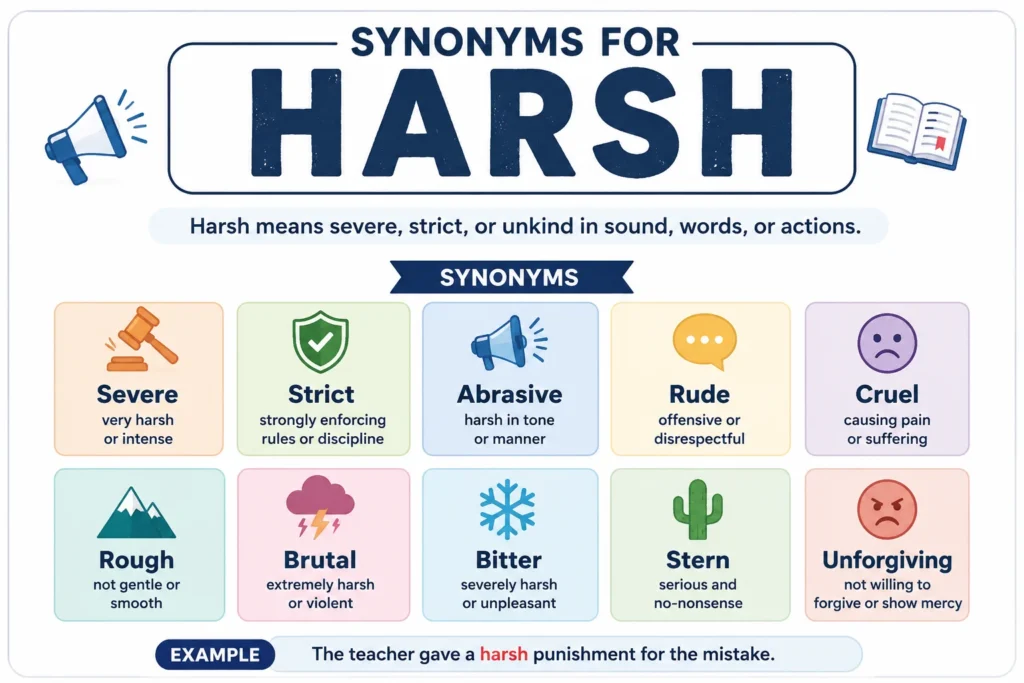
Looking for another word for “harsh” but not sure which one fits your sentence? The best alternative depends on what “harsh” describes. You might use severe for serious conditions, punishment, or criticism; stern for a strict person or manner; cruel when someone causes suffering or shows a lack of compassion; blunt for words that are direct and potentially insensitive; or scathing for extremely severe criticism.
In other contexts, abrasive can describe an unpleasant manner, grating an unpleasant sound, and glaring or stark a type of overly strong light. These words overlap with “harsh,” but they can differ significantly in meaning, intensity, tone, and context.
A word that works perfectly for harsh criticism may sound wrong when describing harsh weather or harsh lighting. That’s why the best synonym isn’t simply the closest word in a thesaurus—it’s the word that preserves the exact meaning and tone you want. Below, the alternatives are organized by context, with clear meanings, example sentences, formal and informal choices, and notes on when each synonym works best.
Severe
Meaning: Severe means very serious, strong, or extreme, and it is often used for weather, pain, punishment, or problems.
Examples:
- The town suffered severe damage after the storm.
- She received severe criticism for the mistake.
Stern
Meaning: Stern means very strict and serious, especially when describing a person, voice, look, or warning.
Examples:
- The teacher gave me a stern warning.
- His stern voice made the children stop talking.
Strict
Meaning: Strict means making people follow rules closely without giving much freedom.
Examples:
- Our school has strict rules about uniforms.
- My parents were strict about my bedtime.
Rough
Meaning: Rough means not gentle, smooth, or easy, and it can describe weather, treatment, surfaces, or experiences.
Examples:
- We had a rough journey through the mountains.
- The boat moved through rough water.
Cruel
Meaning: Cruel means causing pain or showing no kindness toward another person or living thing.
Examples:
- It was cruel to laugh at his mistake.
- The cruel comment made her cry.
Unkind
Meaning: Unkind means not caring, friendly, or gentle toward someone.
Examples:
- That was an unkind thing to say.
- He apologized for his unkind words.
Brutal
Meaning: Brutal means extremely rough, violent, or unpleasant, especially when something causes great harm or difficulty.
Examples:
- The team suffered a brutal defeat.
- The summer heat was brutal this year.
Tough
Meaning: Tough means difficult, demanding, or hard to deal with.
Examples:
- She had a tough day at work.
- The students faced a tough exam.
Intense
Meaning: Intense means very strong or powerful, especially when describing feelings, heat, pressure, or experiences.
Examples:
- The intense heat kept everyone indoors.
- He felt intense pressure before the interview.
Synonyms for Pursue:64+Better Words for Every Meaning
Forceful
Meaning: Forceful means very strong and powerful, especially when describing speech, actions, or opinions.
Examples:
- She gave a forceful answer to the question.
- His forceful speech changed many people’s minds.
Abrasive
Meaning: Abrasive means rough or unpleasant in the way a person speaks or behaves.
Examples:
- His abrasive manner upset his coworkers.
- She sounded abrasive during the meeting.
Blunt
Meaning: Blunt means very direct and honest without trying to make words softer or gentler.
Examples:
- She was blunt about my writing.
- His blunt answer surprised everyone.
Cutting
Meaning: Cutting means very sharp and hurtful when describing someone’s words or remarks.
Examples:
- Her cutting remark ended the conversation.
- He made a cutting comment about my clothes.
Sharp
Meaning: Sharp can describe words, tones, or replies that sound sudden, strong, or unfriendly.
Examples:
- The manager gave him a sharp reply.
- Her sharp tone made me feel uncomfortable.
Hostile
Meaning: Hostile means openly unfriendly, angry, or aggressive toward someone.
Examples:
- The customer became hostile after the delay.
- The group received a hostile response.
Unfriendly
Meaning: Unfriendly means not warm, kind, welcoming, or pleasant toward others.
Examples:
- The new neighbor seemed unfriendly.
- His unfriendly attitude made guests uncomfortable.
Unpleasant
Meaning: Unpleasant means not nice, comfortable, enjoyable, or pleasant to experience.
Examples:
- We had an unpleasant conversation yesterday.
- The smell made the room unpleasant.
Oppressive
Meaning: Oppressive means very heavy, difficult, or uncomfortable, especially when describing heat, conditions, or control.
Examples:
- The oppressive heat made it hard to work outside.
- The workers lived under oppressive conditions.
Punishing
Meaning: Punishing means extremely difficult, tiring, or demanding to experience.
Examples:
- The long hike was punishing.
- The athletes completed a punishing workout.
Rigorous
Meaning: Rigorous means very strict, careful, and demanding, especially for rules, training, testing, or study.
Examples:
- The students followed a rigorous study plan.
- The job requires rigorous training.
Demanding
Meaning: Demanding means requiring a lot of effort, time, skill, or attention.
Examples:
- Caring for a baby can be demanding.
- She has a demanding job.
Unforgiving
Meaning: Unforgiving means allowing little room for mistakes, weakness, or failure.
Examples:
- The rocky trail was unforgiving.
- The tight deadline was unforgiving.
Merciless
Meaning: Merciless means showing no pity, kindness, or willingness to forgive.
Examples:
- The army launched a merciless attack.
- The merciless heat made the workers exhausted.
Relentless
Meaning: Relentless means continuing strongly without stopping or becoming weaker.
Examples:
- The relentless rain flooded several streets.
- She faced relentless pressure at work.
Ruthless
Meaning: Ruthless means having no pity when trying to win, succeed, or reach a goal.
Examples:
- The ruthless businessman removed every rival.
- Her ruthless strategy helped her win the competition.
Fierce
Meaning: Fierce means very strong, powerful, or intense, especially when describing conflict, weather, or competition.
Examples:
- The two teams had a fierce battle.
- Fierce winds shook the windows.
Ferocious
Meaning: Ferocious means extremely fierce, violent, or powerful.
Examples:
- The animal looked ferocious behind the fence.
- A ferocious storm hit the coast.
untamed
Meaning: untamed means extremely violent, cruel, or rough.
Examples:
- The animal made a untamed attack.
- The writer received untamed criticism online.
Vicious
Meaning: Vicious means cruel, violent, or deliberately hurtful.
Examples:
- The dogs became involved in a vicious fight.
- He made a vicious attack on her character.
Harrowing
Meaning: Harrowing means extremely frightening, painful, or upsetting to experience.
Examples:
- She described her harrowing journey home.
- The rescue team faced a harrowing experience.
Distressing
Meaning: Distressing means causing strong worry, sadness, fear, or emotional pain.
Examples:
- The news was distressing for the family.
- He received a distressing message that morning.
Synonyms for Pursue:64+Better Words for Every Meaning
Painful
Meaning: Painful means causing physical or emotional pain or making an experience difficult to accept.
Examples:
- It was a painful lesson for the young player.
- She had a painful conversation with her friend.
Hurtful
Meaning: Hurtful means causing emotional pain through words or actions.
Examples:
- His hurtful words stayed with me all day.
- She apologized for her hurtful comment.
Insensitive
Meaning: Insensitive means not thinking about or caring enough about another person’s feelings.
Examples:
- His insensitive joke upset the guests.
- That question was insensitive and unnecessary.
Callous
Meaning: Callous means showing very little care about another person’s pain or feelings.
Examples:
- The manager seemed callous about the workers’ problems.
- Her callous response shocked her friends.
Stringent
Meaning: Stringent means very strict and carefully controlled, especially when describing rules, standards, or requirements.
Examples:
- The laboratory has stringent safety rules.
- Applicants must meet stringent requirements.
Exacting
Meaning: Exacting means demanding very high standards and requiring great care or effort.
Examples:
- The editor has exacting standards.
- The training program is exacting but rewarding.
Austere
Meaning: Austere means very plain, strict, or lacking comfort, especially when describing a lifestyle or place.
Examples:
- The room had an austere design.
- He lived an austere life in the countryside.
Draconian
Meaning: Draconian means extremely strict or severe, especially when describing laws, rules, or punishments.
Examples:
- The school introduced draconian rules after the incident.
- Many people opposed the draconian punishment.
Grim
Meaning: Grim means serious, gloomy, or worrying, especially when a situation looks bad.
Examples:
- The doctor gave us a grim warning.
- The team faced a grim situation after the loss.
Dire
Meaning: Dire means extremely serious, urgent, or dangerous and is often used for difficult situations.
Examples:
- The village was in dire need of clean water.
- The company faced dire financial problems.
Rigid
Meaning: Rigid means very strict and unwilling to change, especially when describing rules, systems, or plans.
Examples:
- The office follows a rigid schedule.
- His rigid approach caused problems for the team.
Inflexible
Meaning: Inflexible means unwilling to change a rule, plan, or opinion.
Examples:
- The manager was inflexible about working hours.
- Her inflexible attitude made teamwork difficult.
Intolerant
Meaning: Intolerant means unwilling to accept people, ideas, or behavior that are different.
Examples:
- His intolerant attitude hurt the group.
- The teacher spoke against intolerant behavior.
Repressive
Meaning: Repressive means using strict control to limit people’s freedom or choices.
Examples:
- The people lived under a repressive system.
- Repressive rules limited freedom of speech.
Punitive
Meaning: Punitive means intended to punish someone for doing something wrong.
Examples:
- The school took punitive action after the fight.
- The company introduced punitive measures for repeated violations.
Scathing
Meaning: Scathing means extremely critical and harsh, especially when describing comments, reviews, or criticism.
Examples:
- The newspaper published a scathing review of the movie.
- She gave a scathing reply to the unfair accusation.
Caustic
Meaning: Caustic means sharply critical or hurtful, especially when describing someone’s words or humor.
Examples:
- He made a caustic remark about the new policy.
- Her caustic humor made some guests uncomfortable.
Acerbic
Meaning: Acerbic means sharp, bitter, and often harsh in speech or writing.
Examples:
- The critic wrote an acerbic review of the film.
- His acerbic comments upset the team.
Extreme
Meaning: Extreme means far beyond what is normal or usual and can describe very strong conditions or behavior.
Examples:
- The hikers faced extreme weather conditions.
- The punishment seemed extreme for such a small mistake.
How to Choose the Right Synonym for Harsh
Not every synonym for harsh works in every sentence. The best choice depends on what you are describing.
For harsh criticism, words such as scathing, caustic, acerbic, cutting, blunt, and severe often work well.
For a harsh person or attitude, stern, cruel, callous, ruthless, insensitive, and unfriendly may be better choices.
For harsh weather or conditions, try severe, rough, intense, brutal, fierce, oppressive, or extreme.
For harsh rules or punishment, words such as strict, stringent, rigorous, rigid, draconian, and punitive can fit well.
For harsh experiences, consider tough, painful, distressing, harrowing, punishing, or unforgiving.
Choosing the right word makes your meaning clearer and helps your writing sound more natural.
Another Word for Harsh
Another word for harsh depends on the context. Severe is a strong general choice for serious conditions or criticism. Stern works well for people, voices, and warnings. Cruel focuses on a lack of kindness. Rough fits difficult conditions or experiences. Blunt is useful for direct speech, while scathing is especially useful for very strong criticism.
Synonyms for Harsh Criticism
If you want another way to say harsh criticism, you can use phrases such as severe criticism, scathing criticism, cutting criticism, brutal criticism, or caustic criticism.
The best choice depends on the tone. Scathing suggests very strong negative criticism. Caustic suggests sharp and hurtful words. Blunt suggests direct speech without softening the message.
Synonyms for Harsh Weather
For harsh weather, useful alternatives include severe, extreme, brutal, fierce, rough, and unforgiving.
For example, “harsh weather” can become “severe weather” when talking about dangerous conditions. “Fierce winds” highlights strong wind, while “extreme weather” emphasizes conditions far outside the normal range.
Synonyms for Harsh Treatment
When describing harsh treatment, words such as cruel, severe, brutal, rough, merciless, and punishing can be useful.
Choose cruel when the main idea is a lack of kindness. Choose brutal when the treatment is extremely rough or violent. Choose severe when the treatment is very serious or strict.
Synonyms for Harsh Words
If someone uses harsh words, you can describe those words as hurtful, cutting, sharp, blunt, caustic, acerbic, or scathing.
These words are not always interchangeable. Hurtful focuses on emotional pain, while blunt focuses on directness. Cutting and scathing suggest especially sharp criticism.
Opposite of Harsh
The opposite of harsh can be gentle, kind, mild, soft, pleasant, or compassionate, depending on the context.
For example, the opposite of harsh weather can be mild weather. The opposite of harsh words can be kind or gentle words. The opposite of harsh treatment can be compassionate or caring treatment.
Conclusion
Learning synonyms for harsh gives you more control over your English. Instead of repeating one word, you can choose severe for serious conditions, stern for strict behavior, cruel for unkind treatment, or scathing for strong criticism. This improves writing, blogging, speaking, and everyday communication. Practice these words in emails, essays, blog posts, and daily conversations. The more you use the right synonym in the right context, the clearer and more natural your English will become.

Leo Grant is a language strategist at SynonymLabi, providing meticulously crafted synonym content that sharpens vocabulary and elevates expression.