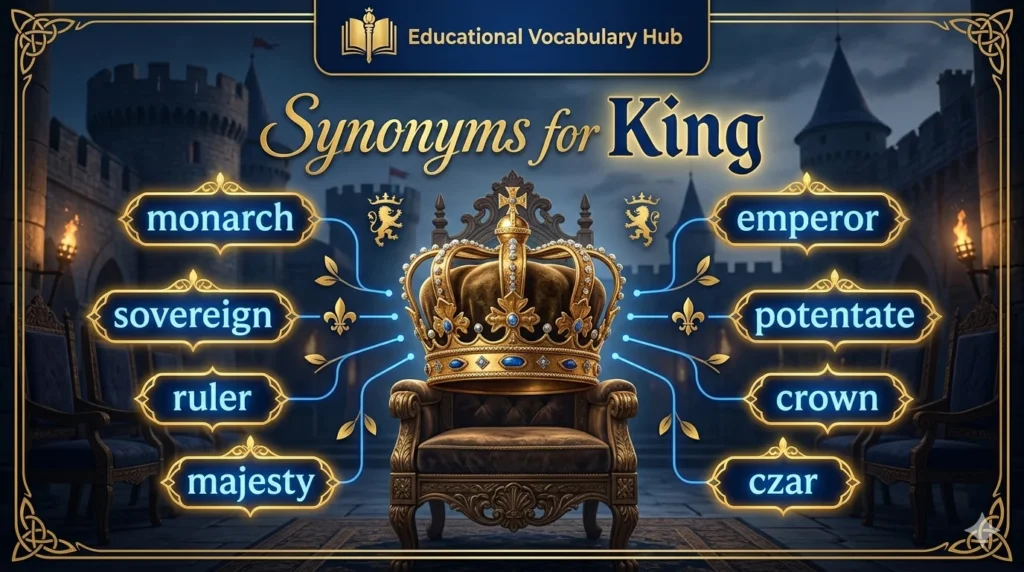
Whether you’re writing a fantasy novel, a history essay, a speech, or simply looking for a stronger alternative to “king,” choosing the right title can make all the difference. While many words have similar meanings, not every royal title carries the same level of authority, history, or tone. The best synonyms for “king” include monarch, sovereign, ruler, emperor, crowned head, lord, prince, and leader, but the most accurate choice depends on your context and the impression you want to create.
For example, “monarch” is a broad term for a royal ruler, “sovereign” emphasizes supreme authority, “emperor” often represents a higher rank in many historical empires, while “leader” works best in figurative or modern expressions. In creative writing, historical content, and even everyday communication, selecting the right title can shape how powerful, respected, or authentic a character or person appears.
This guide helps you choose the most accurate synonyms for “king” by organizing them according to meaning, tone, historical significance, and real-world usage. You’ll also find clear definitions, practical examples, and writing tips so you can confidently select the perfect alternative for essays, novels, fantasy stories, business writing, or everyday conversations—ensuring every sentence conveys exactly the authority and meaning you intend.
Monarch
Meaning:
A monarch is a ruler of a country or kingdom.
Examples:
The monarch greeted the people.
The monarch ruled with fairness.
Ruler
Meaning:
A ruler is someone who controls a land or nation.
Examples:
The ruler made new laws.
People respected their ruler.
Sovereign
Meaning:
A sovereign is a supreme independent leader.
Examples:
The sovereign signed the treaty.
The sovereign addressed the nation.
Emperor
Meaning:
An emperor is a ruler of a large empire.
Examples:
The emperor expanded his empire.
The emperor lived in a grand palace.
Empress
Meaning:
An empress is a female ruler of an empire.
Examples:
The empress guided her people.
The empress held a royal court.
Sultan
Meaning:
A sultan is a Muslim ruler of a kingdom.
Examples:
The sultan welcomed guests.
The sultan ruled wisely.
Caliph
Meaning:
A caliph is a religious and political Muslim leader.
Examples:
The caliph made important decisions.
The caliph led his community.
Tsar
Meaning:
A tsar is a Russian emperor.
Examples:
The tsar ruled Russia.
The tsar met his advisors.
Czar
Meaning:
Another spelling of tsar.
Examples:
The czar signed new laws.
The czar addressed soldiers.
Pharaoh
Meaning:
An ancient Egyptian king.
Examples:
The pharaoh built pyramids.
The pharaoh ruled Egypt.
Khan
Meaning:
A Central Asian tribal ruler.
Examples:
The khan led his army.
The khan expanded his land.
Warlord
Meaning:
A military leader who controls land by force.
Examples:
The warlord controlled the region.
The warlord led soldiers.
Chieftain
Meaning:
The leader of a tribe.
Examples:
The chieftain made decisions.
The chieftain welcomed guests.
High King
Meaning:
A king above other kings.
Examples:
The high king united tribes.
People followed the high king.
Suzerain
Meaning:
A ruler who controls other states.
Examples:
The suzerain demanded loyalty.
The suzerain ruled regions.
Autocrat
Meaning:
A ruler with complete power.
Examples:
The autocrat made strict rules.
The autocrat controlled the state.
Despot
Meaning:
A harsh and unfair ruler.
Examples:
The despot ruled with fear.
People suffered under the despot.
Tyrant
Meaning:
A cruel and oppressive ruler.
Examples:
The tyrant lost support.
The tyrant punished people.
Overlord
Meaning:
A powerful ruler over others.
Examples:
The overlord controlled lands.
The overlord gave orders.
Potentate
Meaning:
A very powerful ruler.
Examples:
The potentate met leaders.
The potentate ruled vast lands.
Liege
Meaning:
A feudal lord or master.
Examples:
The liege protected his land.
The liege gave orders.
Lord
Meaning:
A nobleman with authority.
Examples:
The lord owned land.
The lord met villagers.
Noble
Meaning:
A person from a high social class.
Examples:
The noble attended the banquet.
The noble helped people.
Aristocrat
Meaning:
A member of a wealthy ruling class.
Examples:
The aristocrat lived in luxury.
The aristocrat attended court.
Feudal Lord
Meaning:
A landowner in the feudal system.
Examples:
The feudal lord collected taxes.
The feudal lord ruled land.
Head of State
Meaning:
The top leader of a country.
Examples:
The head of state spoke publicly.
The head of state visited schools.
Supreme Ruler
Meaning:
The highest authority in a land.
Examples:
The supreme ruler made final decisions.
The supreme ruler led the nation.
Kingdom Ruler
Meaning:
A person who rules a kingdom.
Examples:
The kingdom ruler visited towns.
The kingdom ruler made laws.
Realm Ruler
Meaning:
A ruler of a kingdom or realm.
Examples:
The realm ruler protected land.
The realm ruler led people.
60+Synonyms for Identity: Powerful Words to Define Identity
Crowned Head
Meaning:
A king or queen wearing a crown.
Examples:
The crowned head appeared in public.
People welcomed the crowned head.
Majesty
Meaning:
A respectful title for a king.
Examples:
His Majesty arrived.
Everyone greeted Majesty.
Imperial Ruler
Meaning:
A ruler of an empire.
Examples:
The imperial ruler expanded territory.
The imperial ruler gave orders.
Dynast
Meaning:
A ruler from a royal family line.
Examples:
The dynast continued his rule.
The dynast strengthened power.
Hereditary Ruler
Meaning:
A ruler who inherits power.
Examples:
The hereditary ruler took the throne.
The hereditary ruler followed tradition.
70+Synonyms for True: Powerful Words to Express Truth and Accuracy
Absolute Ruler
Meaning:
A ruler with total control.
Examples:
The absolute ruler passed laws.
The absolute ruler ruled alone.
Traditional Ruler
Meaning:
A leader who follows customs.
Examples:
The traditional ruler respected culture.
The traditional ruler met elders.
Ceremonial Monarch
Meaning:
A symbolic king with limited power.
Examples:
The ceremonial monarch attended events.
The ceremonial monarch gave speeches.
Conclusion
Learning synonyms for king improves your writing, speaking, and vocabulary skills. It helps you avoid repetition and express ideas in a more powerful and creative way. Whether you are writing essays, blogs, or stories, these words will make your English more professional and engaging. Practice using them daily in real sentences to build strong communication skills.

Evan Blake creates powerful, research-backed synonym resources, guiding readers to communicate smarter, clearer, and more effectively every day.