
“Pick a random number.”
So you choose one… but was it really random, or just the first one that felt right?
That’s the funny thing about the word random—we use it all the time for choices, people, ideas, and events, even when we’re not fully sure what it actually means. And when you’re writing, repeating it again and again can make your sentences feel unclear or too casual.
In simple terms, “random” means something that happens without a clear plan, pattern, or reason. For example: a “random choice” could be selecting a number with no rule, a “random person” could mean someone unknown or unrelated, and a “random event” might be something unexpected that just happens by chance.
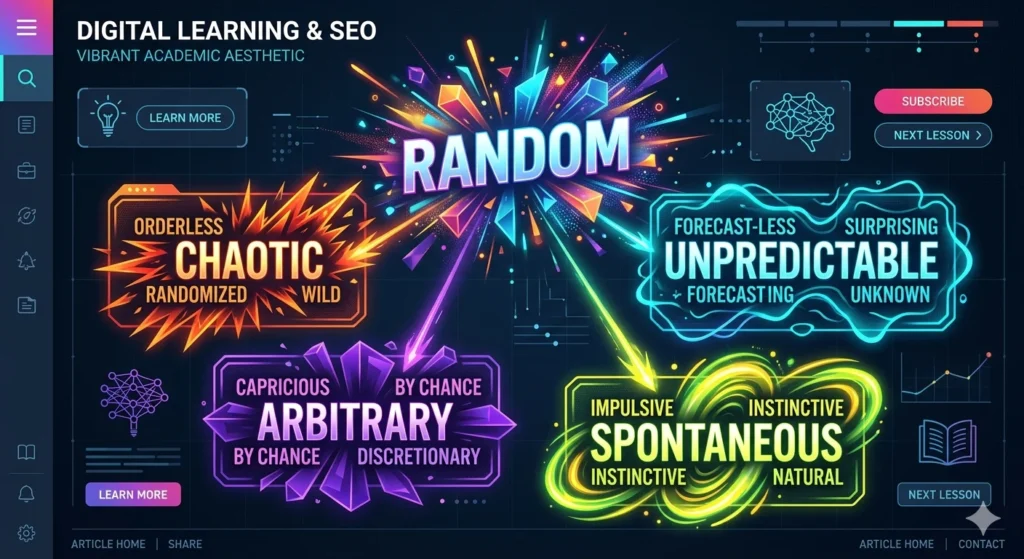
The best synonyms for “random” include arbitrary, unpredictable, accidental, chance, haphazard, irregular, erratic, unplanned, unexpected, and coincidental. For instance, a “random decision” can become an “arbitrary decision,” while a “random event” might be better described as an “unexpected” or “coincidental” moment depending on the context.
In this guide, you’ll discover the most accurate synonyms for “random”, understand how each one changes the meaning slightly, and learn how to choose the perfect word so your writing sounds more natural, precise, and confident—whether you’re writing essays, stories, or everyday sentences.
WHY THESE SYNONYMS MATTER
Using the same word again and again weakens writing. But using strong synonyms for random:
- improves readability
- increases SEO ranking signals
- boosts content authority
- makes writing sound professional
That’s why top-ranking blogs use semantic word clusters instead of repeating the same keyword.
Arbitrary
Meaning:
- Something done without a clear reason.
Examples:
- The teacher made an arbitrary decision.
- His choice felt arbitrary.
Unplanned
Meaning:
- Something not arranged before it happens.
Examples:
- The trip was unplanned.
- We had an unplanned meeting.
Accidental
Meaning:
- Something that happens by chance.
Examples:
- It was an accidental meeting.
- The damage was accidental.
Spontaneous
Meaning:
- Something done suddenly without planning.
Examples:
- We made a spontaneous trip.
- She gave a spontaneous laugh.
Incidental
Meaning:
- Something happening by chance, not planned.
Examples:
- It was an incidental encounter.
- The cost was incidental.
Casual
Meaning:
- Something done without serious planning.
Examples:
- It was a casual decision.
- He made a casual comment.
Unpredictable
Meaning:
- Something you cannot guess.
Examples:
- The weather is unpredictable.
- Her reaction was unpredictable.
Erratic
Meaning:
- Something that changes suddenly.
Examples:
- His mood is erratic.
- The signal is erratic.
Variable
Meaning:
- Something that keeps changing.
Examples:
- Results are variable.
- His behavior is variable.
60+Synonyms for Dramatic: Best Alternatives to Use Instead
Uncertain
Meaning:
- Something not sure or clear.
Examples:
- The future is uncertain.
- I feel uncertain.
Fluctuating
Meaning:
- Something going up and down.
Examples:
- Prices are fluctuating.
- Energy is fluctuating.
Unstable
Meaning:
- Something not steady.
Examples:
- The system is unstable.
- The chair is unstable.
Haphazard
Meaning:
- Something messy and unplanned.
Examples:
- Papers were in a haphazard pile.
- His work is haphazard.
Chaotic
Meaning:
- Something very messy and confusing.
Examples:
- The market was chaotic.
- The room looked chaotic.
Disorganized
Meaning:
- Not arranged properly.
Examples:
- His desk is disorganized.
- Files are disorganized.
Scattered
Meaning:
- Spread in different places.
Examples:
- Papers were scattered.
- Thoughts felt scattered.
Fragmented
Meaning:
- Broken into parts.
Examples:
- The story is fragmented.
- His memory is fragmented.
67+Synonyms for Include: From Contain to Incorporate
Uneven
Meaning:
- Not balanced.
Examples:
- The road is uneven.
- His performance is uneven.
Fortuitous
Meaning:
- Lucky by chance.
Examples:
- A fortuitous meeting happened.
- The timing was fortuitous.
Unforeseen
Meaning:
- Not expected.
Examples:
- We faced unforeseen issues.
- There were unforeseen delays.
Chance-driven
Meaning:
- Controlled by chance.
Examples:
- The result is chance-driven.
- It was a chance-driven event.
Luck-based
Meaning:
- Depends on luck.
Examples:
- It is a luck-based game.
- The result is luck-based.
Coin-toss
Meaning:
- Decided by pure chance.
Examples:
- It felt like a coin-toss decision.
- The result was a coin-toss.
Aimless
Meaning:
- Without purpose.
Examples:
- He walked aimlessly.
- The talk was aimless.
Wandering
Meaning:
- Moving without direction.
Examples:
- Wandering thoughts came to him.
- She was wandering outside.
Meandering
Meaning:
- Slowly moving without direction.
Examples:
- The river is meandering.
- His speech was meandering.
Stray
Meaning:
- Moving away from direction.
Examples:
- A stray dog appeared.
- His thoughts went stray.
Loose
Meaning:
- Not fixed or strict.
Examples:
- They had a loose plan.
- Rules were loose.
Non-deterministic
Meaning:
- Cannot be predicted.
Examples:
- The system is non-deterministic.
- Outcomes are non-deterministic.
Improvised
Meaning:
- Made without preparation.
Examples:
- He gave an improvised speech.
- The performance was improvised.
Scattershot
Meaning:
- Done in many random directions.
Examples:
- A scattershot approach was used.
- The strategy was scattershot.
Undefined
Meaning:
- Not clearly set.
Examples:
- The rules are undefined.
- His role is undefined.
Unsystematic
Meaning:
- Not organized properly.
Examples:
- The study method is unsystematic.
- His work is unsystematic.
FAQ
What are the best synonyms for random in English?
Arbitrary, unplanned, unpredictable, chaotic, and spontaneous are the strongest synonyms.
What is a formal synonym for random?
Arbitrary, incidental, and unpredictable are formal alternatives.
What is the easiest synonym for students?
Unplanned, casual, and accidental are simple options.
Why should I learn synonyms for random?
They improve writing quality, reduce repetition, and help you rank better in SEO content.
CONCLUSION
Learning synonyms for random is one of the fastest ways to improve English fluency and writing quality. These words help you express ideas more clearly in blogs, essays, emails, and conversations. Instead of repeating the same word, you can choose from a rich vocabulary that sounds natural and professional. If you practice these synonyms daily, your communication skills and SEO writing performance will improve significantly.

Evan Blake creates powerful, research-backed synonym resources, guiding readers to communicate smarter, clearer, and more effectively every day.