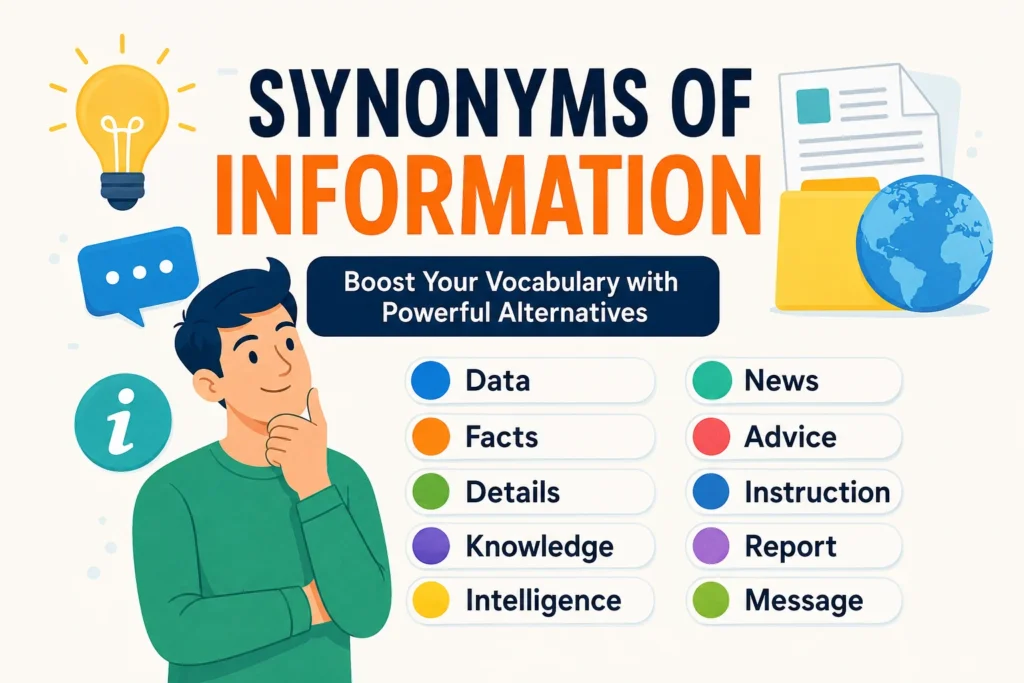
Looking for a better or more precise way to say “information”? The right synonym depends on what kind of information you mean and how you’re using it. You might use facts for verified truths, data for raw figures or measurements, knowledge for what someone has learned or understands, details for specific pieces of information, evidence for information that supports a claim, or insight for a deeper understanding of a subject.
Other words, such as findings, news, intelligence, guidance, records, and documentation, may fit particular contexts but aren’t interchangeable with “information” in every sentence. That’s why choosing a synonym from a thesaurus isn’t always enough: the wrong word can change your meaning or make your writing sound unnatural.
Whether you’re writing an essay, email, report, article, academic paper, presentation, or everyday message, choosing the right alternative can make your writing clearer, more precise, and more effective. In this guide, you’ll find synonyms for information with meanings, examples, formal and informal alternatives, context-specific choices, and words that work best when you want to avoid repeating “information.”
Details
Meaning: Details are specific facts or pieces of information about something.
Examples:
- Please send me the details of the meeting.
- I need more details about the course.
Facts
Meaning: Facts are pieces of information that are true and can usually be checked.
Examples:
- The teacher gave us facts about the solar system.
- Check the facts before sharing the post.
Data
Meaning: Data is information collected for study, analysis, or use.
Examples:
- The company collects customer data.
- We need more data before making a decision.
Knowledge
Meaning: Knowledge is information that a person has learned or understands.
Examples:
- Reading books can increase your knowledge.
- Her knowledge of English is impressive.
News
Meaning: News is new information about recent events or changes.
Examples:
- Did you hear the news this morning?
- The news about the match spread quickly.
Particulars
Meaning: Particulars are specific facts or details about a person, thing, or event.
Examples:
- Please give me the particulars of your booking.
- The form asks for the particulars of the applicant.
Specifics
Meaning: Specifics are exact details about something.
Examples:
- We need to discuss the specifics of the plan.
- Can you give me the specifics of the job?
Intelligence
Meaning: Intelligence is useful information collected to understand a person, place, or situation.
Examples:
- The team received intelligence about the threat.
- The new intelligence changed their plan.
Word
Meaning: Word can mean news or information about something in informal English.
Examples:
- Have you heard any word about the job?
- We finally got word from the manager.
Scoop
Meaning: A scoop is important news or information discovered before others know about it.
Examples:
- The reporter got a scoop about the new deal.
- Her interview gave the newspaper a major scoop.
Lowdown
Meaning: The lowdown is informal information that explains what is really happening.
Examples:
- Give me the lowdown on the new project.
- She told us the lowdown before the meeting.
Account
Meaning: An account is a description that gives information about an event or experience.
Examples:
- She gave an account of what happened.
- His account helped us understand the accident.
Report
Meaning: A report is a written or spoken record that gives information about something.
Examples:
- I read the report before the meeting.
- The manager asked for a report on sales.
Statement
Meaning: A statement is something spoken or written that gives information about a situation.
Examples:
- The company released a statement today.
- His statement answered my main question.
Message
Meaning: A message is information sent from one person or group to another.
Examples:
- I left a message for my teacher.
- Her message explained the new schedule.
Advice
Meaning: Advice is helpful information about what someone should do.
Examples:
- My father gave me useful advice.
- I asked my teacher for advice about the exam.
Guidance
Meaning: Guidance is information or help that shows someone what to do.
Examples:
- The website provides guidance for new users.
- I needed some guidance before starting the task.
Instruction
Meaning: An instruction tells someone how to do something.
Examples:
- Read the instructions before using the machine.
- The teacher gave clear instructions for the project.
Explanation
Meaning: An explanation gives information that helps someone understand something.
Examples:
- The teacher gave a simple explanation.
- I need an explanation for this answer.
Description
Meaning: A description gives information about what a person, place, thing, or event is like.
Examples:
- Her description helped me find the house.
- The product has a clear description online.
Evidence
Meaning: Evidence is information that helps show that something is true.
Examples:
- The police found evidence at the scene.
- We need evidence to support the claim.
Proof
Meaning: Proof is evidence or information that shows something is true or correct.
Examples:
- Do you have proof of payment?
- The photo was proof that he was there.
Clue
Meaning: A clue is a small piece of information that helps solve a problem or mystery.
Examples:
- The detective found an important clue.
- That clue helped us solve the puzzle.
Finding
Meaning: A finding is a fact discovered during research, testing, or investigation.
Examples:
- The researchers shared an important finding.
- Her finding changed our view of the problem.
Result
Meaning: A result is information that shows what happened after a test, action, or process.
Examples:
- The doctor gave me my test results.
- We checked the results after the experiment.
Research
Meaning: Research is careful work done to collect and learn information about a subject.
Examples:
- I did research before buying the laptop.
- Her research helped improve the article.
Study
Meaning: A study is a careful investigation that provides information about a subject.
Examples:
- The study examined how children learn.
- I read a study about healthy habits.
Survey
Meaning: A survey is a method of collecting information by asking people questions.
Examples:
- We completed a survey about customer service.
- The company used a survey to learn what customers wanted.
Record
Meaning: A record is stored information about a person, event, activity, or result.
Examples:
- The school keeps a record of student grades.
- I checked the record for the correct date.
Documentation
Meaning: Documentation is written information that explains how something works or provides proof about it.
Examples:
- Read the documentation before installing the software.
- The project needs better documentation.
Material
Meaning: Material can mean useful information prepared for reading, teaching, or study.
Examples:
- The teacher gave us reading material.
- I found useful material for my essay.
Content
Meaning: Content is the information, ideas, or material found in a book, website, video, or other work.
Examples:
- This website has useful content.
- The writer creates content for students.
Source
Meaning: A source is a person, document, website, or place where information comes from.
Examples:
- Always check your source before publishing.
- The article uses a reliable source.
Reference
Meaning: A reference is a source used to check facts or find more information.
Examples:
- I used a dictionary as a reference.
- Keep this book as a reference for your studies.
Briefing
Meaning: A briefing is a short meeting or document that gives important information about a situation.
Examples:
- The manager gave us a morning briefing.
- I attended a briefing before the event.
Synonyms for Ask: Find the Perfect Word for Every Situation
Update
Meaning: An update is new information about something that has changed.
Examples:
- Can you give me an update on the project?
- The company posted an update online.
Notification
Meaning: A notification is a message that tells you about something new or important.
Examples:
- I received a notification on my phone.
- The app sent a notification about the new feature.
Announcement
Meaning: An announcement is information made public about something important or new.
Examples:
- The school made an announcement this morning.
- We heard an announcement about the event.
Disclosure
Meaning: A disclosure is information that is officially made known to people.
Examples:
- The company made a full disclosure.
- The disclosure gave readers more facts about the deal.
Notice
Meaning: A notice is a short written message that gives people important information.
Examples:
- I saw a notice on the classroom door.
- The landlord sent a notice about the repair.
Memo
Meaning: A memo is a short written message that gives information to people in a workplace or group.
Examples:
- The manager sent a memo to all employees.
- I read the memo before lunch.
Bulletin
Meaning: A bulletin is a short public message that gives news or important information.
Examples:
- The school posted a bulletin about the holiday.
- I read the latest weather bulletin.
Communication
Meaning: Communication is the sharing of information between people or groups.
Examples:
- Good communication makes teamwork easier.
- Clear communication prevents many problems.
Input
Meaning: Input is information, advice, or ideas given to help with a decision or task.
Examples:
- I asked for your input before choosing.
- Her input improved the final plan.
Feedback
Meaning: Feedback is information about how well something was done and how it can improve.
Examples:
- My teacher gave me useful feedback.
- We need customer feedback to improve the service.
Insight
Meaning: Insight is a clear and useful understanding of something.
Examples:
- Her insight helped us understand the problem.
- The book gives useful insight into human behavior.
Awareness
Meaning: Awareness is knowledge or understanding of a fact, issue, or situation.
Examples:
- The campaign raised awareness about online safety.
- More awareness can help people avoid mistakes.
Understanding
Meaning: Understanding is knowledge of what something means or how it works.
Examples:
- The lesson improved my understanding of grammar.
- We need a better understanding of the problem.
Background
Meaning: Background is information about the history or situation behind something.
Examples:
- The article gives useful background on the topic.
- I need some background before reading the report.
Context
Meaning: Context is information that helps you understand the meaning or situation of something.
Examples:
- The quote makes more sense in its context.
- Please give me some context before I answer.
Particulars
Meaning: Particulars are exact pieces of information needed to understand or identify something.
Examples:
- The application asks for your particulars.
- Please check the particulars before signing.
Word
Meaning: Word is an informal way to mean news or information about a situation.
Examples:
- We have not heard a word about the decision.
- I got word that the meeting was canceled.
Best Synonyms for Information
The best synonym depends on the situation. Details, facts, data, knowledge, and particulars are useful general choices. For recent events, news works well. For research, data, findings, and results are stronger choices. For helpful suggestions, advice or guidance may be better.
Formal Synonyms for Information
For formal writing, choose words that match the exact meaning you need. Data, facts, details, findings, evidence, documentation, report, and particulars are useful in academic and professional writing.
For example, instead of writing:
The report contains a lot of information.
You could write:
The report contains important findings and supporting evidence.
This sounds more precise because it tells the reader what type of information the report contains.
Simple Synonyms for Information
If you want easy everyday English, use words such as details, facts, news, message, knowledge, update, and advice.
For example:
Can you give me more information?
You could say:
Can you give me more details?
The second sentence is simple and natural in everyday conversation.
Synonyms for Information in Academic Writing
Academic writing needs precise words. The best choices depend on the subject.
Use data for collected numbers or measurements. Use findings for facts discovered through research. Use evidence when supporting an argument. Use sources for materials used to support your work. Use research when discussing the process of finding knowledge.
These choices make an essay sound clearer and more professional.
Synonyms for Specific: Better Words for Precise and Particular
Synonyms for Information in Business Writing
Business English often uses words such as details, data, report, update, briefing, feedback, input, documentation, and statement.
For example:
Please send me more information about the project.
A more precise business version is:
Please send me more details about the project.
The right word depends on what you actually need.
Synonyms for “Give Information”
There are many natural ways to replace “give information.”
You can say:
- provide details
- share facts
- give an update
- offer guidance
- provide an explanation
- share knowledge
- provide evidence
- give an account
For example:
The teacher gave information about the test.
You could write:
The teacher provided details about the test.
Synonyms for “Provide Information”
In formal writing, provide information can often be replaced with:
- provide details
- present facts
- share data
- offer guidance
- provide evidence
- give an explanation
- report findings
- share an update
Choose the phrase that explains exactly what is being provided.
Synonyms for “More Information”
The best alternative depends on the context.
You can use:
- more details
- further information
- additional facts
- extra details
- more context
- additional data
- further guidance
- specific information
For example:
Please contact us for more information.
A natural alternative is:
Please contact us for further details.
Synonyms for “Important Information”
If you want to avoid repeating important information, you can use:
- key details
- essential facts
- important findings
- critical data
- useful guidance
- key points
- relevant details
- vital information
The best choice depends on what the information actually contains.
Synonyms for Information Based on Context
No single synonym works in every sentence. Details usually means specific facts. Data often means collected facts or numbers. Knowledge refers to what someone knows. News means recent information. Evidence supports a claim. Guidance helps someone decide what to do. Feedback tells someone how well something worked.
This difference is important because good vocabulary is not just about replacing one word with another. It is about choosing the word that gives the exact meaning you want.
How to Choose the Right Synonym for Information
Ask yourself what type of information you mean.
If you mean specific facts, use details or particulars.
If you mean true and checkable facts, use facts.
If you mean collected facts or numbers, use data.
If you mean what someone has learned, use knowledge.
If you mean recent events, use news or updates.
If you mean support for a claim, use evidence or proof.
If you mean help with a decision, use advice, guidance, or input.
If you mean a clear understanding, use insight or understanding.
Why Learn Synonyms of Information?
Learning different words for information helps you avoid repetition. It also makes your writing more exact.
A student can use evidence in an essay instead of using “information” every time. A blogger can use details, facts, and insights to make an article more natural. A business writer can use updates, reports, and feedback in professional messages.
The goal is not to replace information every time. The goal is to choose the word that best matches your meaning.
Conclusion
Learning synonyms of information can make your writing clearer, stronger, and more natural. Words such as details, facts, data, knowledge, evidence, insight, guidance, feedback, and updates each have their own useful place.
Use them in essays, blog posts, emails, reports, and daily conversations. Start with a few common words and practice them in real sentences. The more you use these alternatives, the easier it becomes to choose the right word and communicate your ideas with confidence.

Leo Grant is a language strategist at SynonymLabi, providing meticulously crafted synonym content that sharpens vocabulary and elevates expression.