
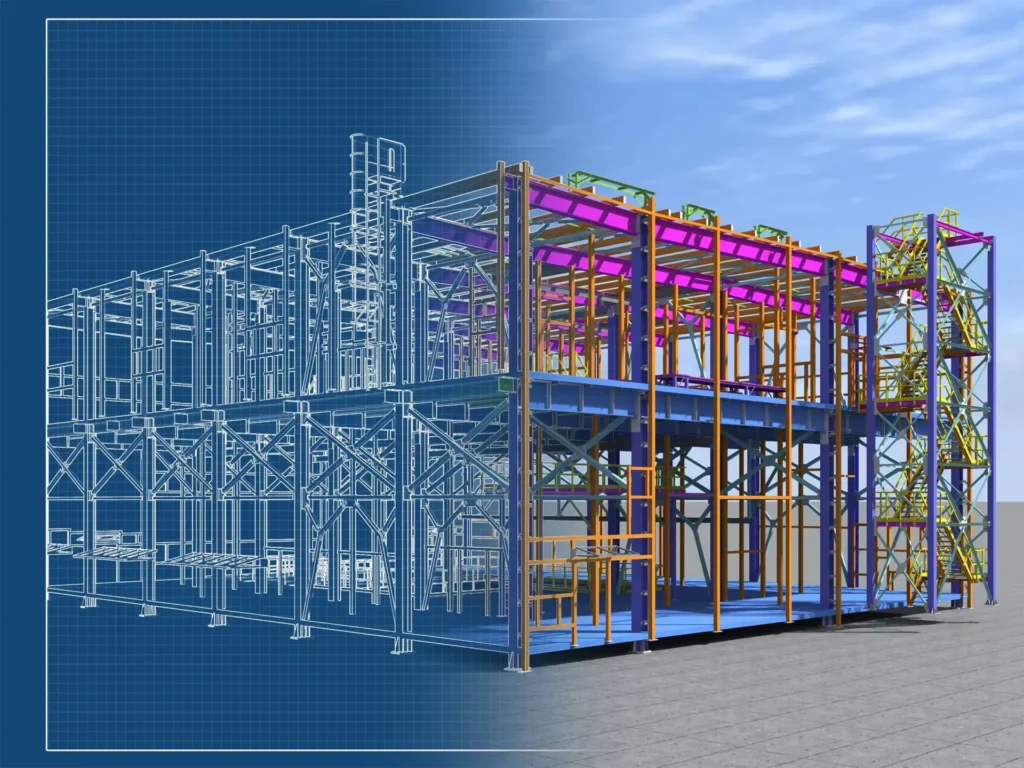

Building Information Modeling (BIM) has already changed how construction projects are designed and coordinated, but its true potential is now most effective when unlocked through integration with artificial intelligence.BIM provides companies with an accurate virtual representation of a task. Paired with AI, that version is a living, intelligent pricing engine capable of producing accurate volumes, predicting tariff volatility, and flagging threats before unmarried dollars are committed Turns out, advanced AI and BIM strategies allow assessment kits to move past static 2D replacement and replacement mechanisms an, as spreadsheets- place as the design evolves Results faster pricing cycles, tighter price manipulation during the task life cycle, and a stronger foundation for sustainable revenue growth That is this paper explores how AI-enhanced BIM workflows have been transformed during pricing, how they can curate measures for which provide strategies in, and profitability.
2. From Static Models to Intelligent Pricing Engines
Traditional BIM use often stops at conflict identification and layout coordination, leaving the pricing methodology to estimate disconnected workflows from the actual version, leaving additional guidance. AI closes this gap by connecting to the BIM environment without delay, automatically extracting dimensions, tracking layout revisions, and converting charges in real-time as versions change This capability is especially valuable for Electrical Estimating Companies, where BIM models usually involve preliminary work dogs staIM components in manual resizing after even minor configuration revisions, organizations eliminate delays between configuration changes and updated payment visibility, keeping every stakeholder aligned with the contemporary event economy.
Deliveries
- Traditional BIM workflows typically separate design coordination from pricing, a growing delay.
- AI integration allows for robotic replacement of parts and charges as versions change.
- Complex organizations with high object density benefit significantly from pricing related to live releases.
- Real-time cost visibility aligns design and economic choices at all levels of the organization.
3. Traditional BIM Workflows Versus AI-Enhanced BIM Pricing
The commercial enterprise case for AI-Enhanced BIM is clear when compared directly to traditional, discrete BIM estimation workflows in metrics that maximize numbers for pricing accuracy and speed.
| Metric | Traditional BIM Workflow | AI-Enhanced BIM Pricing |
| Time to Re-Price After Design Change | 6–10 hours | 30–90 minutes |
| Quantity Extraction Accuracy | 88%–93% | 96%–99% |
| Cost Visibility Update Frequency | Manual, per revision | Continuous / Automated |
| Clash-to-Cost Linkage | Limited or none | Integrated |
| Estimator Hours per Project (avg.) | 40–60 hours | 15–25 hours |
| Change-Order Disputes (avg. per project) | 4–7 | 1–2 |
To see the impact of repricing speed as AI-BIM integration deepens, take a simplified process below:
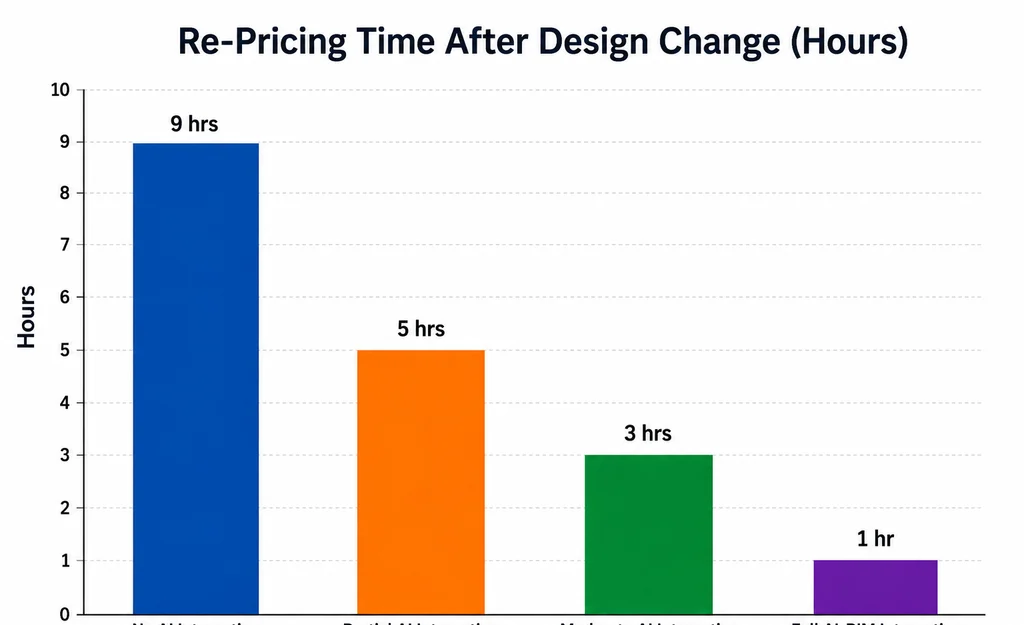
The trend defies sound financial judgment: as AI-BIM integration deepens, repricing times drop, allowing companies to catch late-stage configuration changes through guessing or following deadlines or losing pricing accuracy under time stress.
4. Reducing Price Errors Through Model-Driven Accuracy
A chronic demanding situation in job pricing is human errors allocated to the duration of indicative amount exchanges — copying figures from publications directly into spreadsheets, misreading schedules, or failing to take hold of late configuration corrections Stops the transcription stage Electrical Estimating Companies,, completely compromising power estimates wire lengths and track specs buried within dense model data, this straightforward removal dramatically reduces the expensive inspection performed by AI constantly cross-referencing versions as opposed to modern design improvements, so discrepancies are usually flagged rather than determined after already offered cop guides cop remo’s cop guides’ exchange from it rebuilds confidence within the pricing process itself, giving management more certainty when reviewing very final numbers before submission.
Deliveries
- Manual amount copying is the primary source of pricing errors in traditional workflows.
- Direct copy removal eliminates the human transcription step.
- Automatic discrepancy flagging catches errors before bid submission, not after.
- Model-driven pricing will increase management’s confidence in the final numbers.
5. Cost control throughout the project life cycle
The cost of AI-enhanced BIM did not stop with the submission of a bid — it extends the cost management benefits to the period where it is significantly more specific to track cost levels for individual versions. The table below compares cost manipulation results at different job levels.
| Project Phase | Cost Variance (Traditional Tracking) | Cost Variance (AI-BIM Tracking) | Improvement |
| Design Development | 6%–9% | 1.5%–3% | ~5% tighter |
| Preconstruction | 8%–12% | 2%–4% | ~7% tighter |
| Construction Phase | 10%–15% | 3%–5% | ~8% tighter |
| Closeout/Final Reconciliation | 5%–8% | 1%–2.5% | ~5% tighter |
This data shows a clear pattern: Cost variance decreases meaningfully across all segments as monitoring AI-BIM replaces traditional technologies, with the greatest evolution sometimes occurring in energy-intensive design — the stage at which out-of-control costs max out in the public sector.
6. Position of revenue growth through technology adoption
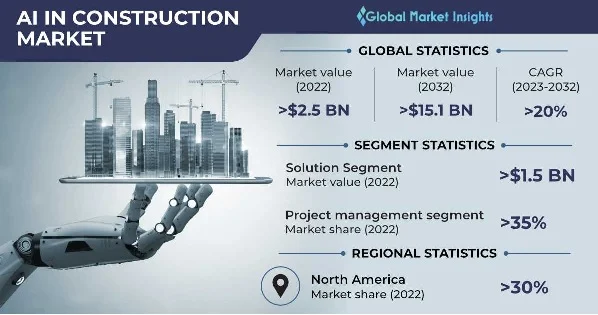
Beyond error reduction, AI-enhanced BIM strategies create a strategic path to revenue growth through enabling companies to perform more complex and best-value tasks with added price assurances. Many companies are accelerating this shift by leveraging partnerships with a specialized construction oversight assessment service, AIB, allowing internal teams to scale pricing capabilities without a proportional increase in headcount. This hybrid approach allows us, Construction estimating Services Lubbock companies, to respond to large RFPs, take on configuration-heavy or fast-paced projects, and maintain pricing accuracy even under compressed timelines. When companies use those strategies to build a portfolio of detailed, well-managed projects, they become more aggressive for repeat business and larger contract awards.
Deliveries
- The adoption of AI and BIM will hopefully allow companies to pursue larger, more complex projects.
- Special partnerships make it possible to increase pricing capabilities with a primary increase in population.
- Faster, more accurate pricing promotes competitiveness in fast-paced music and design-heavy campaigns.
- A music statement on fee-led initiatives reinforces the right to recurring high-value contracts.
7. Final Thoughts
Advanced AI and BIM integration marks a turning point in how manufacturing companies price, control costs, and achieve long-term growth. What was once a fragmented system — a layout version here, a spreadsheet estimate there — is converging to an integrated, intelligent workflow where pricing automatically updates as projects evolve. Firms that already adopt these techniques are now setting themselves up not only to increase their fees, but also to increase their market share. Ambitious, more prestigious work with confidence. As BIM adoption becomes a trending practice across the industry, the differentiator will increasingly be how intelligently that version is used — and companies that pair it with AI-pushed pricing will outperform those that rely on consistently discrete manual techniques
Frequently Asked Questions
Q1: How does AI increase accuracy in constellation flights based entirely on BIM?
A: The AI extracts parts directly from the BIM version without considering the guide copy, achieving an accuracy rate of ninety-six%–ninety-ninety% compared to 88%–ninety-three% with traditional techniques
Q2: Can AI-enhanced BIM reduce the time it takes to charge after a layout change?
A: Yes. Full AI-BIM integration can reduce cost time all the way from several hours, depending on the scope of the change.
Q 3: Does AI-BIM integration help control costs after construction has started, now and not just at the quote?
A: Yes. Cost variance information shows significant increases in each project component, with significant gains occurring during active construction control.
Q4: Are AI and BIM integration techniques most useful for large, complex projects?
A: As the benefits increase with complexity, companies of all sizes see reduced errors and faster pricing cycles, making adoption valuable even for medium-sized tasks.
Q5: How should a company initiate an AI-powered BIM pricing technology?
A: Most companies start by integrating AI tools into existing BIM workflows for high-cost or configuration-heavy initiatives, often supported through specialized estimating partners experienced in AI and BIM implementation
Also Read
- https://synonymlabi.com/patronize-meaning/
- https://synonymlabi.com/synonyms-for-uncomfortable/
- https://synonymlabi.com/synonyms-for-destruction/