
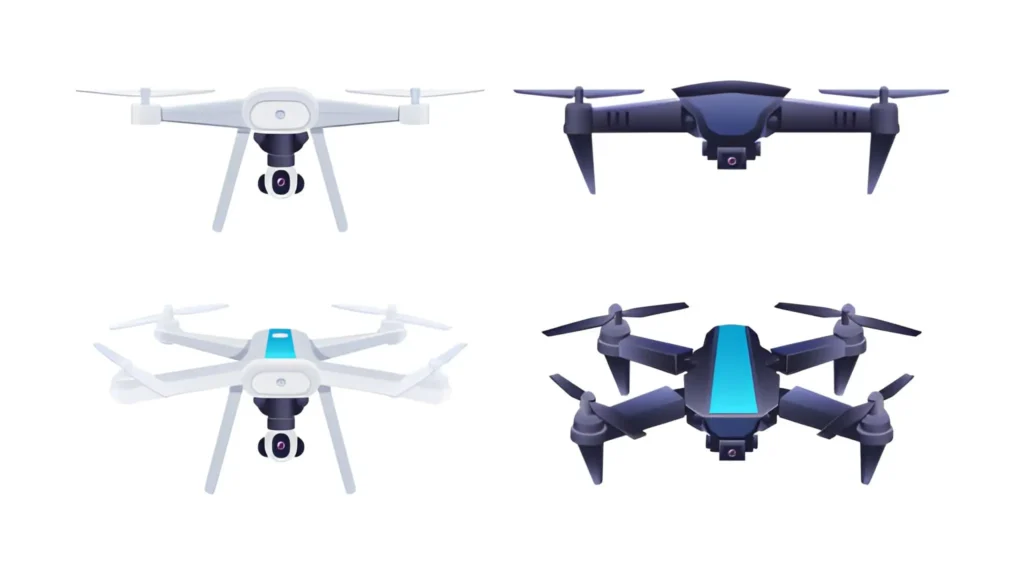

Read a few news articles, product listings and FAA documents in a row, and you will notice that the same flying machine goes by many names. A reporter calls it a drone, a manufacturer calls it a quadcopter, a regulator calls it a small unmanned aircraft system, and an FPV pilot just calls it a quad. Are they all talking about the same thing?
Mostly, yes, but not exactly. Each term has its own scope, and some are much broader than others. Understanding the differences helps when you are reading regulations, comparing products or trying to explain your hobby to friends who think every drone looks like a camera-carrying gadget from an electronics store.
It also helps when you shop. Browsing drone parts at Zaruba Store, for example, is easier when you know whether a component is meant for a multirotor, a fixed-wing aircraft or a specific FPV build. Below, we break down what each term means, where it came from and when to use it.
The Short Answer
Think of these terms as a set of nesting boxes. “Drone” is the broadest, everyday word for an aircraft without a pilot on board. “UAV” and “UAS” are the more formal, technical versions used by engineers and regulators. “Multirotor” describes drones that fly using several spinning rotors, and “quadcopter” is a specific type of multirotor with exactly four.
So every quadcopter is a multirotor and a drone, but not every drone is a quadcopter. A fixed-wing survey aircraft, a six-rotor camera platform and a palm-sized whoop are all drones, while only the last one is also a quadcopter.
Where the Word “Drone” Came From
The word has an unexpectedly charming origin. In the 1930s, British forces used a radio-controlled target aircraft called the Queen Bee for anti-aircraft gunnery training. When the US Navy developed its own remote-controlled target aircraft soon after, the program reportedly adopted the name “drone,” after the male honeybee, as a nod to the British design. The buzzing sound of small engines made the name stick.
For decades, “drone” mainly referred to military target and reconnaissance aircraft. That changed in the 2010s, when affordable consumer quadcopters arrived and the word moved into everyday language. Today it covers everything from toy quadcopters to delivery aircraft, and in casual use, it has even spread to underwater and ground robots.
UAV, UAS and RPAS: The Official Terms
Regulators prefer more precise language. A UAV, or unmanned aerial vehicle, is the aircraft itself. A UAS, or unmanned aircraft system, includes the aircraft plus everything needed to fly it: the ground control station, the radio link and the pilot’s equipment. The International Civil Aviation Organization often uses RPAS, short for remotely piloted aircraft system, to emphasize that a human pilot is still in control.
“Unmanned aircraft means an aircraft operated without the possibility of direct human intervention from within or on the aircraft.”
— Federal Aviation Regulations, 14 CFR 1.1
In the United States, most hobby and commercial drones fall under the FAA’s definition of small unmanned aircraft, meaning anything weighing less than 55 pounds at takeoff, as set out in Part 107 of the Federal Aviation Regulations. As of November 2025, more than 837,000 drones were registered with the FAA, all covered by these formal definitions, even though almost none of their owners use the term “UAS” in everyday conversation.
Quadcopters and Other Multirotors
A multirotor is any drone that flies using several fixed-pitch rotors, changing their speeds to steer. Quadcopters are by far the most common, but they are not the only option:
- Tricopter: three rotors, usually with a tilting rear motor for yaw control. Popular with hobbyists in the early days of multirotors.
- Quadcopter: four rotors. The simplest stable design and the standard for consumer camera drones, racing quads and most FPV builds.
- Hexacopter: six rotors, offering more lift and some redundancy if a motor fails.
- Octocopter: eight rotors, used for heavy cameras and professional payloads.
- Coaxial designs (Y6, X8): stacked pairs of rotors that add lift without a wider frame.
Not every drone is a multirotor, either. Fixed-wing drones fly like small airplanes and are prized for efficiency and range. VTOL hybrids take off vertically like a multirotor and then transition to wing-borne flight. Interestingly, the quadcopter concept is far older than consumer drones: experimental four-rotor manned aircraft were flying in the 1920s, long before electronics made them easy to control.
Where FPV Fits In
FPV, short for first-person view, is not a type of aircraft but a way of flying. An FPV pilot sees through a camera on the drone using goggles or a screen, as if sitting in the cockpit. Most FPV drones are quadcopters, which is why pilots so often simply say “quad,” but FPV wings and even FPV hexacopters exist.
Within the FPV world, you will hear more specific labels. A freestyle quad is built for tricks, a cinewhoop has ducted props for smooth, safe filming, a toothpick is an ultralight micro, and a long-range rig is designed for distance and endurance. All of them are quadcopters, multirotors, UAVs and drones at the same time.
Quick Reference: Which Term to Use When
Choosing the right word depends on who you are talking to:
- Casual conversation: “drone” works for almost everything.
- Describing a four-rotor design: “quadcopter” or simply “quad.”
- Comparing designs: “multirotor,” “fixed-wing” or “VTOL” add useful precision.
- Technical or engineering writing: “UAV” for the aircraft and “UAS” for the full system.
- US regulations and paperwork: “small unmanned aircraft” and “small UAS,” as used by the FAA.
- International aviation contexts: “RPAS” is common in ICAO and many European documents.
Using the right term will not change how your drone flies, but it does make you easier to understand, whether you are filling out FAA forms, ordering parts or chatting at your local flying field.
About Zaruba Store
Zaruba Store, based in Tarzana, California, supplies the components that turn any of these terms into a working aircraft, from compact quadcopters to large multirotor platforms. Its drone parts range includes flight controllers and ESCs, brushless motors from 1604 to 3115 sizes, cameras, video transmitters, GPS modules, antennas, propellers, frame hardware and batteries. Orders placed before 2 PM PST ship the same day, and unused items in their original packaging can be returned within 30 days, which makes it easy to experiment with new builds.
Also Read
- https://synonymlabi.com/personal-loan-for-first-time-borrowers-what-lenders-actually-check/
https://synonymlabi.com/will-better-route-planning-make-local-van-deliveries-more-profitable/
https://synonymlabi.com/british-autumn-nursery-2026-the-complete-october-furniture-guide-for-expecting-parents/