
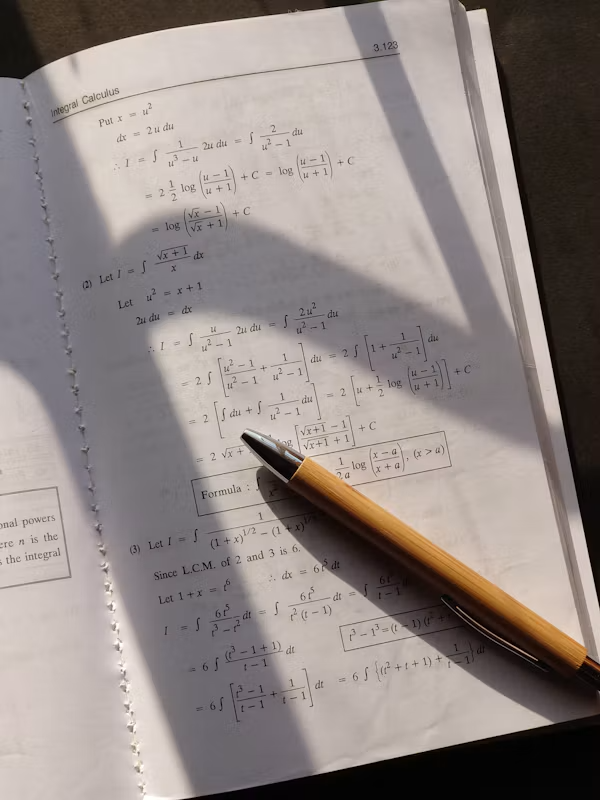

Using the correct 4MA1 tier materials and moving from diagnostic questions to timed practice can support more reliable preparation for Pearson Edexcel International GCSE Mathematics. After each marked paper, turn every lost mark into one clear next task. This guide is for Pearson Edexcel International GCSE Mathematics (Specification A, 4MA1) for UK students entered for the International GCSE, not GCSE Mathematics generally.
Start with the correct 4MA1 papers and topic coverage
Check your entry before collecting papers. The Pearson Edexcel specification says Foundation candidates should practise 4MA1/1F and 4MA1/2F, while Higher candidates should use 4MA1/1H and 4MA1/2H. Higher papers assume Foundation knowledge, so repair gaps in core fraction, percentage, ratio, algebra and geometry skills rather than treating Higher revision as Higher-only topics.
Use Pearson Edexcel’s course-materials page to find the specification, sample assessment materials, available 4MA1 papers and matching mark schemes. Use papers that match your current specification and tier. Some of the most recent papers, mark schemes and examiner reports may be restricted to registered centres for 12 months. Keep number and algebra in your weekly rotation, but schedule geometry, trigonometry, vectors, transformations, statistics and probability too. Include questions set in unfamiliar contexts, because the assessment tests mathematical reasoning and problem solving as well as remembered methods.
Build revision from diagnosis to timed mixed practice
Begin with a short diagnostic set: a small group of questions across topics, completed without notes. Mark it and name the precise weakness, such as solving simultaneous equations, trigonometry in three dimensions or cumulative frequency. Do focused mini-sets only where the method is insecure. Move on when you can choose and explain the method, solve questions accurately without notes, and do so at a steady pace.
First narrow the weakness to one named skill, such as solving simultaneous equations. For GCSE revision resources, use SimpleStudy topic notes and quizzes for that skill. Then complete a short no-notes question set to check whether the gap has closed.
Use the result to decide whether to do another focused mini-set or begin timed mixed sections.
Once individual methods are secure, use timed mixed sections. These force you to recognise the topic and select a method without a heading giving it away. Attempt a full matched-tier official paper after you can finish mixed sections within a time allowance based on their marks. Official Pearson 4MA1 papers and mark schemes should remain your source for qualification-specific full-paper practice.
Use the two-hour papers to set a realistic pace
Calculators may be used on every 4MA1 paper, so practise with a calculator permitted by Pearson and of the type you will use in the exam. At the start of a two-hour paper, scan the front-page instructions and the demands of the questions. Reserve a final checking window, then divide the remaining minutes roughly by the total marks printed on that paper. A 4-mark question should not absorb the same time as a longer question worth many more marks.
If no useful diagram, equation or setup is forming within the planned time, circle the question, leave clear space for working and move on. Return later with a fresh view. Timed mixed sections build pace across changing topics. A full paper also tests concentration, question selection and checking in one uninterrupted sitting, so do not use full papers as your only form of practice.
Turn every marked paper into a precise repair plan
Mark a paper with its matching official mark scheme, then make an error log before doing more questions. A score tells you where you are; the log tells you what to do next. Record enough detail to reproduce the correct method and test it again.
- Question number and topic
- Marks lost and error type: knowledge, method or missing working, reading, timing, accuracy or rounding, copied data, or answer form
- Correct method and why the mistake happened
- One follow-up question or short mini-set to confirm the repair
For example, imagine a student who is accurate in untimed algebra, trigonometry and statistics sets but runs out of time on a full paper, rounds early and omits working. Their log identifies a timing pattern and presentation errors rather than a topic weakness. They shorten further untimed work, move to timed mixed sections for pace, and delay another full paper until they repeatedly finish sections on time. This is an illustration, not a universal timetable, but it shows why marking should change the next revision decision.
Recurring knowledge or method errors need brief reteaching followed by a retest. An isolated copied number or missed unit needs a prevention habit, such as pointing to each value while entering it or checking units before boxing an answer. Do not restart a whole topic because of one slip.
Make your method visible before using the calculator
On calculator papers, write the mathematical route before relying on the display. Put down the formula, equation or diagram-based setup. Substitute values on a separate line. Show rearrangements and intermediate values, then use the calculator for arithmetic. Finish with the requested unit and rounding. Where working or algebraic working is requested, a calculator answer on its own may receive no credit.
For example, find the mass of an object with density 2.7 g/cm³ and volume 0.015 m³. First convert the volume: 0.015 m³ = 0.015 × 1,000,000 cm³ = 15,000 cm³. Then write mass = density × volume. mass = 2.7 g/cm³ × 15,000 cm³ = 40,500 g = 40.5 kg. The object has a mass of 40.5 kg.
Estimate before calculating, so an answer that is wildly too large or too small stands out. Enter brackets and negative values deliberately. Keep full calculator precision until the final instruction says how to round. Check a result with an inverse operation or substitution where possible.
Catch the avoidable errors that cost easy marks
Use the final checking time for a targeted scan, while still reading carefully throughout the paper. Check the final line against the exact wording of the question.
- Misread command: underline the quantity, condition and requested form before starting.
- Wrong angle mode: check that the calculator shows DEG before trigonometry.
- Premature rounding: retain calculator precision until the final line.
- Missing units: add the required unit before boxing the answer.
- Area, perimeter or volume confusion: write the relevant formula and use squared or cubed units where needed.
- Copied data: point to each number in the question as you enter it.
- Wrong answer form: check for simplest form, the correct inequality sign, index notation, or a numerical gradient rather than an expression containing x.
Set up the next practice session
Before each session, prepare the matching mark scheme. Across the week, pair repairs from your error log with topics you have not practised recently, so weak areas do not replace coverage of the whole course.
Small, specific next tasks help you turn practice into more reliable exam performance.
Read more: https://synonymlabi.com/top-5-data-warehouse-service-companies-in-2026/
https://synonymlabi.com/what-size-solar-generator-do-you-need-for-camping/
https://synonymlabi.com/what-should-you-know-about-solar-generator-cycle-life/