
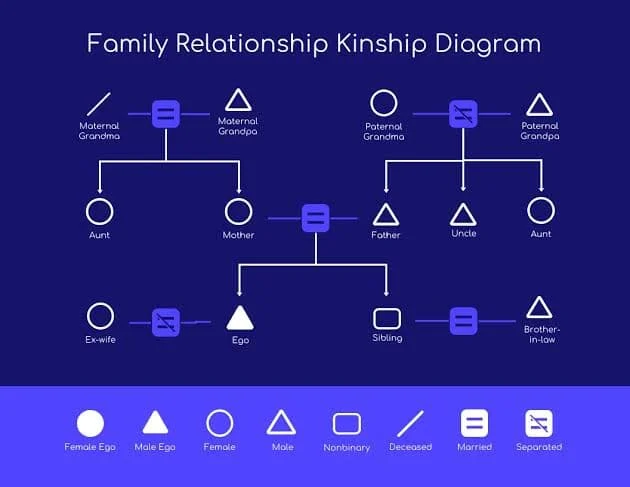

A family can look simple when you live inside it and surprisingly tangled the moment you try to explain it to someone else. A list of names in a notes app rarely shows who is a parent, who is a partner, who is a half-sibling, or which household a cousin actually grew up in. Reunions, school projects, and personal records all run into the same problem: the information exists, but it is hard to see at a glance.
A one-page relationship diagram is often enough to fix that. It is not a medical chart, not a diagnosis, and not a substitute for a counselor. It is a visual list—who is connected to whom—so that homework, planning, and family-history notes stop collapsing into a muddle of similar first names.
Why a picture beats a long list
Text hides structure. “Maya, Jordan, Priya, Sam, and the twins” may be perfectly clear to one relative and meaningless to a classmate, a partner marrying into the family, or a grandchild who only hears the stories at holidays. A diagram puts generations in rows or branches, places partnerships and children where they can be seen, and makes repeated names less confusing.
The same clarity helps when you are keeping personal records or doing a classroom project. People often want a compact way to remember how households connect, or to notice patterns in family history—who lived where, which branch shared a trade, or which relatives mentioned the same long-running health story in old letters. Seeing those notes next to a simple chart can make the archive easier to use. It does not turn the chart into a clinical tool, and it should not be used to diagnose anyone or to replace professional advice.
What belongs on a first diagram
Start smaller than you think. A useful first version often includes the household at the center, plus parents and children, and then one ring of relatives who actually matter for the task at hand.
For each person, a first name, an optional last name, and a life-year range if you know it are plenty. Add a short label only when the relationship would otherwise be unclear: partner, parent, sibling, step-parent, adopted child, or former partner if that fact is needed to explain a child’s place on the chart. Consistency matters more than decorative shapes.
Leave sensitive details off the public version. A diagram for a reunion table or a school poster is not the place for private medical notes, conflict, or information a relative has not agreed to share.
Gathering names without turning a meal into an interview
The most accurate charts are built from existing notes and short, specific questions, not from a surprise interrogation at dinner. Start with what you already have: address books, old programs from memorials, baby books, and the family group chat. Write down the connections you are sure of, and mark the rest as uncertain.
When you do ask someone, ask one narrow thing at a time. “Was Uncle Rao your mother’s brother or your father’s?” is easier to answer than “Tell me the whole family.” Offer to share the draft so people can correct their own line, and respect anyone who prefers not to be included in a widely shared file. If the diagram is for homework, check the assignment’s scope. Many teachers want a simple structure and a short written reflection, not an exhaustive genealogy.
Building the diagram so you can revise it
Paper still works. A pencil sketch on a large sheet is hard to beat for a first pass, especially if several people are talking at the same time. The limitation appears when you need to rearrange a branch, share a neat copy, or keep a version that will still be readable next year.
A browser-based chart is useful at that point because you can move people, add a missing partner, and export a copy without starting over. If you want a straightforward way to chart household relationships in a simple diagram, you can begin in the browser without creating an account, then save or export once the layout looks right. A free account may add a watermark on exports; a paid option, if you need it later, can remove the watermark and add formats such as SVG for sharper printing. None of that matters as much as getting the relationships right. Use the drawing surface as a helper, not as an authority on your family.
Family-history patterns, handled carefully
Once the structure is visible, some people like to add light annotations: a town, a profession, a year of arrival, or a health story that relatives have already chosen to share in the family’s own records. A careful line still needs to be drawn. A diagram can help you remember that several relatives mentioned the same condition, or that a branch of the family lived in the same region for decades. It cannot tell you what that means for anyone’s future, and it is not a substitute for talking with a qualified professional about health questions. If a school or community project asks for family health history, stay with what people have agreed to share, keep the language factual, and avoid conclusions.
Privacy, blended families, and messy real life
Real families are rarely a tidy tree. There are second marriages, households that raised a child together without a legal label, relatives who are close in practice but not in blood, and people who have stepped away. A good diagram reflects the relationships that are true for the purpose of the chart. You may need two versions: a detailed private one and a simpler public one.
Chosen family can appear on a personal chart if that is how the household actually works. A school assignment may require a narrower definition. Do not force a relative into a box that misrepresents them, and check who can open a shared link. A chart is a compact bundle of personal data.
Start with a picture you can maintain
Date the file, and update it after known changes: a marriage, a birth, a move, a death, or a correction from someone who finally saw the draft.
You do not need a complicated system to keep kinship clear. You need a readable picture, a modest scope, and enough care to leave private matters private. A simple household relationship diagram will not answer every family question, and it should never be asked to do clinical work. It will, however, make the next reunion, assignment, or personal record much easier to start—and much harder to confuse.
Also Read-How Health Tech Companies Can Protect Patient Data with CMMC Solutions