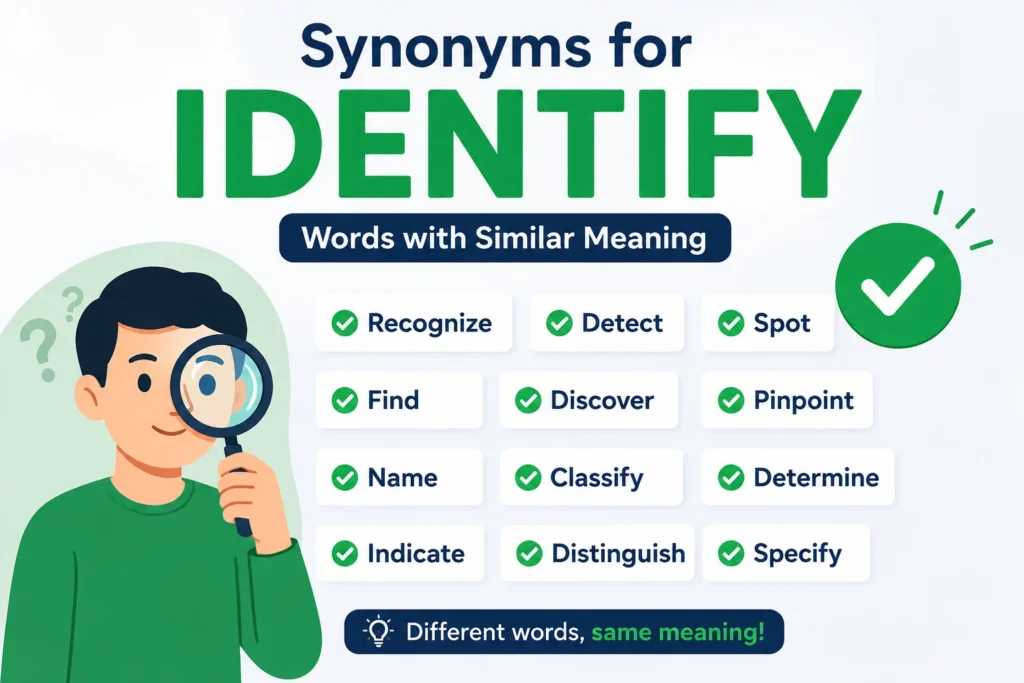
Looking for another word for “identify” but want one that expresses the exact meaning you need? The best alternative depends on whether you mean recognizing someone or something, determining what it is, naming it, or distinguishing it from something else.
Recognize works when you know or remember a person or thing, while determine or establish can fit when you figure out or confirm an answer, cause, or fact. Name is useful when you state who or what something is, while distinguish emphasizes telling one person or thing apart from another.
In specific contexts, diagnose can mean determining a medical condition, detect can mean discovering something hidden, and pinpoint can emphasize locating or determining something precisely. These alternatives overlap with “identify,” but they are not interchangeable in every sentence. This guide explains which synonyms for identify work best in different contexts, with clear meanings, examples, and practical usage tips.
Recognize
Meaning: To recognize means to know someone or something because you have seen, heard, or known it before.
Examples:
- I recognized her from her profile photo.
- He recognized the song after a few notes.
Name
Meaning: To name means to say what a person, object, place, or thing is called.
Examples:
- Can you name this animal?
- She named every part of the machine.
Spot
Meaning: To spot means to notice or find someone or something, often quickly.
Examples:
- I spotted my brother near the entrance.
- She spotted a typo in the article.
Notice
Meaning: To notice means to become aware of something by seeing or observing it.
Examples:
- I noticed a small crack in the window.
- Did you notice the new sign outside?
Detect
Meaning: To detect means to discover something that may be hidden, small, or hard to notice.
Examples:
- The device detected smoke in the room.
- The editor detected an error in the report.
Distinguish
Meaning: To distinguish means to tell one person or thing apart from another.
Examples:
- I can distinguish the twins by their voices.
- The label helps us distinguish the two products.
Differentiate
Meaning: To differentiate means to show or understand how one thing is different from another.
Examples:
- The chart differentiates new users from old users.
- Can you differentiate these two shades?
Determine
Meaning: To determine means to find out something after checking the facts or evidence.
Examples:
- We need to determine the cause of the delay.
- The test helped determine the correct answer.
Discover
Meaning: To discover means to find something that was not known before.
Examples:
- Scientists discovered a new species.
- We discovered the reason for the mistake.
Find
Meaning: To find means to discover, locate, or learn what something is.
Examples:
- I found the missing document.
- The team found the source of the problem.
Locate
Meaning: To locate means to find the exact place where someone or something is.
Examples:
- We located the missing package.
- The map helped us locate the village.
Pinpoint
Meaning: To pinpoint means to find the exact person, place, problem, or cause.
Examples:
- The engineer pinpointed the source of the noise.
- We pinpointed the exact location on the map.
Classify
Meaning: To classify means to place people or things into groups based on their type or features.
Examples:
- Scientists classify animals into groups.
- The teacher asked us to classify the plants.
Categorize
Meaning: To categorize means to put similar things into the same group.
Examples:
- I categorized my notes by subject.
- The store categorizes products by type.
Label
Meaning: To label means to give a name or description to a person, object, or group.
Examples:
- Please label each folder clearly.
- The diagram labels every part of the heart.
Indicate
Meaning: To indicate means to show, point to, or give a sign of something.
Examples:
- The arrow indicates the correct door.
- The results indicate a change in demand.
Point Out
Meaning: To point out means to show someone something or draw attention to it.
Examples:
- She pointed out an error in my essay.
- Can you point out the nearest exit?
Reveal
Meaning: To reveal means to make something known that was hidden or unknown.
Examples:
- The interview revealed new details.
- The test revealed the main problem.
Uncover
Meaning: To uncover means to find something hidden or previously unknown.
Examples:
- The investigation uncovered new evidence.
- We uncovered an old family photo.
Expose
Meaning: To expose means to show something that was hidden or not known.
Examples:
- The report exposed serious safety issues.
- The camera exposed the truth about the event.
Verify
Meaning: To verify means to check that information, a fact, or an identity is correct.
Examples:
- Please verify your phone number.
- We verified the customer’s identity.
Confirm
Meaning: To confirm means to prove or show that something is true or correct.
Examples:
- She confirmed the booking by email.
- The test confirmed our original idea.
Establish
Meaning: To establish means to prove or clearly determine something using facts or evidence.
Examples:
- The investigation established his identity.
- The study established a link between the two factors.
Ascertain
Meaning: To ascertain means to find out something for certain after careful checking.
Examples:
- We must ascertain the facts first.
- The manager tried to ascertain the cause of the issue.
Discern
Meaning: To discern means to notice or understand something that is difficult to see or understand.
Examples:
- I could barely discern a face in the dark.
- She discerned a change in his mood.
Synonyms for Insight: Choose the Perfect Word for Your Sentence
Perceive
Meaning: To perceive means to notice or understand something through your senses or thoughts.
Examples:
- He perceived a change in the speaker’s tone.
- The child perceived danger near the road.
Observe
Meaning: To observe means to watch or notice something carefully.
Examples:
- We observed the birds from a distance.
- The teacher observed a change in his behavior.
Examine
Meaning: To examine means to look at something carefully to understand or check it.
Examples:
- The doctor examined the injured arm.
- She examined the document for mistakes.
Inspect
Meaning: To inspect means to check something closely for problems or details.
Examples:
- The worker inspected the machine.
- We inspected the room before opening it.
Analyze
Meaning: To analyze means to study information carefully to understand it.
Examples:
- We analyzed the survey results.
- The writer analyzed the reader’s comments.
Study
Meaning: To study means to look at or think about something carefully to understand it.
Examples:
- Scientists study animal behavior.
- I studied the photo for several minutes.
Trace
Meaning: To trace means to find the origin, path, or source of something.
Examples:
- The police traced the phone call.
- We traced the error back to the original file.
Track
Meaning: To track means to follow or monitor someone or something to know where it is or where it goes.
Examples:
- I tracked my package online.
- The researchers tracked the animal’s movement.
Follow
Meaning: To follow means to watch or go along with the path of someone or something.
Examples:
- We followed the footprints across the field.
- The team followed the clues carefully.
Match
Meaning: To match means to show that two things are the same, connected, or belong together.
Examples:
- The police matched the fingerprint to the record.
- Match each photo with the correct name.
Associate
Meaning: To associate means to connect a person, thing, or idea with something else.
Examples:
- Many people associate spring with fresh flowers.
- I associate that song with my childhood.
Connect
Meaning: To connect means to link one thing, person, or idea with another.
Examples:
- The clues connected the suspect to the case.
- We connected the name with the old photograph.
Relate
Meaning: To relate means to connect something with another thing, person, or idea.
Examples:
- I can relate this lesson to real life.
- She related the problem to poor planning.
Describe
Meaning: To describe means to explain what someone or something looks like or is like.
Examples:
- Can you describe the missing wallet?
- He described the car to the police.
Define
Meaning: To define means to explain the exact meaning or nature of something.
Examples:
- Can you define this English word?
- The teacher defined the term clearly.
Synonyms for Sustainable: Find the Right Word for Every Context
Specify
Meaning: To specify means to give exact details about something.
Examples:
- Please specify your preferred meeting time.
- The form specifies the required file type.
Characterize
Meaning: To characterize means to describe the main qualities or nature of someone or something.
Examples:
- The article characterizes the town as peaceful.
- The author characterized the hero as brave.
Diagnose
Meaning: To diagnose means to identify an illness, fault, or problem by studying its signs.
Examples:
- The doctor diagnosed the infection quickly.
- The technician diagnosed the computer problem.
Isolate
Meaning: To isolate means to separate one thing from others so it can be found or studied.
Examples:
- The scientist isolated the unknown substance.
- We isolated the damaged section of the cable.
Select
Meaning: To select means to choose one person or thing from several options.
Examples:
- The editor selected the best headline.
- We selected three photos for the website.
Choose
Meaning: To choose means to decide which person or thing you want.
Examples:
- I chose the blue folder.
- She chose the best answer on the test.
Classify
Meaning: To classify means to identify something by placing it into a suitable group.
Examples:
- The app classifies photos by subject.
- Students classified the rocks by type.
Recognize Patterns
Meaning: To recognize patterns means to notice repeated features or connections.
Examples:
- The software recognizes patterns in the data.
- She recognized a pattern in the test results.
Identify
Meaning: To identify means to know, find, or state exactly who or what someone or something is.
Examples:
- Can you identify the person in this photo?
- We identified the cause of the problem.
Differentiate
Meaning: To differentiate means to tell how two or more things are different.
Examples:
- The colors differentiate each category.
- Good examples help students differentiate similar words.
Compare
Meaning: To compare means to look at two or more things to see their similarities and differences.
Examples:
- We compared the two reports.
- She compared both products before buying one.
Recognize Features
Meaning: To recognize features means to notice the special qualities that help you know something.
Examples:
- The software recognizes facial features.
- I recognized the building by its tall windows.
Determine Identity
Meaning: To determine identity means to find out exactly who a person or thing is.
Examples:
- The police determined the man’s identity.
- The document helped determine the person’s identity.
Establish Identity
Meaning: To establish identity means to prove or confirm exactly who someone is.
Examples:
- The passport helped establish her identity.
- Officers used the records to establish his identity.
Confirm Identity
Meaning: To confirm identity means to make sure that a person is really who they claim to be.
Examples:
- The website asked me to confirm my identity.
- Staff checked his ID to confirm his identity.
How to Choose the Right Synonym for Identify
Not every word above works in every sentence. The best synonym depends on the meaning you want.
Use recognize when you know something from past experience.
- I recognized my old teacher.
Use detect when you find something hidden, small, or difficult to notice.
- The scanner detected a problem.
Use distinguish when you need to tell two similar things apart.
- I can distinguish the two voices.
Use pinpoint when you find an exact location, cause, or source.
- We pinpointed the source of the error.
Use verify or confirm when you need to make sure information or identity is correct.
- Please verify your identity.
Use classify or categorize when you place something into a group.
- The system categorizes users by age.
Use describe when you explain what something looks like rather than saying exactly what it is.
- Can you describe the person?
Use define when you explain the exact meaning of a word or idea.
- Can you define this term?
Synonyms for Identify a Person
When you want to identify a person, some of the most useful alternatives are recognize, name, spot, identify, distinguish, confirm, verify, and establish identity.
For example:
- I recognized the woman from the photo.
- The officer verified his identity.
- She spotted her friend in the crowd.
The best choice depends on the situation. Recognize focuses on knowing someone from previous experience, while verify focuses on checking that the person’s identity is correct.
Synonyms for Identify a Problem
When talking about a problem, useful alternatives include detect, discover, find, diagnose, determine, pinpoint, uncover, and locate.
For example:
- The technician detected the problem.
- The doctor diagnosed the issue.
- The team pinpointed the cause.
These words are common in business, medicine, technology, schoolwork, and everyday English.
Synonyms for Identify a Cause
When you want to say that you found the reason for something, use words such as determine, discover, pinpoint, establish, ascertain, or trace.
For example:
- We determined the cause of the delay.
- The engineer pinpointed the cause of the failure.
- Researchers traced the problem to an old system.
Synonyms for Identify Differences
When your goal is to show how two things are different, distinguish, differentiate, compare, and contrast can be useful choices.
For example:
- Can you distinguish the two designs?
- The chart differentiates the two groups.
- We compared both versions.
These words are especially useful in essays, reports, reviews, and academic writing.
Synonyms for Identify an Object
When you need to say what an object is, useful words include recognize, name, identify, determine, describe, and classify.
For example:
- Can you identify this tool?
- I recognized the object from the picture.
- The teacher asked us to name each object.
Formal Synonyms for Identify
In formal writing, you may use words such as determine, establish, ascertain, distinguish, specify, verify, confirm, and pinpoint, depending on the context.
For example:
- The study determined the main cause.
- The investigation established the facts.
- The team verified the information.
Choose the word based on its exact meaning rather than simply replacing “identify” with a longer word.
Informal Alternatives to Identify
In everyday English, simple words often sound more natural. Good choices include spot, notice, find, know, name, recognize, and point out.
For example:
- I spotted him near the door.
- Did you notice the mistake?
- Do you know that person?
Simple words are often better for casual conversations.
Identify vs Recognize
Identify means to find out or state exactly who or what something is.
Recognize means to know someone or something because you have seen or experienced it before.
For example:
- I identified the bird as an eagle.
- I recognized the bird from my last visit.
The two words can overlap, but their focus is different.
Identify vs Detect
Identify focuses on knowing exactly what something is.
Detect focuses on finding something that may be hidden or difficult to notice.
For example:
- The doctor identified the illness.
- The scanner detected an unusual signal.
Identify vs Distinguish
Identify means to know what something is.
Distinguish means to tell one thing apart from another.
For example:
- She identified the bird.
- She distinguished the bird from another similar species.
Identify vs Determine
Identify can mean finding what something is.
Determine often means finding an answer or reaching a clear conclusion after checking information.
For example:
- We identified the problem.
- We determined the cause of the problem.
Identify vs Pinpoint
Identify can mean finding or naming something.
Pinpoint is stronger when you mean finding the exact location, cause, or source.
For example:
- We identified the issue.
- We pinpointed the exact source of the issue.
Identify vs Describe
These words are not always interchangeable.
Identify means to say what someone or something is.
Describe means to explain what someone or something looks like or is like.
For example:
- Can you identify the man?
- Can you describe the man?
The first asks who he is. The second asks what he looks like.
Identify vs Define
Identify means to recognize or determine something.
Define means to explain its exact meaning.
For example:
- The student identified the main issue.
- The student defined the key term.
This difference is important in academic writing.
Why Learn Synonyms for Identify?
Learning different words for identify gives you more control over your English. You can choose a word that matches your exact meaning instead of repeating the same word.
For students, these alternatives can improve essays and assignments. For bloggers, they can make articles smoother and less repetitive. Content writers can use them to create natural sentences. Daily English users can also speak with more confidence.
The goal is not to use difficult words just to sound smart. The goal is to choose the right word for the right situation.
Common Mistakes When Using Synonyms for Identify
One common mistake is treating every synonym as an exact replacement.
For example, recognize is not always the same as identify. You can recognize a friend’s face without knowing their name. Likewise, describe does not mean exactly the same as identify because describing something tells us what it looks like.
Another mistake is using very formal words in casual speech. Words like ascertain and establish can sound too formal in a simple conversation.
Always check the context before choosing a synonym.
Conclusion
Learning synonyms for identify can make your writing, blogging, speaking, and communication much stronger. Words such as recognize, detect, distinguish, pinpoint, verify, define, and describe help you express different meanings with greater accuracy. Students can use them in essays, bloggers can use them to reduce repetition, and daily English users can use them in conversations and emails. Practice a few words at a time. Try them in your emails, essays, blog posts, and daily conversations. The more you practice, the easier it becomes to choose the right word naturally.

Noah Reed delivers authoritative, high-quality synonym insights, helping readers master language with precision, clarity, and creative finesse.