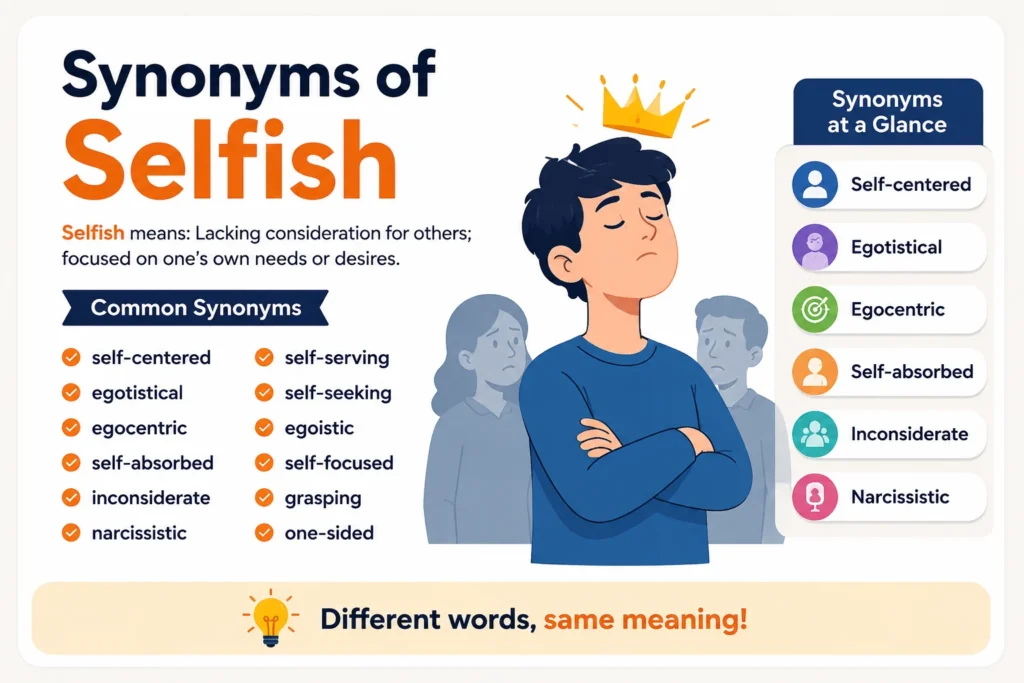
Looking for another word for “selfish” but want one that matches the exact behavior or tone you mean? The best alternative depends on whether you are describing someone who is focused on themselves, acting for personal gain, ignoring others’ needs, or excessively wanting more.
Self-centered suggests being overly focused on oneself, while self-absorbed emphasizes being deeply preoccupied with one’s own thoughts or feelings. Self-serving highlights actions taken mainly for personal benefit, whereas self-interested can sound more neutral or formal. Inconsiderate focuses on a lack of concern for other people, while egocentric suggests an unusually strong focus on oneself.
In more specific situations, greedy can describe an excessive desire for money, possessions, or other benefits. These words overlap with “selfish,” but they differ in meaning, intensity, and tone. This guide explains which alternatives work best in different situations, with clear definitions, examples, and practical usage tips.
Self-centered
Meaning: A self-centered person thinks mostly about their own needs, feelings, and interests.
Examples:
- Mia is too self-centered to ask how others feel.
- His self-centered behavior caused problems at home.
Self-absorbed
Meaning: A self-absorbed person is so focused on themselves that they often ignore other people.
Examples:
- Jake was too self-absorbed to notice his friend was upset.
- Her self-absorbed attitude made group talks difficult.
Self-interested
Meaning: A self-interested person mainly considers what will benefit them.
Examples:
- His self-interested decision helped him but hurt the team.
- She made a self-interested choice during the business deal.
Self-serving
Meaning: A self-serving action is mainly done to give the person a personal benefit.
Examples:
- His apology sounded self-serving.
- The manager made a self-serving decision before the vote.
Self-seeking
Meaning: A self-seeking person tries to gain personal success, money, or attention.
Examples:
- His self-seeking behavior damaged the team’s trust.
- She was criticized for making a self-seeking choice.
Egocentric
Meaning: An egocentric person sees the world mainly from their own point of view.
Examples:
- His egocentric attitude made teamwork hard.
- The egocentric child wanted every game to follow his rules.
Egoistic
Meaning: An egoistic person puts their own interests above the interests of others.
Examples:
- His egoistic behavior upset his classmates.
- She made an egoistic choice without asking anyone else.
Egotistical
Meaning: An egotistical person thinks very highly of themselves and their abilities.
Examples:
- The egotistical player never praised his teammates.
- His egotistical comments quickly became annoying.
Self-important
Meaning: A self-important person thinks they are more important than they really are.
Examples:
- His self-important manner made the meeting uncomfortable.
- She sounded self-important when talking about her job.
Self-regarding
Meaning: A self-regarding person is mainly concerned with their own interests.
Examples:
- His self-regarding attitude made cooperation difficult.
- She seemed self-regarding during the family discussion.
Self-focused
Meaning: A self-focused person gives most of their attention to their own goals and needs.
Examples:
- His self-focused approach left little room for others.
- She became less self-focused after joining the volunteer group.
Self-concerned
Meaning: A self-concerned person thinks mainly about their own problems or interests.
Examples:
- He was too self-concerned to help his neighbor.
- Her self-concerned attitude changed after the conversation.
Self-obsessed
Meaning: A self-obsessed person thinks about themselves far too much.
Examples:
- He is so self-obsessed that every topic becomes about him.
- Her self-obsessed habits pushed some friends away.
Narcissistic
Meaning: A narcissistic person has an extreme focus on themselves and their importance.
Examples:
- His narcissistic behavior made teamwork difficult.
- She found his narcissistic attitude hard to handle.
Self-aggrandizing
Meaning: A self-aggrandizing person tries to make themselves seem more important or successful.
Examples:
- His self-aggrandizing speech annoyed the audience.
- She made a self-aggrandizing post about her achievement.
Conceited
Meaning: A conceited person thinks they are better, smarter, or more attractive than others.
Examples:
- Tom is too conceited to accept helpful advice.
- Her conceited attitude made new friends uncomfortable.
Vain
Meaning: A vain person cares too much about their looks, success, or image.
Examples:
- He is very vain about his appearance.
- She became vain after receiving lots of praise.
Arrogant
Meaning: An arrogant person acts as if they are better or more important than others.
Examples:
- The arrogant player refused to hear another opinion.
- His arrogant tone upset the new employee.
Presumptuous
Meaning: A presumptuous person assumes they have the right to do or ask for something without proper permission.
Examples:
- It was presumptuous of him to take her seat.
- Her presumptuous request surprised everyone in the room.
Inconsiderate
Meaning: An inconsiderate person does not think enough about other people’s feelings or needs.
Examples:
- It was inconsiderate to leave the dishes for everyone else.
- His inconsiderate comment hurt his sister.
Thoughtless
Meaning: A thoughtless person acts without considering how their actions may affect others.
Examples:
- Forgetting her birthday was a thoughtless mistake.
- His thoughtless words made his friend feel bad.
49+Synonyms for Identify: The Right Word for What You Mean
Insensitive
Meaning: An insensitive person does not notice or care enough about other people’s feelings.
Examples:
- His insensitive joke upset the whole group.
- She regretted making such an insensitive comment.
Uncaring
Meaning: An uncaring person shows little concern for other people’s needs or feelings.
Examples:
- His uncaring response made the child cry.
- She seemed uncaring when her friend needed support.
Uncharitable
Meaning: An uncharitable person is unwilling to show kindness, help, or understanding toward others.
Examples:
- His uncharitable attitude made the situation worse.
- It was uncharitable to judge her so quickly.
Unmindful
Meaning: An unmindful person fails to notice or consider the needs of others.
Examples:
- He was unmindful of the noise he was making.
- She was unmindful of how tired her parents were.
Greedy
Meaning: A greedy person wants more money, food, power, or things than they really need.
Examples:
- The greedy child took all the cookies.
- His greedy behavior caused an argument over money.
Avaricious
Meaning: An avaricious person has a very strong desire for wealth.
Examples:
- The avaricious owner cared only about higher profits.
- His avaricious nature changed the way he treated people.
Acquisitive
Meaning: An acquisitive person strongly wants to gain or collect more possessions or wealth.
Examples:
- Her acquisitive nature led her to buy things she did not need.
- He became more acquisitive after earning more money.
Covetous
Meaning: A covetous person strongly wants something that belongs to someone else.
Examples:
- He was covetous of his neighbor’s new car.
- Her covetous feelings made the friendship uncomfortable.
Grasping
Meaning: A grasping person is eager to get money, power, or other benefits for themselves.
Examples:
- The grasping businessman wanted every possible reward.
- His grasping nature made people avoid him.
Rapacious
Meaning: A rapacious person has an extreme desire to gain wealth, power, or resources.
Examples:
- The rapacious company tried to control the whole market.
- His rapacious behavior hurt smaller businesses.
Mercenary
Meaning: A mercenary person is mainly interested in money or personal gain.
Examples:
- His mercenary attitude changed the way he chose friends.
- She thought the offer was too mercenary to be sincere.
Stingy
Meaning: A stingy person does not like spending or sharing money.
Examples:
- Don’t be stingy with the snacks.
- He is too stingy to buy a gift for anyone.
Miserly
Meaning: A miserly person hates spending money and often saves it excessively.
Examples:
- His miserly habits made family outings difficult.
- The miserly owner refused to replace the old chairs.
Tightfisted
Meaning: A tightfisted person is unwilling to spend or give money.
Examples:
- My uncle is very tightfisted with his money.
- The tightfisted manager refused to pay for basic supplies.
Possessive
Meaning: A possessive person wants to keep people or things for themselves and may dislike sharing.
Examples:
- Her possessive behavior made the relationship stressful.
- The child was possessive of his favorite toy.
Grabby
Meaning: A grabby person tries to take more than their fair share.
Examples:
- The grabby child reached for all the prizes.
- His grabby behavior annoyed everyone at the table.
Synonyms for Insight: Choose the Perfect Word for Your Sentence
Me-first
Meaning: A me-first person puts their own wants before the needs of other people.
Examples:
- His me-first attitude caused problems at work.
- She realized that her me-first behavior was hurting her friends.
Self-indulgent
Meaning: A self-indulgent person gives themselves too much pleasure or attention without thinking about others.
Examples:
- His self-indulgent spending left the family with less money.
- She took a long, self-indulgent break while others worked.
Self-maximizing
Meaning: A self-maximizing person focuses strongly on getting the greatest personal benefit.
Examples:
- His self-maximizing strategy ignored the team’s needs.
- The company used a self-maximizing approach during the deal.
Self-prioritizing
Meaning: A self-prioritizing person puts their own needs or goals ahead of other people’s needs.
Examples:
- Her self-prioritizing choices caused tension with her coworkers.
- He became less self-prioritizing after learning to share responsibility.
Domineering
Meaning: A domineering person tries to control other people and make decisions for them.
Examples:
- His domineering style made the team afraid to speak.
- Her domineering behavior caused arguments at home.
Controlling
Meaning: A controlling person wants to decide what other people should do.
Examples:
- His controlling behavior made his partner unhappy.
- She became controlling when the project got stressful.
Bossy
Meaning: A bossy person keeps telling other people what to do.
Examples:
- My little brother can be very bossy.
- She sounded bossy during the group project.
Demanding
Meaning: A demanding person expects a lot from other people and may focus strongly on getting what they want.
Examples:
- The demanding customer wanted an immediate answer.
- His demanding behavior exhausted his coworkers.
Exploitative
Meaning: An exploitative person unfairly uses other people for personal benefit.
Examples:
- The company was accused of using exploitative work practices.
- His exploitative behavior took advantage of new employees.
Manipulative
Meaning: A manipulative person tries to control others in an unfair or dishonest way.
Examples:
- His manipulative words made her feel guilty.
- She noticed his manipulative behavior during the argument.
Opportunistic
Meaning: An opportunistic person uses a situation to gain a personal advantage.
Examples:
- He made an opportunistic move when the rival company struggled.
- Her opportunistic decision gave her a quick advantage.
Predatory
Meaning: A predatory person or business tries to take unfair advantage of weaker people.
Examples:
- The company used predatory sales methods.
- His predatory behavior made younger workers uncomfortable.
Monopolistic
Meaning: A monopolistic person or business tries to control a resource or market and leave little for others.
Examples:
- The company’s monopolistic behavior hurt smaller sellers.
- His monopolistic approach gave other team members no room to contribute.
Conclusion
Learning synonyms for selfish gives you more control over your English. The right word can make an essay clearer, a blog more engaging, and a conversation more precise. These words also help you describe different forms of selfish behavior, from greed and self-focus to control and personal gain. Practice them in emails, essays, blog posts, and daily conversations. Start with common words such as self-centered, greedy, and inconsiderate, then add stronger or more formal words to grow your vocabulary.

Evan Blake creates powerful, research-backed synonym resources, guiding readers to communicate smarter, clearer, and more effectively every day.