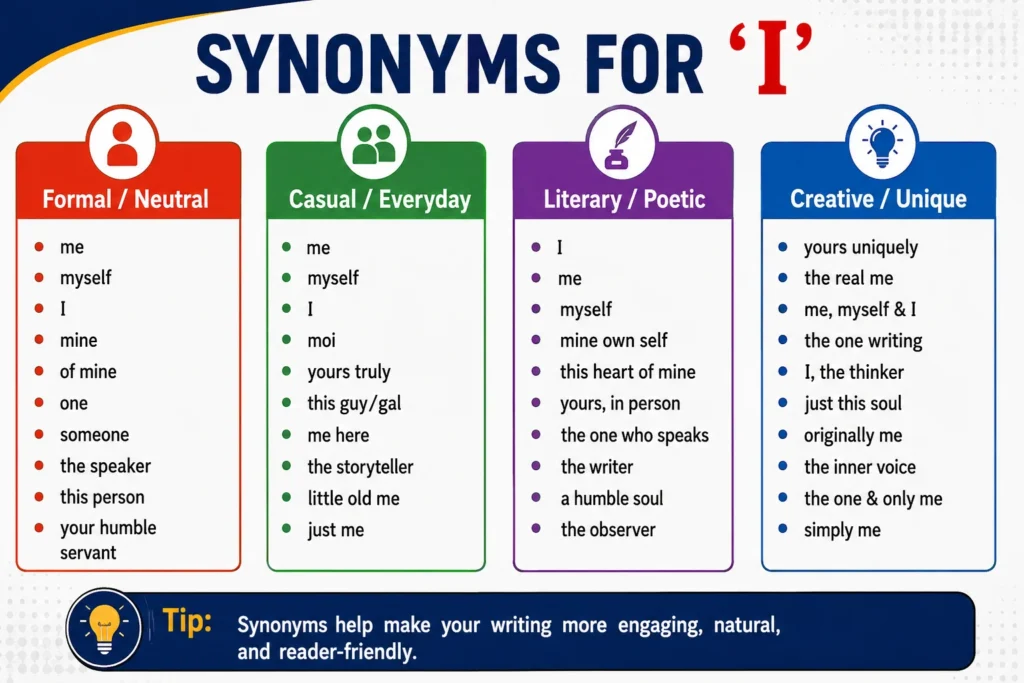
Looking for another word for “I” without changing the meaning or making your writing sound awkward? Here’s the important point: “I” has no direct one-word synonym when it is used as the first-person singular subject pronoun.
Instead, you can often avoid repeating it by changing the sentence structure or using a context-specific phrase. For example, “I believe” can sometimes become “in my view,” while “I think” can become “in my opinion.” However, words such as “me,” “myself,” and “we” are not interchangeable synonyms: me is the object form, myself is a reflexive or emphatic form, and we refers to more than one person.
This guide explains alternatives to “I,” when each option works, common grammatical mistakes, and natural examples for essays, academic writing, professional communication, and everyday English.
Me
Meaning: “Me” is the first-person pronoun used when the speaker receives an action.
Examples:
- Please send me the file.
- She called me after lunch.
Myself
Meaning: “Myself” refers back to the speaker and often adds strong personal emphasis.
Examples:
- I made the cake myself.
- I taught myself how to edit videos.
We
Meaning: “We” refers to the speaker together with one or more other people.
Examples:
- We finished the project today.
- We are ready for the meeting.
Us
Meaning: “Us” refers to the speaker and other people when they receive an action.
Examples:
- The teacher helped us.
- Please give us a few minutes.
My
Meaning: “My” shows that something belongs to or is connected with the speaker.
Examples:
- My laptop is on the desk.
- I forgot my notebook at home.
Mine
Meaning: “Mine” shows that something belongs to the speaker.
Examples:
- The black jacket is mine.
- That seat is mine.
Ourselves
Meaning: “Ourselves” refers to the speaker and other people and adds emphasis.
Examples:
- We prepared the food ourselves.
- We painted the room ourselves.
The Speaker
Meaning: “The speaker” refers to the person who is talking.
Examples:
- The speaker shared a personal story.
- The speaker answered the question clearly.
The Writer
Meaning: “The writer” refers to the person who created the written text.
Examples:
- The writer explains the topic in simple words.
- The writer gives a useful example.
The Author
Meaning: “The author” refers to the person who wrote a book, article, or other text.
Examples:
- The author explains the idea clearly.
- The author shares a personal lesson.
This Writer
Meaning: “This writer” is a formal way for an author to refer to themselves.
Examples:
- This writer prefers short sentences.
- This writer has tested the method.
The Researcher
Meaning: “The researcher” refers to the person who conducts a study or research.
Examples:
- The researcher collected the data.
- The researcher found an interesting result.
The Student
Meaning: “The student” can refer to yourself when writing about your role as a learner.
Examples:
- The student completed the task on time.
- The student learned a new skill.
The Blogger
Meaning: “The blogger” refers to the person who creates blog content.
Examples:
- The blogger shares helpful writing tips.
- The blogger tested the new tool.
The Content Writer
Meaning: “The content writer” refers to the person who creates written online content.
Examples:
- The content writer checked the article carefully.
- The content writer used simple language.
In My Opinion
Meaning: “In my opinion” introduces your personal view about something.
Examples:
- In my opinion, this book is worth reading.
- In my opinion, the second choice is better.
In My View
Meaning: “In my view” introduces what you personally think about a topic.
Examples:
- In my view, the rule is fair.
- In my view, the plan needs more time.
From My Perspective
Meaning: “From my perspective” explains how you personally see a situation.
Examples:
- From my perspective, the problem is simple.
- From my perspective, both choices have value.
From My Point of View
Meaning: “From my point of view” introduces your personal way of seeing something.
Examples:
- From my point of view, the lesson was useful.
- From my point of view, we need a better plan.
As I See It
Meaning: “As I see it” means that you are giving your personal understanding or opinion.
Examples:
- As I see it, we have two good options.
- As I see it, the problem can be solved.
In My Experience
Meaning: “In my experience” introduces something you have learned from your own experience.
Examples:
- In my experience, practice improves writing.
- In my experience, simple tools are easier to use.
Based on My Experience
Meaning: “Based on my experience” shows that your idea comes from something you have experienced.
Examples:
- Based on my experience, mornings are more productive.
- Based on my experience, short lessons work well.
From Where I Stand
Meaning: “From where I stand” introduces your personal position or opinion.
Examples:
- From where I stand, the deal looks fair.
- From where I stand, we need more information.
To Me
Meaning: “To me” shows how something seems or feels from your personal point of view.
Examples:
- To me, the answer seems clear.
- To me, this design looks better.
For Me
Meaning: “For me” explains what is true, useful, or important in your own case.
Examples:
- For me, writing is a relaxing activity.
- For me, this method saves time.
Personally
Meaning: “Personally” clearly shows that you are giving your own opinion.
Examples:
- Personally, I prefer the first option.
- Personally, I would choose the smaller bag.
Synonyms for Selfish:40+Stronger and More Precise Alternatives
In My Case
Meaning: “In my case” explains what is true for you personally.
Examples:
- In my case, the simple plan worked.
- In my case, daily practice made a difference.
My Perspective
Meaning: “My perspective” means your personal way of viewing a subject or situation.
Examples:
- My perspective changed after the trip.
- My perspective is different now.
My View
Meaning: “My view” means your personal opinion about something.
Examples:
- My view is based on real experience.
- My view changed after I learned more.
My Opinion
Meaning: “My opinion” means what you personally think about a subject.
Examples:
- My opinion may differ from yours.
- My opinion is based on what I saw.
I Think
Meaning: “I think” introduces a personal thought or opinion and is useful in everyday English.
Examples:
- I think this answer is correct.
- I think we should leave early.
I Believe
Meaning: “I believe” introduces something you think is true or important.
Examples:
- I believe this idea can work.
- I believe practice leads to progress.
I Feel
Meaning: “I feel” introduces a personal feeling, reaction, or opinion.
Examples:
- I feel happy about the results.
- I feel this choice is better.
I Would Say
Meaning: “I would say” gives a careful or polite personal opinion.
Examples:
- I would say the test was easy.
- I would say this is the best option.
49+Synonyms for Identify: The Right Word for What You Mean
I Would Suggest
Meaning: “I would suggest” gives a polite recommendation or idea.
Examples:
- I would suggest starting early.
- I would suggest checking the details first.
I Recommend
Meaning: “I recommend” means you think something is a good choice for someone.
Examples:
- I recommend this book to beginners.
- I recommend trying the new recipe.
I Suggest
Meaning: “I suggest” means you offer an idea or possible choice.
Examples:
- I suggest taking a short break.
- I suggest reading the instructions again.
I Prefer
Meaning: “I prefer” shows that you like one choice more than another.
Examples:
- I prefer tea in the morning.
- I prefer the second design.
I Consider
Meaning: “I consider” shows how you personally think about or judge something.
Examples:
- I consider her a good friend.
- I consider this a useful lesson.
I Find
Meaning: “I find” describes something you notice or experience in a certain way.
Examples:
- I find this app easy to use.
- I find the story very funny.
I Regard
Meaning: “I regard” means you think of someone or something in a certain way.
Examples:
- I regard him as a great teacher.
- I regard this book as a helpful guide.
I Agree
Meaning: “I agree” shows that your opinion is the same as another person’s opinion.
Examples:
- I agree with your idea.
- I agree that the plan is useful.
I Admit
Meaning: “I admit” means you openly accept that something is true.
Examples:
- I admit that I was wrong.
- I admit the task was difficult.
I Notice
Meaning: “I notice” means you become aware of something through seeing, hearing, or observing it.
Examples:
- I notice a change in her voice.
- I notice that the room is quieter today.
I Understand
Meaning: “I understand” means you know what something means or why it happened.
Examples:
- I understand your concern.
- I understand the main idea now.
I Know
Meaning: “I know” shows that you have information or knowledge about something.
Examples:
- I know the answer.
- I know where the keys are.
I Realize
Meaning: “I realize” means you become aware of something that you did not fully understand before.
Examples:
- I realize that I made a mistake.
- I realize how important this lesson is.
I Remember
Meaning: “I remember” means you can bring information or an event from the past to mind.
Examples:
- I remember that day clearly.
- I remember your helpful advice.
I Would Argue
Meaning: “I would argue” introduces a strong personal point in a discussion or formal essay.
Examples:
- I would argue that practice matters most.
- I would argue that the plan is fair.
I Believe That
Meaning: “I believe that” introduces a personal belief about a fact, idea, or situation.
Examples:
- I believe that simple writing works best.
- I believe that students need more practice.
I Would Say That
Meaning: “I would say that” gives a careful opinion about a specific idea or situation.
Examples:
- I would say that the answer is clear.
- I would say that the first plan is safer.
As Far as I Know
Meaning: “As far as I know” shows that you are giving information based on what you currently know.
Examples:
- As far as I know, the store is open.
- As far as I know, the meeting starts at ten.
As I Understand It
Meaning: “As I understand it” introduces your current understanding of a situation.
Examples:
- As I understand it, the meeting is tomorrow.
- As I understand it, the task is already finished.
My Understanding
Meaning: “My understanding” refers to what you personally understand about a subject.
Examples:
- My understanding is that the class starts at nine.
- My understanding of the topic has improved.
In My Mind
Meaning: “In my mind” introduces an idea, thought, or belief that you personally hold.
Examples:
- In my mind, the answer is simple.
- In my mind, kindness matters most.
Conclusion
Learning synonyms for I is really about learning better ways to express yourself. Because “I” is a first-person pronoun, it has no perfect synonym that works in every sentence. However, first-person forms, nouns, and useful phrases can help you avoid unnecessary repetition. These alternatives are valuable in essays, blogs, emails, professional writing, and daily conversations. Practice them in small sentences first. With regular use, your writing can become smoother, clearer, and more natural.

Noah Reed delivers authoritative, high-quality synonym insights, helping readers master language with precision, clarity, and creative finesse.