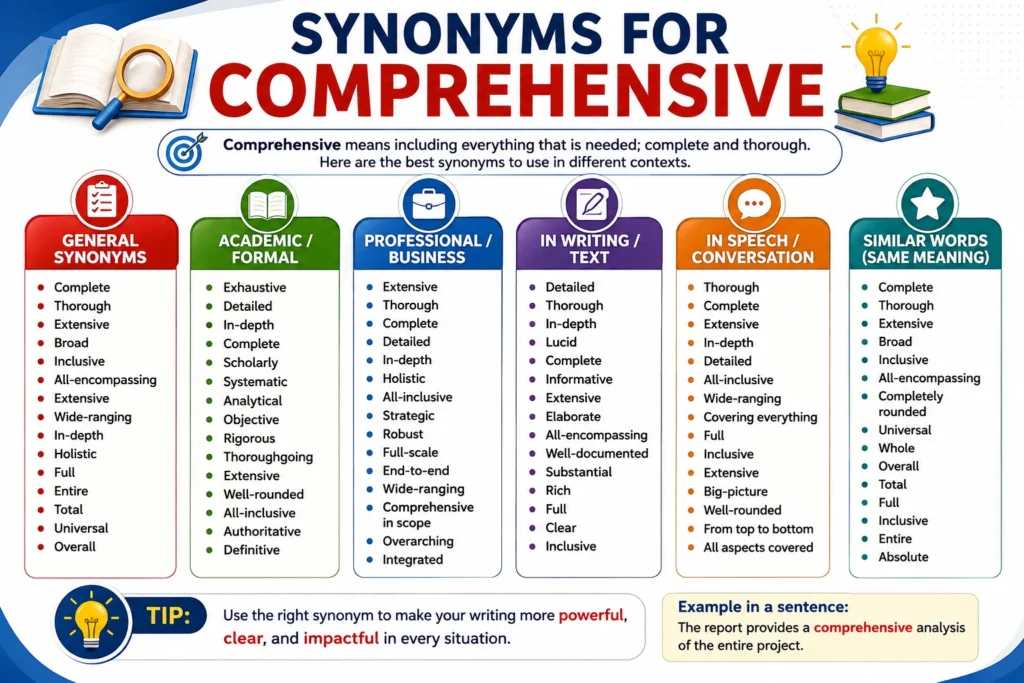
Looking for another word for “comprehensive” but want one that matches the exact meaning and tone you need? The best alternative depends on whether you mean complete coverage, careful detail, broad scope, or thorough treatment of a subject.
Thorough emphasizes careful attention to important details, while complete suggests that nothing essential has been left out. Extensive highlights a large size or broad range, whereas detailed emphasizes specific information and depth rather than overall coverage. Wide-ranging focuses on covering many topics or areas, while exhaustive suggests an exceptionally complete treatment that leaves very little relevant information unexplored.
These words overlap with “comprehensive,” but each carries a slightly different emphasis and may work better in particular contexts. This guide breaks down synonyms for comprehensive by meaning, tone, and usage, with clear definitions, example sentences, formal and informal alternatives, and practical tips for choosing the most precise word.
Thorough
Meaning:
- Thorough means covering every important part with great care.
Examples:
- She gave the report a thorough review.
- Please give the room a thorough cleaning.
Complete
Meaning:
- Complete means having all the parts that are needed.
Examples:
- Please send me the complete report.
- We need the complete story before we decide.
Detailed
Meaning:
- Detailed means giving many useful facts and specific points.
Examples:
- He wrote a detailed guide for new students.
- The manager gave us detailed instructions.
Exhaustive
Meaning:
- Exhaustive means covering almost every possible detail or option.
Examples:
- The researchers made an exhaustive study of the problem.
- We carried out an exhaustive search for the missing file.
Extensive
Meaning:
- Extensive means covering a large amount, area, or range.
Examples:
- She has extensive knowledge of digital marketing.
- The company conducted extensive research before launching the product.
All-Inclusive
Meaning:
- All-inclusive means including everything important or expected.
Examples:
- We booked an all-inclusive travel package.
- The course provides an all-inclusive introduction to English grammar.
Inclusive
Meaning:
- Inclusive means including all important parts, groups, or ideas.
Examples:
- The school created an inclusive learning plan.
- We need an inclusive discussion of the main issues.
In-Depth
Meaning:
- In-depth means examining a subject carefully and in great detail.
Examples:
- The article provides an in-depth look at online learning.
- We had an in-depth discussion about the project.
Wide-Ranging
Meaning:
- Wide-ranging means covering many different subjects or areas.
Examples:
- The interview covered wide-ranging topics.
- She has wide-ranging interests in science and art.
Broad
Meaning:
- Broad means covering a large subject or many different areas.
Examples:
- The course gives students a broad understanding of history.
- He has a broad knowledge of business.
All-Encompassing
Meaning:
- All-encompassing means including nearly every part or aspect of something.
Examples:
- The website offers an all-encompassing guide to photography.
- We need an all-encompassing plan for the campaign.
Encompassing
Meaning:
- Encompassing means including many or all parts of something.
Examples:
- The course has an encompassing approach to language learning.
- The report gives an encompassing view of the problem.
All-Embracing
Meaning:
- All-embracing means including many or nearly all parts of a subject.
Examples:
- The book gives an all-embracing view of modern education.
- The company needs an all-embracing strategy for growth.
Holistic
Meaning:
- Holistic means looking at all important parts of something as one whole.
Examples:
- The school uses a holistic approach to education.
- We need a holistic view of the customer’s needs.
Well-Rounded
Meaning:
- Well-rounded means including many useful areas, skills, or qualities.
Examples:
- The program gives students a well-rounded education.
- She has a well-rounded understanding of the subject.
Broad-Based
Meaning:
- Broad-based means involving many areas, groups, or types of people.
Examples:
- The project has broad-based support from the community.
- The company created a broad-based training program.
Wide
Meaning:
- Wide means covering many different subjects, choices, or areas.
Examples:
- The library has a wide range of English books.
- She has wide experience in content writing.
Expansive
Meaning:
- Expansive means covering a large range of ideas, subjects, or areas.
Examples:
- The book gives an expansive view of world history.
- His expansive knowledge helped the research team.
Synonyms for I: How to Write Without Repeating “I”
Encyclopedic
Meaning:
- Encyclopedic means containing a very large amount of information about a subject.
Examples:
- She has encyclopedic knowledge of world literature.
- The website provides encyclopedic information about birds.
Panoramic
Meaning:
- Panoramic means giving a broad view of many parts of a subject.
Examples:
- The documentary gives a panoramic view of modern life.
- His book offers a panoramic look at the country’s history.
Sweeping
Meaning:
- Sweeping means covering a very large range or area.
Examples:
- The report recommends sweeping changes to the system.
- She gave a sweeping overview of the subject.
Far-Reaching
Meaning:
- Far-reaching means affecting or covering many areas over a wide range.
Examples:
- The new law could have far-reaching effects.
- Technology has far-reaching effects on modern education.
Overarching
Meaning:
- Overarching means covering or connecting the main parts of a subject.
Examples:
- Our overarching goal is to improve customer service.
- The report explains the overarching purpose of the project.
Multifaceted
Meaning:
- Multifaceted means having many different parts or sides.
Examples:
- Education is a multifaceted subject.
- The problem requires a multifaceted solution.
Systematic
Meaning:
- Systematic means covering parts in an organized and planned way.
Examples:
- The team made a systematic review of the data.
- She took a systematic approach to the research.
Methodical
Meaning:
- Methodical means doing something in a careful and organized order.
Examples:
- He made a methodical review of every document.
- Her methodical approach helped find the error.
Meticulous
Meaning:
- Meticulous means extremely careful about every small detail.
Examples:
- She made a meticulous check of the final report.
- His meticulous research impressed the editor.
Synonyms for Selfish:40+Stronger and More Precise Alternatives
Careful
Meaning:
- Careful means paying close attention to important details.
Examples:
- We need a careful review before publishing the article.
- She gave the proposal a careful examination.
Elaborate
Meaning:
- Elaborate means containing many carefully developed details or parts.
Examples:
- He prepared an elaborate plan for the event.
- The website contains an elaborate explanation of the process.
Full
Meaning:
- Full means containing all the information or parts that are needed.
Examples:
- Please read the full report before the meeting.
- The teacher gave us a full explanation.
Entire
Meaning:
- Entire means including every part of something.
Examples:
- She spent the entire morning studying.
- We reviewed the entire document together.
Whole
Meaning:
- Whole means including all parts of something.
Examples:
- We need to understand the whole situation.
- He explained the whole process to the team.
Total
Meaning:
- Total means including everything without leaving out a part.
Examples:
- The manager requested a total review of the system.
- We need total information before making a final choice.
All-Around
Meaning:
- All-around means covering many different areas or qualities.
Examples:
- The course offers all-around support for beginners.
- She received all-around training for her new role.
All-Round
Meaning:
- All-round means including many useful aspects or abilities.
Examples:
- The program provides all-round development for children.
- He is an all-round employee who can handle different tasks.
All-Sided
Meaning:
- All-sided means considering all important sides of an issue.
Examples:
- The article gives an all-sided view of the debate.
- We need an all-sided discussion before reaching a decision.
Full-Scale
Meaning:
- Full-scale means complete in size, range, or effort.
Examples:
- The company began a full-scale investigation.
- They launched a full-scale review of their services.
Far-Reaching
Meaning:
- Far-reaching means extending across many areas or having a wide effect.
Examples:
- The decision may have far-reaching results.
- The internet has far-reaching effects on education.
Global
Meaning:
- Global means considering a whole system, subject, or large area rather than one small part.
Examples:
- We need a global view of the business.
- The report gives a global picture of the market.
Universal
Meaning:
- Universal means applying to all people, places, or cases.
Examples:
- The need for clear communication is universal.
- The guide explains universal principles of good writing.
General
Meaning:
- General means covering the main points instead of focusing on one small detail.
Examples:
- The introduction gives a general overview of the topic.
- I only need a general idea for now.
Detailed-Oriented
Meaning:
- Detail-oriented means giving close attention to many small details.
Examples:
- She is a detail-oriented editor.
- A detail-oriented writer can catch small mistakes.
Informed
Meaning:
- Informed means based on a good amount of useful information.
Examples:
- The report helped us make an informed decision.
- Read several sources before making an informed choice.
Well-Researched
Meaning:
- Well-researched means supported by careful research and useful information.
Examples:
- Her article is well-researched and easy to understand.
- Readers trust a well-researched guide.
In-Depth
Meaning:
- In-depth means providing a close and detailed examination of a subject.
Examples:
- The teacher gave an in-depth explanation of the lesson.
- This book offers an in-depth study of language.
Exhaustive-Style
Meaning:
- Exhaustive-style describes work that aims to cover nearly every important detail.
Examples:
- The researcher created an exhaustive-style reference guide.
- The team prepared an exhaustive-style review of the evidence.
Far-Flung
Meaning:
- Far-flung means spread across many distant places or areas.
Examples:
- The company has offices in far-flung regions.
- The study includes examples from far-flung parts of the world.
All-Over
Meaning:
- All-over means spread across every part of a physical area or surface.
Examples:
- The children left toys all over the room.
- Paint was splashed all over the floor.
Omnibus
Meaning:
- Omnibus means combining many different items, subjects, or works into one collection.
Examples:
- The publisher released an omnibus edition of the novels.
- The course is an omnibus collection of beginner writing lessons.
Exhaustive in Scope
Meaning:
- Exhaustive in scope means covering nearly every important part of a subject.
Examples:
- The report is exhaustive in scope.
- Her research is exhaustive in scope and very useful.
Broad in Scope
Meaning:
- Broad in scope means covering many areas or a large range of topics.
Examples:
- The project is broad in scope.
- His research is broad in scope but easy to follow.
Comprehensive in Scope
Meaning:
- Comprehensive in scope means covering almost every important part of a subject.
Examples:
- The study is comprehensive in scope.
- We need a guide that is comprehensive in scope.
Rich in Detail
Meaning:
- Rich in detail means containing many useful facts and specific points.
Examples:
- The article is rich in detail.
- Her notes are rich in detail and easy to review.
Deep and Detailed
Meaning:
- Deep and detailed means giving a close and careful explanation of a subject.
Examples:
- The guide gives a deep and detailed explanation.
- We need a deep and detailed review of the plan.
Conclusion
Learning synonyms for comprehensive can make your writing stronger and more natural. Students can use them in essays and assignments. Bloggers and content writers can use them to avoid repetition and make articles more useful. These words can also improve emails, reports, conversations, and everyday communication. The key is to choose a word that fits the context. Practice these alternatives in your next essay, blog post, email, or conversation, and your vocabulary will become more flexible and precise

Evan Blake creates powerful, research-backed synonym resources, guiding readers to communicate smarter, clearer, and more effectively every day.