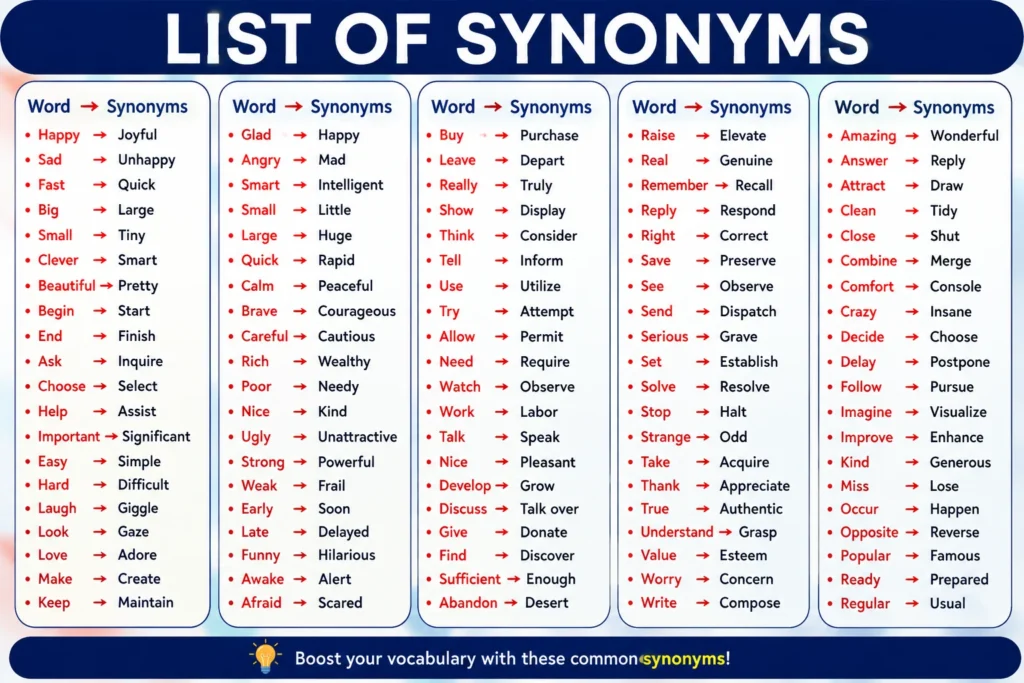
Looking for a list of synonyms to make your writing clearer, more varied, and more precise? Synonyms are words with the same or similar meanings, but most are not interchangeable in every sentence. Differences in tone, intensity, formality, context, and usage can make one synonym a much better choice than another.
For example, “happy,” “joyful,” “delighted,” and “content” all describe positive feelings, but they express different shades of meaning and emotion. Choosing the right synonym can help you avoid repetition while making your writing sound more natural, precise, and engaging.
This guide brings together useful synonym lists organized around common words, contexts, and writing needs, including everyday, formal, academic, professional, and creative alternatives. You’ll find clear meanings, example sentences, usage differences, and practical guidance for choosing the most natural synonym for what you actually want to say.
Alternative
Meaning: An alternative is another choice that can be used instead of the first choice.
Examples:
- We need an alternative to this plan.
- Walking is a good alternative to driving.
Substitute
Meaning: A substitute is a person or thing used in place of another.
Examples:
- Can you suggest a substitute for butter?
- Tom worked as a substitute teacher today.
Equivalent
Meaning: An equivalent is something that has the same or nearly the same value or meaning.
Examples:
- “Begin” is an equivalent of “start” in this sentence.
- This amount is the equivalent of ten dollars.
Similar
Meaning: Similar means almost the same but not exactly the same.
Examples:
- These two words have similar meanings.
- Your idea is similar to mine.
Alike
Meaning: Alike means similar to each other.
Examples:
- The two words sound alike.
- The brothers look very much alike.
Same
Meaning: Same means not different from something else.
Examples:
- These words have the same meaning.
- We chose the same answer.
Equal
Meaning: Equal means the same in value, amount, or level.
Examples:
- Both answers are equal in value.
- The two sides are equal in length.
Comparable
Meaning: Comparable means similar enough to be compared.
Examples:
- The two phones have comparable features.
- Her results are comparable to last year’s results.
Corresponding
Meaning: Corresponding means matching or relating to something else.
Examples:
- Write the corresponding synonym beside each word.
- Each picture has a corresponding sentence.
Related
Meaning: Related means connected in meaning, subject, or idea.
Examples:
- “Teacher” and “school” are related words.
- These terms are closely related.
Connected
Meaning: Connected means joined by a clear link or relationship.
Examples:
- These words are connected by meaning.
- The two ideas are closely connected.
Linked
Meaning: Linked means connected or related to something else.
Examples:
- The two terms are linked by the same idea.
- These topics are closely linked.
Associated
Meaning: Associated means connected with a person, thing, idea, or subject.
Examples:
- “Doctor” is often associated with health.
- The word is associated with success.
Resembling
Meaning: Resembling means being similar in appearance, form, or nature.
Examples:
- This word resembles another common term.
- The two phrases resemble each other.
60+Synonyms for Comprehensive: Precise Alternatives
Parallel
Meaning: Parallel means similar in form, purpose, or development.
Examples:
- The two stories have parallel themes.
- Their ideas follow parallel lines.
Identical
Meaning: Identical means exactly the same.
Examples:
- The two copies are identical.
- They used identical words in the report.
Duplicate
Meaning: A duplicate is an exact copy of something.
Examples:
- I found a duplicate file on my computer.
- Please remove the duplicate entry.
Copy
Meaning: A copy is something made to be the same as another thing.
Examples:
- Please send me a copy of the document.
- I saved a copy of my essay.
Version
Meaning: A version is a particular form of something that may differ from another form.
Examples:
- I wrote a shorter version of the article.
- The latest version is easier to read.
Form
Meaning: A form is a particular way something appears or is expressed.
Examples:
- This phrase has a formal form.
- We learned another form of the word.
Expression
Meaning: An expression is a word or group of words used to communicate an idea.
Examples:
- “Take care” is a common expression.
- She used a polite expression in her email.
Term
Meaning: A term is a word or phrase used for a particular idea or subject.
Examples:
- “Keyword” is a common SEO term.
- I learned a new term in class.
Phrase
Meaning: A phrase is a group of words that works together as part of a sentence.
Examples:
- “In a hurry” is a common phrase.
- I found a better phrase for my sentence.
Word
Meaning: A word is a unit of language used to express a meaning or idea.
Examples:
- Choose a simple word for your sentence.
- This word is common in daily English.
Vocabulary
Meaning: Vocabulary means the words a person knows, understands, or uses.
Examples:
- Reading can improve your vocabulary.
- She has a strong English vocabulary.
Wording
Meaning: Wording means the exact words used to express an idea.
Examples:
- I changed the wording of my email.
- The new wording sounds more friendly.
Word Choice
Meaning: Word choice means selecting words that fit your meaning and situation.
Examples:
- Good word choice makes writing clearer.
- Her word choice was perfect for the audience.
Word Selection
Meaning: Word selection means choosing the words you want to use.
Examples:
- Careful word selection can improve an essay.
- His word selection made the message clear.
Synonyms for I: How to Write Without Repeating “I”
Word Variation
Meaning: Word variation means using different words to express similar ideas.
Examples:
- Word variation can make a blog more interesting.
- I used word variation to avoid repetition.
Vocabulary Variation
Meaning: Vocabulary variation means using a range of different words in speech or writing.
Examples:
- Vocabulary variation can make your essay stronger.
- Good vocabulary variation keeps readers interested.
Word Replacement
Meaning: Word replacement means using one word instead of another.
Examples:
- Word replacement can remove repeated terms.
- I used word replacement to improve the paragraph.
Alternative Word
Meaning: An alternative word is another word that can be used in a particular context.
Examples:
- “Quick” is an alternative word for “fast.”
- Can you give me an alternative word?
Similar Word
Meaning: A similar word has a meaning that is close to another word.
Examples:
- “Large” is a similar word to “big.”
- Find a similar word for this sentence.
Related Word
Meaning: A related word has a clear connection to another word or idea.
Examples:
- “Rain” and “cloud” are related words.
- Write one related word for each topic.
Matching Word
Meaning: A matching word is a word that fits the meaning or context of another word.
Examples:
- Find a matching word for “happy.”
- This is a good matching word for the sentence.
Suitable Word
Meaning: A suitable word is a word that fits a particular situation well.
Examples:
- Choose a suitable word for the email.
- The teacher helped me find a suitable word.
Appropriate Word
Meaning: An appropriate word is a word that is right for a particular situation.
Examples:
- Use an appropriate word in a formal essay.
- She chose an appropriate word for the message.
Exact Word
Meaning: An exact word is a word that expresses an idea very precisely.
Examples:
- I need an exact word for this feeling.
- The writer found the exact word she wanted.
Better Word
Meaning: A better word is a word that fits an idea more clearly or naturally.
Examples:
- Can you suggest a better word?
- I found a better word for my headline.
Stronger Word
Meaning: A stronger word gives an idea more force or emotion.
Examples:
- “Amazing” is a stronger word than “good.”
- Use a stronger word to show excitement.
Clearer Word
Meaning: A clearer word makes an idea easier to understand.
Examples:
- Use a clearer word in this sentence.
- I changed the term to a clearer word.
Simpler Word
Meaning: A simpler word is easier to understand or use.
Examples:
- Use a simpler word for young readers.
- The teacher suggested a simpler word.
Formal Word
Meaning: A formal word is suitable for serious, professional, or academic situations.
Examples:
- Choose a formal word for your report.
- “Purchase” is more formal than “buy.”
Informal Word
Meaning: An informal word is common in relaxed and friendly situations.
Examples:
- “Kids” is an informal word for children.
- Use an informal word when chatting with friends.
Common Word
Meaning: A common word is used often by many English speakers.
Examples:
- “Happy” is a common English word.
- Try a common word when writing for beginners.
Advanced Word
Meaning: An advanced word is a less common word that may require more English knowledge.
Examples:
- The teacher introduced an advanced word.
- I learned an advanced word from the book.
Everyday Word
Meaning: An everyday word is a word people often use in normal daily life.
Examples:
- “Help” is an everyday word.
- Use everyday words in a friendly message.
Descriptive Word
Meaning: A descriptive word gives more information about a person, place, thing, or idea.
Examples:
- “Bright” is a useful descriptive word.
- Add a descriptive word to make the story vivid.
Precise Word
Meaning: A precise word gives a very exact meaning.
Examples:
- Choose a precise word for your report.
- A precise word can make your meaning clear.
Contextual Alternative
Meaning: A contextual alternative is another word that fits the meaning of a sentence or situation.
Examples:
- “Purchase” is a contextual alternative to “buy” in formal writing.
- Choose a contextual alternative that fits the sentence.
Thesaurus
Meaning: A thesaurus is a reference tool that helps you find words with similar meanings.
Examples:
- I used a thesaurus to find a better word.
- A thesaurus can help you avoid repeated words.
Glossary
Meaning: A glossary is a list that explains special or difficult words.
Examples:
- The textbook has a glossary at the end.
- Check the glossary for unfamiliar terms.
Lexicon
Meaning: A lexicon is the set of words used in a language or a particular subject.
Examples:
- Reading can expand your English lexicon.
- The book uses a specialized scientific lexicon.
Vocabulary List
Meaning: A vocabulary list is a group of words collected for learning or reference.
Examples:
- The teacher gave us a vocabulary list.
- I made a vocabulary list for my exam.
Word List
Meaning: A word list is a collection of words grouped together for a purpose.
Examples:
- I created a word list for my writing class.
- Check the word list before starting the exercise.
Conclusion
A strong list of synonyms can make your English more flexible and useful. Learning similar words helps you avoid repetition, choose the right tone, and explain ideas more clearly. It can improve essays, blog posts, emails, conversations, and everyday communication. Remember that synonyms are not always exact replacements, so always check the sentence and context. Practice a few new words each day. Try them in emails, essays, blog posts, and daily conversations. The more you use them, the more natural your English will become.

Eli Frost is a passionate writer at SynonymLabi, specializing in words, meanings, and language insights, helping readers express ideas with clarity and creativity.