Looking for a better word than “lazy” without sounding too harsh? The best synonym depends on what you actually mean.
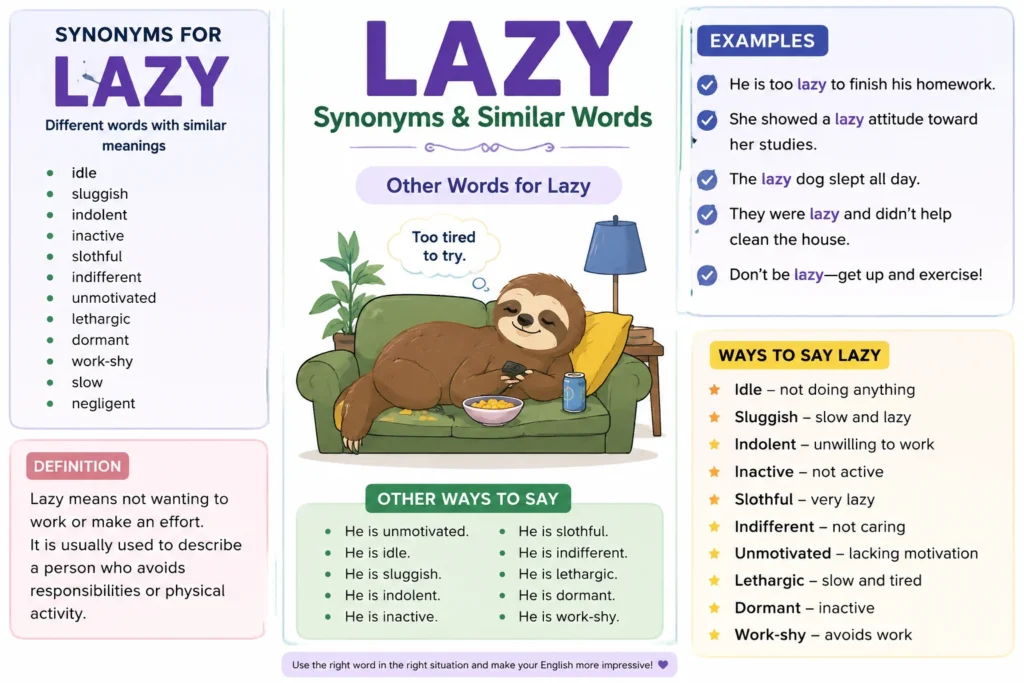
You might use idle for someone who is not currently working, inactive for someone who is not physically active, unmotivated for someone who lacks drive, sluggish for slow or low-energy behavior, or indolent for someone who is habitually unwilling to make an effort.
If you’re searching for synonyms for lazy, you may want to avoid repetition, improve an essay or professional description, or find a more precise way to describe someone’s behavior. The tricky part? Some alternatives describe inactivity, tiredness, or low motivation rather than laziness itself. Choosing the wrong word can change the meaning of your sentence.
This guide covers useful synonyms, near-synonyms, and related words for lazy, from mild and neutral options to stronger or more formal terms, with clear examples to help you choose the right word.
Idle
Meaning: Not working or not being active.
Usage: Neutral; often describes a person, machine, or time when nothing is happening.
Examples:
- The workers sat idle after the machine stopped.
- I had an idle afternoon at home.
Inactive
Meaning: Not doing much or taking part in an activity.
Usage: Neutral; best for people, accounts, groups, or activities.
Examples:
- He has been inactive since the project ended.
- My old account is still inactive.
Indolent
Meaning: Not willing to work or make an effort.
Usage: Formal and negative; a strong synonym for lazy.
Examples:
- The indolent worker avoided every difficult task.
- His indolent habits slowed his progress.
Slothful
Meaning: Very lazy and unwilling to work.
Usage: Strong and negative; often used in formal or literary writing.
Examples:
- His slothful behavior caused problems at work.
- The slothful student kept avoiding his homework.
Sluggish
Meaning: Slow to move, act, or work.
Usage: Best for slow behavior or low energy rather than unwillingness to work.
Examples:
- I felt sluggish after the heavy meal.
- The team had a sluggish start this morning.
Shiftless
Meaning: Lazy and lacking a clear purpose or plan.
Usage: Informal to literary; usually negative.
Examples:
- The shiftless man spent most of his day doing nothing.
- His shiftless habits made it hard to keep a job.
Work-shy
Meaning: Unwilling to work.
Usage: Informal; commonly used for a person who avoids work.
Examples:
- The manager disliked hiring work-shy employees.
- His work-shy attitude was easy to notice.
Bone-idle
Meaning: Extremely lazy.
Usage: Informal; especially common in British English.
Examples:
- My brother can be bone-idle on weekends.
- The bone-idle student never wanted to study.
Otiose
Meaning: Not useful, active, or productive.
Usage: Very formal and uncommon; useful in advanced writing.
Examples:
- His otiose approach added little to the project.
- The team removed several otiose tasks.
Slacker
Meaning: A person who avoids work or does less than expected.
Usage: Informal and negative; mainly used for people.
Examples:
- Everyone knew that Tom was a slacker.
- The boss warned the slacker about his missed tasks.
Slack
Meaning: Not working hard or putting in enough effort.
Usage: Informal; can describe a person, effort, or work.
Examples:
- He has been slack with his homework.
- Do not be slack about your daily tasks.
Slacking
Meaning: Avoiding work or putting in less effort than needed.
Usage: Informal; describes an action rather than a person.
Examples:
- Stop slacking and finish your report.
- She was caught slacking during work hours.
Shirker
Meaning: A person who avoids duties or work.
Usage: Negative; usually describes someone who leaves work for others.
Examples:
- Nobody wants a shirker on the team.
- The shirker left his duties for his coworkers.
Shirking
Meaning: Avoiding a duty or responsibility.
Usage: Formal or neutral; focuses on the action.
Examples:
- He was shirking his responsibilities.
- Shirking your duties can affect the whole team.
Loafer
Meaning: A person who avoids work and spends time doing little.
Usage: Informal and negative.
Examples:
- His friends called him a loafer.
- The loafer spent the morning watching TV.
Loafing
Meaning: Spending time doing little or no work.
Usage: Informal; focuses on behavior.
Examples:
- They were loafing instead of cleaning the room.
- He spent the afternoon loafing at home.
Unmotivated
Meaning: Not feeling willing or ready to work toward a goal.
Usage: Neutral and common; often more polite than lazy.
Examples:
- I felt unmotivated after getting a low grade.
- She was unmotivated and needed a clear goal.
Unproductive
Meaning: Not getting useful work or results done.
Usage: Neutral; good for work, time, habits, or activities.
Examples:
- I had an unproductive morning.
- The meeting was long and unproductive.
Unwilling
Meaning: Not wanting to do something.
Usage: Neutral; focuses on choice rather than ability.
Examples:
- He was unwilling to help with the task.
- The child was unwilling to clean his room.
Reluctant
Meaning: Not willing or eager to do something.
Usage: Neutral and polite; softer than lazy.
Examples:
- She was reluctant to start the long assignment.
- He felt reluctant to join the activity.
Synonyms for Independent: 53+ Words for Different Meanings
Disinclined
Meaning: Not wanting to do something.
Usage: Formal; useful when you want a polite alternative.
Examples:
- I was disinclined to go out in the rain.
- She felt disinclined to discuss the issue.
Apathetic
Meaning: Not caring enough to take interest or action.
Usage: Neutral to negative; describes a lack of interest, not simple tiredness.
Examples:
- He seemed apathetic about his schoolwork.
- The team became apathetic after several losses.
Passive
Meaning: Not taking action or making an effort to change something.
Usage: Neutral to negative; useful when someone waits instead of acting.
Examples:
- He stayed passive during the discussion.
- A passive approach may not solve the problem.
Listless
Meaning: Having little energy or interest.
Usage: Literary or descriptive; often describes behavior or mood.
Examples:
- The child looked listless after the long trip.
- I felt listless during the rainy afternoon.
Languid
Meaning: Moving or acting in a slow and relaxed way.
Usage: Literary; can describe slow behavior without directly meaning lazy.
Examples:
- He gave a languid wave from the sofa.
- She walked with a languid pace.
Torpid
Meaning: Very slow and lacking energy or activity.
Usage: Formal or literary; describes a low-energy state.
Examples:
- The heat left him feeling torpid.
- His torpid movements showed that he needed a break.
Dormant
Meaning: Not active or working for a period of time.
Usage: Neutral; usually describes activity, projects, systems, or abilities rather than a lazy person.
Examples:
- The project has remained dormant for months.
- Her creative side was dormant during the busy season.
Unenergetic
Meaning: Having little energy or showing little activity.
Usage: Neutral; useful when describing low activity.
Examples:
- I felt unenergetic during the hot afternoon.
- The unenergetic team struggled to begin.
Lackadaisical
Meaning: Showing little energy, care, or enthusiasm.
Usage: Common but slightly formal; often means careless or not serious.
Examples:
- His lackadaisical attitude hurt the project.
- She gave a lackadaisical response to the request.
Careless
Meaning: Not giving enough attention or effort to something.
Usage: Related to lazy behavior but not a direct synonym.
Examples:
- His careless work had several errors.
- I was careless with the final part of my assignment.
Negligent
Meaning: Failing to give proper care or attention to a duty.
Usage: Formal and serious; related to failure to do a duty, not simple laziness.
Examples:
- The negligent worker ignored important instructions.
- His negligent actions caused a serious delay.
Complacent
Meaning: Too comfortable to try harder or improve.
Usage: Formal and negative; useful when success makes someone stop trying.
Examples:
- The team became complacent after winning.
- Do not become complacent when your results improve.
Unambitious
Meaning: Not wanting to achieve more or reach bigger goals.
Usage: Neutral to negative; focuses on goals rather than work habits.
Examples:
- He seemed unambitious about his career.
- Her unambitious plan did not challenge her.
Unenterprising
Meaning: Not showing much energy or desire to start new things.
Usage: Formal and uncommon; focuses on a lack of initiative.
Examples:
- His unenterprising attitude limited his progress.
- The unenterprising team missed a useful opportunity.
Synonyms for Activities: 51+ Words That Fit the Context
Spiritless
Meaning: Showing little energy, enthusiasm, or excitement.
Usage: Descriptive; focuses on low enthusiasm.
Examples:
- The team gave a spiritless performance.
- His spiritless reply showed little interest.
Half-hearted
Meaning: Done with little effort, care, or enthusiasm.
Usage: Common; useful when someone makes an effort but does not try hard.
Examples:
- He gave a half-hearted attempt at cleaning.
- Her half-hearted effort was easy to notice.
Lukewarm
Meaning: Showing little interest or enthusiasm.
Usage: Often describes a response, opinion, or reaction rather than a person.
Examples:
- The team gave a lukewarm response to the idea.
- His lukewarm interest made the plan difficult.
Apathetic
Meaning: Showing little care, feeling, or interest.
Usage: Negative; describes a lack of concern or motivation.
Examples:
- The student seemed apathetic about the result.
- She became apathetic after repeated failures.
Unconcerned
Meaning: Not worried or interested enough to react.
Usage: Related to lazy behavior in some contexts, but not a direct synonym.
Examples:
- He seemed unconcerned about the unfinished work.
- She was unconcerned about the growing delay.
Procrastinating
Meaning: Delaying a task that should be done now.
Usage: Very common; related to lazy behavior but not always caused by laziness.
Examples:
- I am procrastinating instead of writing my essay.
- She kept procrastinating on her homework.
Procrastinatory
Meaning: Connected with delaying tasks or actions.
Usage: Formal; describes habits, behavior, or actions.
Examples:
- His procrastinatory habits caused missed deadlines.
- The coach helped him break his procrastinatory routine.
Delaying
Meaning: Waiting to do something until a later time.
Usage: Neutral; focuses on putting off an action.
Examples:
- He kept delaying his homework.
- Stop delaying the task and start now.
Stalling
Meaning: Deliberately slowing down or delaying action.
Usage: Common and informal; often suggests intentional delay.
Examples:
- He was stalling instead of answering the question.
- Stop stalling and make a decision.
Dawdling
Meaning: Moving or acting too slowly instead of getting on with a task.
Usage: Informal; often used for people who waste time.
Examples:
- Stop dawdling and get ready for school.
- She was dawdling when everyone else was ready.
Loitering
Meaning: Staying somewhere without a clear purpose.
Usage: Usually describes behavior, not a person’s general character.
Examples:
- The boys were loitering outside the shop.
- He spent the afternoon loitering near the entrance.
Idling
Meaning: Spending time without working or doing anything useful.
Usage: Neutral; closely related to idle.
Examples:
- He was idling at his desk all morning.
- The workers were idling while they waited for supplies.
Work-averse
Meaning: Unwilling or strongly opposed to doing work.
Usage: Formal or descriptive; stronger than simply saying lazy.
Examples:
- His work-averse attitude caused problems.
- The work-averse employee avoided difficult tasks.
Work-avoiding
Meaning: Trying to avoid work or effort.
Usage: Clear and descriptive; useful in everyday explanations.
Examples:
- His work-avoiding habits frustrated his team.
- The work-avoiding student always looked for excuses.
Effort-averse
Meaning: Unwilling to make much effort.
Usage: Formal and descriptive; useful when laziness means avoiding effort.
Examples:
- His effort-averse attitude slowed the project.
- An effort-averse person may avoid difficult tasks.
Unindustrious
Meaning: Not hardworking or productive.
Usage: Formal; a strong alternative to lazy in writing.
Examples:
- The unindustrious worker often missed deadlines.
- His unindustrious habits affected his results.
Unassiduous
Meaning: Not showing steady effort or care.
Usage: Very formal and uncommon; best for advanced writing.
Examples:
- His unassiduous work led to poor results.
- The unassiduous approach did not help the project.
Idle-minded
Meaning: Not actively thinking about useful work or activity.
Usage: Uncommon; descriptive rather than an everyday synonym.
Examples:
- He spent the afternoon in an idle-minded state.
- An idle-minded approach can waste useful time.
Sloth-like
Meaning: Very slow or inactive in a way that resembles a sloth.
Usage: Informal and descriptive; useful for playful writing.
Examples:
- I moved in a sloth-like way on Sunday morning.
- His sloth-like pace made everyone wait.
Good-for-nothing
Meaning: A person seen as useless, lazy, or unwilling to work.
Usage: Strong, insulting, and informal; use carefully.
Examples:
- The character in the story was called a good-for-nothing.
- His uncle jokingly called him a good-for-nothing.
FAQ
What is the best synonym for lazy?
The best synonym depends on the context. Idle is a simple general choice, while indolent is more formal. Slacker describes a person who avoids work, and procrastinating describes someone who keeps delaying tasks.
What is a polite word for lazy?
Unmotivated, inactive, and unproductive can sound softer than lazy. For example, “unmotivated” focuses on a person’s lack of drive instead of directly judging the person.
What is a positive synonym for lazy?
There is no exact positive synonym for lazy because lazy usually has a negative meaning. Words such as laid-back, relaxed, or easygoing can describe a calm person, but they do not truly mean lazy.
What is the formal word for lazy?
Indolent is one of the strongest formal synonyms for lazy. Unindustrious can also mean not hardworking, while slothful is stronger and often sounds literary or negative.
What is a synonym for a lazy person?
Common words for a lazy person include slacker, loafer, shirker, idler, and work-shy person. Some of these are informal or negative, so choose the word based on the situation.
Is procrastinating the same as being lazy?
No. Procrastinating means delaying a task, while lazy usually means not wanting to make an effort. A person can procrastinate because of fear, stress, confusion, or poor planning, not only because of laziness.
What is the opposite of lazy?
Common opposites of lazy include hardworking, active, energetic, diligent, industrious, motivated, and productive. These words describe people who make an effort and take action.
Conclusion
Learning synonyms for lazy helps you make your English more clear and precise. The right word can improve your writing, blogging, speaking, and everyday communication. Practice these words in emails, essays, articles, and daily conversations. Start with simple choices such as idle, inactive, and unmotivated, then try stronger or more formal words such as indolent and unindustrious. When you understand the small differences between words, you can express your ideas with greater confidence.