
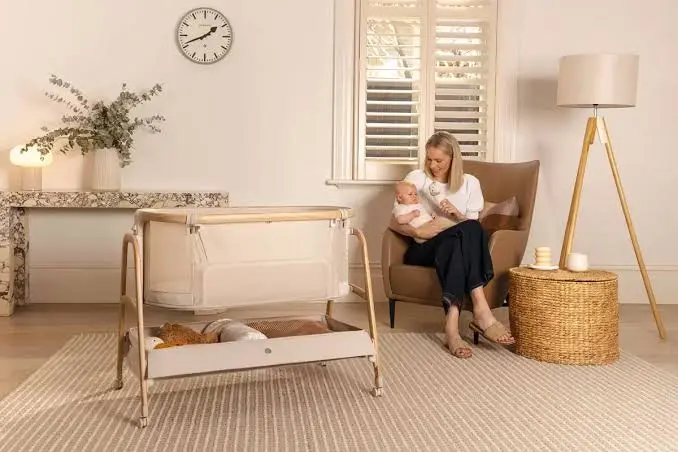

The baby bassinet decision for Australian Q4 2026 families has a summer-specific dimension that the same decision made in April or May does not — the October, November, or December baby will be spending their critical early months in Australian summer conditions where bassinet ventilation, room temperature management, and the timing of the bassinet-to-cot transition intersect with the January-February heat peak. This October guide addresses the summer-specific bassinet considerations alongside the 2026 Australian market updates that every expecting Australian family needs before making the most time-sensitive nursery purchase of the Q4 season.
The Summer Australian Bassinet: What Specifications Matter Most
What bassinet specifications are most important for an Australian summer birth in Q4 2026?
Three bassinet specifications carry elevated importance for Australian Q4 2026 babies who will be two to four months old during January and February. First, open-side or mesh construction: a bassinet with mesh or open-weave sides on at least two sides provides significantly better airflow around the sleeping Australian summer infant than a fully enclosed design — the single most important thermal management specification for a baby who will experience Australian summer at their most developmentally heat-sensitive age. Second, breathable natural fibre mattress: a coconut fibre or natural fibre bassinet mattress provides better thermal regulation than polyfoam in Australian summer conditions where the baby’s body heat cannot be adequately dissipated through a heat-retaining sleep surface. Third, standalone stability at the adult bed position: the bassinet must stand stably beside the adult bed without requiring the bedroom to be redesigned around its footprint — a practical requirement that the summer master bedroom setup, with ceiling fan optimisation for three people’s thermal comfort, may constrain more than in cooler months.
The ACCC and Australian Bassinet Safety in Q4 2026
What has the ACCC’s activity in 2026 meant for the Australian bassinet market?
The ACCC’s increased scrutiny of bassinet products imported through Australian marketplace channels in 2025 and 2026 has produced a clearer understanding among Australian nursery families of the compliance landscape for this product category. Several marketplace bassinet products have been subject to compliance actions in the current market cycle, reinforcing the guidance that Australian families should request specific safety compliance documentation for any bassinet purchased through a marketplace channel rather than assuming listing implies compliance. For Q4 2026 Australian families who want certainty, purchasing from a specialist Australian nursery brand with documented safety standards for the specific model is the most reliable approach in a market where ACCC activity has confirmed the compliance risks in marketplace channels.
| AU Bassinet Purchase Channel | Compliance Certainty | Delivery Speed | Price Range | Q4 2026 Recommendation |
| Specialist AU nursery brand (direct) | Highest: specific compliance docs available | 4-6 weeks | AUD 200-500 | Best for Q4 2026 compliance certainty |
| Authorised AU retail stockist | High: brand documentation available through retailer | 2-5 weeks | AUD 200-500 | Excellent option; confirm model docs |
| General AU baby retailer (major chain) | Moderate: varies by specific model | 1-3 weeks | AUD 100-400 | Request model-specific docs; not all available |
| AU online marketplace | Low: compliance documentation inconsistent | 1-5 days | AUD 60-300 | Request specific compliance docs; highest risk channel |
The Summer Bassinet Timeline for Australian Q4 Families
How long will an Australian summer baby use a bassinet?
An Australian baby born in October 2026 will typically outgrow their bassinet by January to March 2027 — three to five months after birth — depending on the specific baby’s growth rate and the bassinet’s weight limit. October babies frequently approach the 6 to 8 kg bassinet weight limit faster than parents anticipate because the Australian Q4 birth cohort includes a high proportion of above-median-weight newborns, and because the Australian summer growth conditions — warmth and adequate feeding — support rapid weight gain in the early months. Planning the bassinet-to-cot transition before the Christmas-New Year period rather than reactively in February avoids the logistical challenge of a bedroom reconfiguration during the holiday period. Setting up the full-size AS/NZS 8811.1-compliant nursery cot for daytime naps from birth — alongside the bassinet’s overnight role — creates the familiar alternative that makes the overnight transition smooth when the bassinet’s service period ends.
Bassinet vs Bedside Cot for Australian Q4 2026 Families
How should Australian Q4 families choose between a bassinet and a bedside cot for a summer birth?
The bassinet versus bedside cot decision for Australian Q4 2026 families is primarily determined by overnight proximity priority versus daytime portability priority, with summer thermal management as a secondary consideration for both. A bedside cot attached to the adult bed at matching height provides the flush-join arm’s-reach access most valuable for Australian breastfeeding mothers with adequate master bedroom floor space — and its open or mesh side design typically provides good airflow for the summer baby. A standalone bassinet provides portability for daytime naps across the Australian home in different rooms — valuable for the summer heat management approach of keeping the baby in the coolest room of the Australian house at different times of day — alongside adequate overnight proximity when positioned beside but not attached to the adult bed. For Australian Q4 families in compact urban apartments where master bedroom floor space limits the bedside cot option, the bassinet’s smaller footprint and room-to-room portability often makes it the more practical summer choice.
Frequently Asked Questions
Can Australian twins share a bassinet in summer?
No. Red Nose Australia’s guidance is explicit that each Australian infant requires their own separate sleep surface. Australian twins must each have their own individual bassinet from birth. The summer thermal consideration for Australian twin bassinets is that two infants in a shared sleep space generate significantly more collective body heat than a single infant — reinforcing rather than relaxing the individual bassinet requirement during Australian summer conditions.
What is the most important safety check for an Australian bassinet in October 2026?
The most important safety check for an Australian bassinet purchase in October 2026 is confirming the specific model is rated for overnight infant sleep — not only for supervised daytime nap use. Some Australian bassinets marketed as suitable for nursery use are rated only for supervised daytime naps by their manufacturers. This overnight sleep rating must be confirmed from the product documentation before purchasing, not assumed from the retail listing or the general nursery positioning of the product.
How do Australian parents keep a summer baby cool in a bassinet?
The most effective approaches for keeping an Australian summer baby cool in a bassinet are: maintaining the room temperature at Red Nose Australia’s recommended 16 to 20 degrees Celsius using air conditioning or strategic cross-ventilation; using the lowest-tog sleeping bag appropriate for the measured room temperature (0.5 to 1 tog for rooms above 24 degrees Celsius); ensuring the bassinet’s mesh or open sides are not obstructed by room furniture or curtains that restrict airflow; and choosing a natural fibre bassinet mattress rather than polyfoam for better thermal management. Never use fans to direct airflow directly onto the sleeping Australian summer baby — the fan should circulate room air without creating a direct draught on the infant.
Is October the last opportunity to buy an Australian bassinet for a December birth?
For quality specialist Australian nursery brands, October is the practical last month to order a bassinet for December birth with standard delivery. Some brands maintain shorter lead times for bassinets than for larger furniture items, making a November order potentially feasible for a late December delivery — but contact the specific Australian retailer to confirm before relying on this. For Australian families with an early December due date, ordering in the first two weeks of October provides the most reliable delivery timing at quality Australian specialist brands during the Q4 peak period.
Final Thoughts
The Australian summer birth bassinet decision in Q4 2026 requires the open-side or mesh construction specification, the overnight sleep rating confirmation, the ACCC compliance documentation request, and the summer-specific temperature management plan that makes the bassinet a safe and comfortable sleep environment through January and February. Australian families can browse current bassinet options at boori.com.au/collections/bassinet-cradles
Also Read
- /common-misconceptions-about-criminal-defense-attorneys/
- /mastering-the-1xbet-color-prediction-game-a-comprehensive-guide-for-indian-players/
- top-10-ethical-hacking-institutes-in-mumbai-courses-curriculum-comparison/