
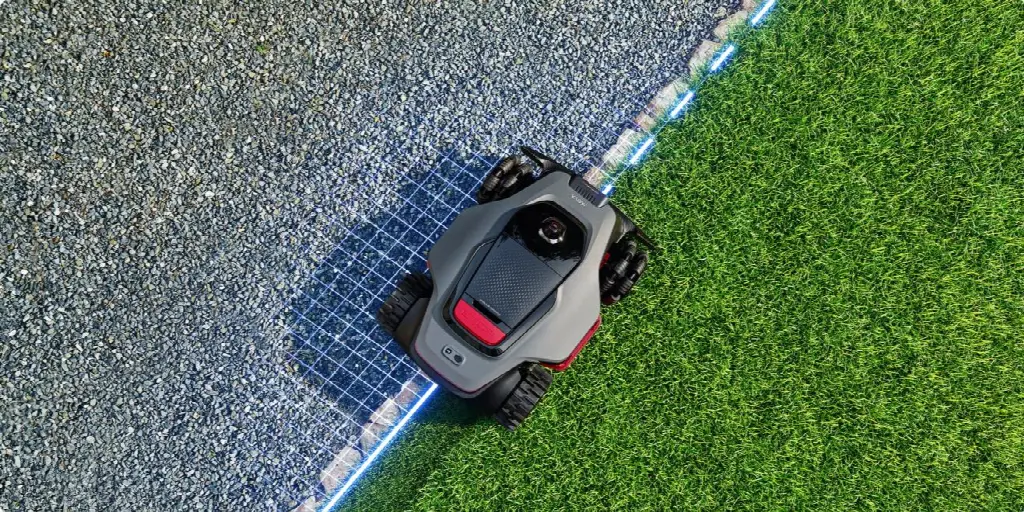

An autonomous lawn mower can cut close to edges, but it will not trim every border equally well. The result depends mainly on the type of lawn edge and how far the cutting discs reach beyond the mower body. Flush borders, such as paving level with the grass, let the mower overlap the edge and reduce leftover strips. Raised walls, fences, and garden borders block the deck before the blades can reach the last blades of grass. If you want a cleaner perimeter, focus on border design, mower edge-cutting features, and a mowing setup that matches the actual shape of your lawn.
Your Lawn Border Determines How Close the Mower Can Cut
Flush Paving Gives the Mower Room to Overlap
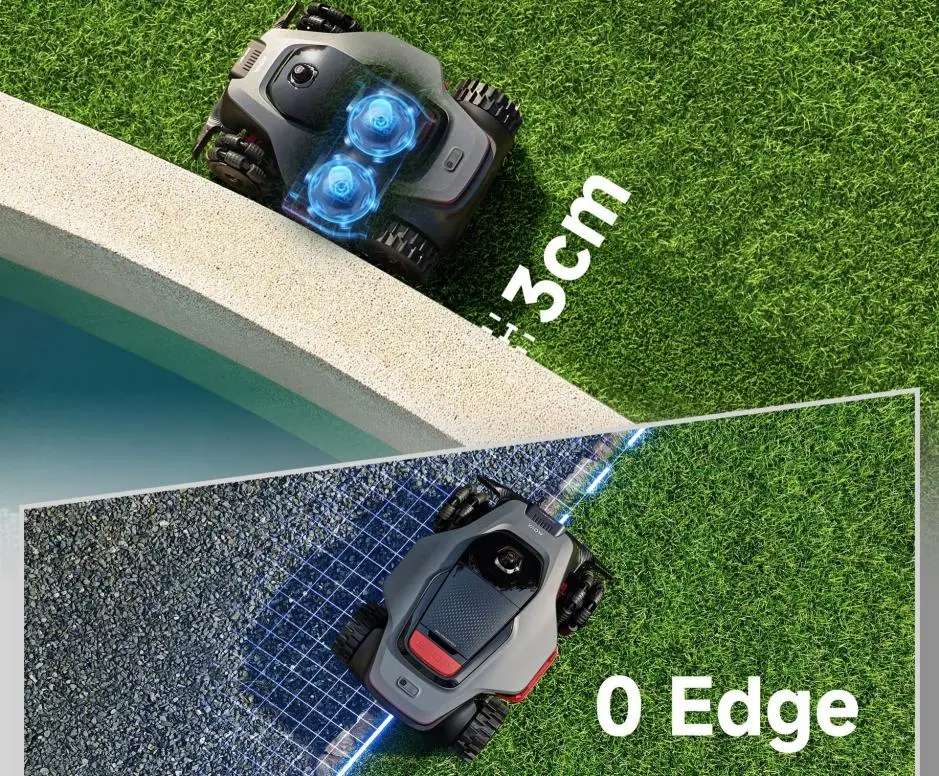
Flush paving is the easiest border for an autonomous lawn mower to handle neatly. When the lawn meets a hard surface at the same level, the mower can place part of its body over the paving while the cutting discs continue trimming the grass right up to the edge. This overlap reduces the narrow strip that often remains after mowing. According to the supplied specification, for level, smooth boundaries between grassy and non-grassy areas, the MOVA Lidax Ultra 3000 AWD Robotic Lawn Mower straddles the edge directly, helping cut grass on the border more effectively. In practical terms, patios, pathways, and driveway edges that sit flush with the turf usually deliver the cleanest finish and require the least follow-up trimming.
Walls and Raised Borders Restrict Blade Access
Walls, raised curbs, timber edging, and tall flower-bed borders create a physical stop point for the mower. The outer shell or wheels touch the obstacle before the cutting discs can reach the very last section of grass, which leaves an uncut strip along the perimeter. The taller and more vertical the border, the more noticeable that strip becomes. Even a capable autonomous lawn mower cannot push the blades through a wall line or under an overhanging edge. Corners can also collect missed grass because the mower must turn before the discs align perfectly with the border. If your lawn has many raised boundaries, expect some finishing work after mowing, especially around beds, fences, and retaining edges.
Which Mower Features Improve Edge Coverage?
Cutting-Disc Reach Reduces the Uncut Strip
Cutting-disc placement has a direct effect on how much grass remains at the edge. A mower with discs mounted closer to the outer sides can cut nearer to borders than one with blades set deep under the chassis. The MOVA Lidax Ultra 3000 AWD Robotic Lawn Mower uses dual 180W cutting motors to power 2 cutting discs with 6 blades each, delivering a 15.8-inch cutting width. It is also equipped with UltraTrim™ 2.0, which extends the cutting discs outward and keeps the gap between the lawn edge and the discs under 1.2 inches. That smaller offset matters because it limits the width of the leftover strip and improves the final look of the perimeter after each mowing cycle.
Boundary Accuracy Helps the Mower Follow the Border
Strong edge coverage also depends on how accurately the mower tracks the lawn boundary. If the machine wanders away from the perimeter, leaves a safety buffer that is too wide, or turns too early, more grass remains untouched. Accurate boundary following helps the mower stay consistently close to the edge instead of producing an uneven finish around the yard. This becomes especially important on curved borders, narrow passages, and irregular lawn shapes where small navigation errors show up quickly. Good boundary control does not eliminate the limits created by raised obstacles, but it does reduce unnecessary misses along accessible edges. In short, precision navigation supports cleaner mowing where the border itself allows close blade access.
How to Reduce the Trimming Left After Mowing
Map Each Border for Its Actual Layout
To reduce trimming, assess each edge by its real construction rather than treating the whole lawn as one uniform boundary. Walk the perimeter and note where grass meets flush paving, where borders are raised, and where corners or narrow sections may force earlier turns. This simple mapping process shows which edges the mower can cut tightly and which areas will still need attention. It also helps you set realistic expectations before installation or setup. A path level with the lawn may need almost no follow-up, while a brick bed edge may always leave a strip. By identifying those differences in advance, you can position routes and mowing behavior more effectively and avoid assuming every edge will finish the same.
Use Suitable Mowing Strips and Targeted Touch-Ups
If you want less cleanup after mowing, create mower-friendly borders where possible. Replacing abrupt lawn edges with flush mowing strips, pavers, or level transitions gives the machine room to overlap and cut closer. These strips work especially well beside patios, paths, and garden beds because they convert hard-to-reach borders into accessible ones. For raised edges that cannot be changed, plan quick targeted touch-ups instead of expecting the mower to solve the problem alone. A brief pass with a trimmer around walls, posts, or high flower-bed borders usually finishes what the mower cannot physically reach. This combination—better border construction plus occasional manual edging—produces a much cleaner result than relying on mowing patterns alone to fix structural edge limitations.
Conclusion
An autonomous lawn mower can cut close to edges when the border allows physical access and the cutting system reaches near the outside of the machine. Flush paving and level transitions usually produce the best result because the mower can overlap the edge. Raised walls, curbs, and bed borders leave more grass behind because the body stops before the blades get there. Features such as outward-reaching cutting discs and accurate boundary tracking help reduce the remaining strip. For the cleanest finish, pair a mower with strong edge-cutting ability with lawn borders designed for overlap, then use quick touch-ups only where obstacles make close cutting impossible.
Also Read
- /paylines-ways-and-clusters-slot-terms-that-are-not-synonyms/
- /the-8-best-ad-monetization-platforms-in-2026-compared/
- are-portable-solar-panels-practical-for-daily-home-use/



Pingback: Light Restaurant Chairs: A Weight Claim, a Color Choice, or a Description of Shape?
Pingback: Why Businesses Turn To Bookkeepers For Scalability Support
Pingback: Loans to Buy a Business with Limited Experience
Pingback: What Should You Know About Solar Generator Cycle Life?